
Around thirty tribes, in two language families that are not related to one another. The Chamic-speaking peoples — Jarai, Rhade, Raglai, Chu Ru — are Austronesian, cousins of the Cham of the coast and, further out, of Malay and Indonesian. The rest speak Bahnaric languages of the Mon-Khmer family, related to Khmer. Below: who is who, where, how many, and what each name means.
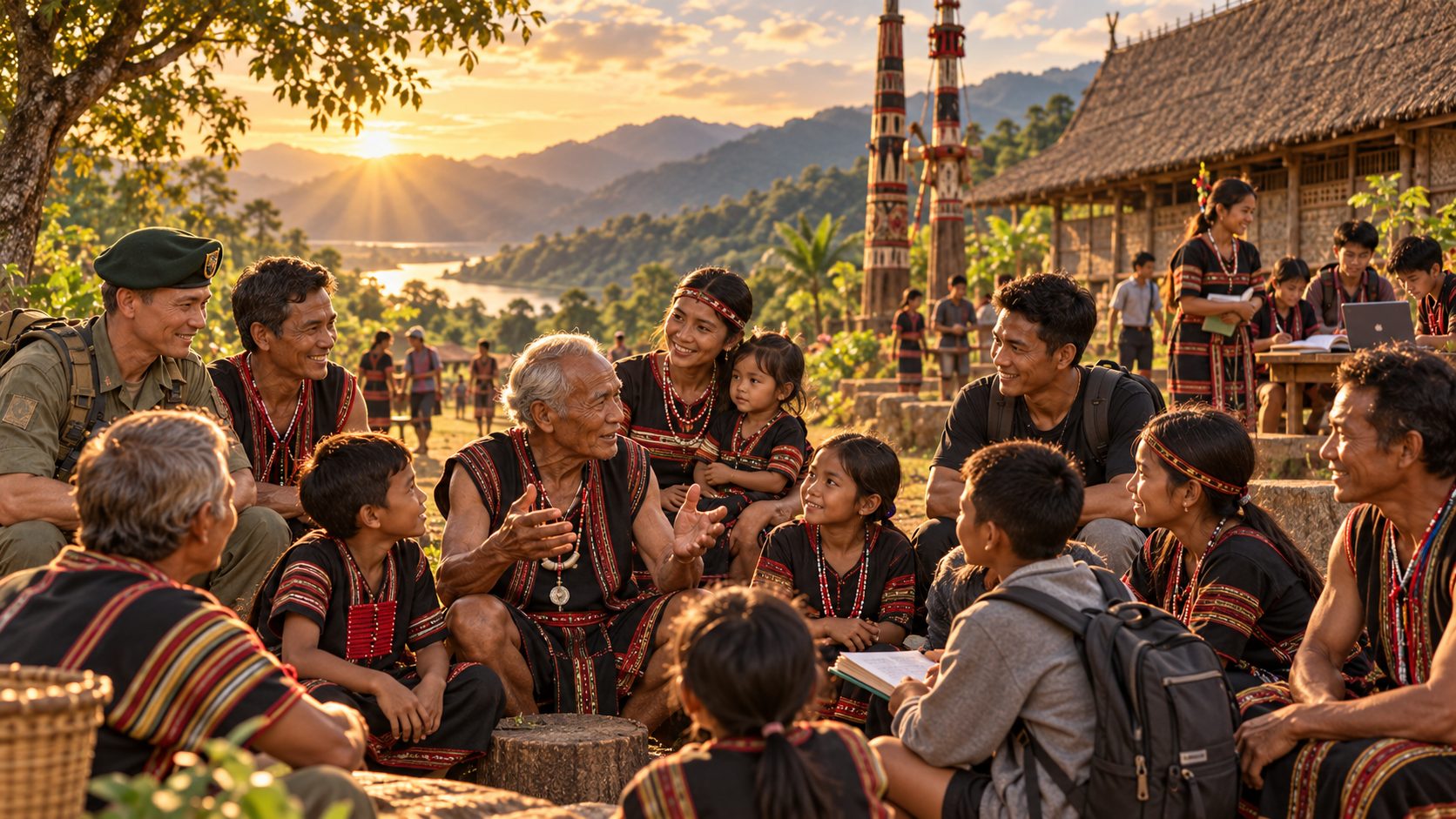
The Chamic peoples (Austronesian)
Chamic is a branch of Malayo-Polynesian. Its speakers arrived in mainland Southeast Asia by sea, and the coastal kingdom of Champa — which lasted, in one form or another, from roughly the second century to 1832 — was its most visible political expression. The highland Chamic peoples are not migrants from Champa: the relationship is one of shared ancestry and long exchange, not descent.
- Jarai Gia Rai, Jrai
- The largest Dega people: 513,930 in Vietnam at the 2019 census, chiefly in Gia Lai, Kon Tum and Dak Lak, with 26,922 more in Ratanakiri province in Cambodia, where the Jarai are about a quarter of the population. Matrilineal — descent and inheritance run through the mother's line and a husband moves to his wife's household. The Jarai held the two ritual offices known to the outside world as the King of Fire and the King of Water, whose authority the courts of Champa, Cambodia and Hue all acknowledged in their different ways.
- Rhade Ê Đê, Ede, Rade, Radhe
- 398,671 at the 2019 census, concentrated in Dak Lak around Buon Ma Thuot. Matrilineal, and traditionally a longhouse people: an extended family of several generations under one roof, with senior women holding the land, the livestock and the heirloom jars. Personal names carry a gender prefix — Y‑ for men, H' for women — which is why so many names in the prisoner records on this site begin that way. Rhade was the first of our languages to be written down systematically and codified into a legal register, under the French résident Léopold Sabatier in the 1910s and 1920s, and it became the lingua franca of highland politics in the twentieth century for that reason.
- Raglai Ra Glai, Orang Glai
- The southern and eastern edge of the Chamic zone, in the hills behind Ninh Thuan, Khanh Hoa and Binh Thuan — closer to the coast and to the Cham than the other highland peoples, and historically the custodians of Cham royal regalia.
- Chu Ru Chưru, Chru
- A smaller Chamic people of the Lam Dong plateau, wet-rice farmers, long in contact with both the Koho above them and the Cham below.
The Bahnaric peoples (Mon-Khmer)
Bahnaric is a branch of Mon-Khmer, within the Austroasiatic family; its relatives are Khmer, Mon, and — at a considerable distance — Vietnamese. The name Bahnar itself is thought to share a root with Khmer phnom, "mountain".
- Bahnar Ba Na, Bana
- 286,910 in Vietnam, mostly in Gia Lai and Kon Tum, with around 10,000 in the United States and some 5,000 in France. Eight recognised subgroups, including Bahnar Jơlơng, Rơngao and Gơlar. Bahnar was the first highland language reduced to writing in the Latin alphabet, by the French missionaries who founded the Kon Tum mission from 1851 — which is why the earliest written record of any of our languages is a Catholic one.
- Sedang Xơ Đăng, Xodang
- North of the Bahnar, in Kon Tum and the mountains toward Quang Nam. Known historically for ironworking and for the fortified hill villages that made the northern highlands the hardest part of the country for any army to enter.
- Mnong M'nông, Bunong, Phnông
- Dak Nong, southern Dak Lak, and across the border in Mondulkiri, Cambodia, where the same people are called Bunong. The Mnong straddle a frontier drawn in Paris, which is one reason Mondulkiri became the refuge it did — people crossing into Cambodia after 1975 and again after 2001 were in many cases crossing into the other half of their own community.
- Koho Cơ Ho, K'Ho, Kaho
- The Lam Dong plateau around Da Lat, with several named subgroups (Sre, Chil, Lat, Nop). The K of BAJARAKA.
- Ma Mạ
- Lam Dong and Dak Nong, along the upper Dong Nai. Weavers; the Ma textile tradition is among the most distinctive in the highlands.
- Stieng Xtiêng, Bu Dip, Bu Lo
- The southern edge, in Binh Phuoc and Dak Nong and over the Cambodian border.
- Gie-Trieng, Brau, Ro Mam Giẻ-Triêng, Brâu, Rơ Măm
- The far north of Kon Tum, at the Lao and Cambodian borders. The Brau and Ro Mam are among the smallest recognised peoples in Vietnam — a few hundred each — and the most at risk of disappearing as distinct communities.
What the names do
Nearly every tribal name in the list above exists in three or four spellings: a Vietnamese official form, a French colonial form, an American military form, and the form the people use themselves. A prisoner appears in one record as Ê Đê and in another as Rhade; a village is Buôn in Rhade and Jarai, Plây or Plếi in Bahnar and Jarai, and làng or thôn on the Vietnamese map that replaced both. Anyone searching these records — a family looking for a relative, a lawyer building a case — has to search all the spellings. That is what the names and words page is for.
Counting tribes
You will see "thirty tribes", "thirty-two tribes" and "more than forty" in different Dega sources, and a different number again in the Vietnamese census. None of them is wrong. Vietnam's list of fifty-four ethnic groups was fixed administratively in 1979 and merges some communities that consider themselves distinct while separating others that do not. Our own counts usually follow the way villages describe themselves. Where this library needs a single figure it says which list it is using.
Sources
- Vietnam General Statistics Office, Population and Housing Census 2019 — ethnic group totals
- Encyclopaedia Britannica, Chamic languages and Austroasiatic languages
- Gerald C. Hickey, Sons of the Mountains (Yale, 1982), appendices on tribal distribution
- Oscar Salemink, The Ethnography of Vietnam's Central Highlanders (2003), on how tribal categories were made and remade by successive administrations
Compiled September 2026. Corrections to spellings, subgroup names and locations are welcome and will be credited unless you ask us not to.