
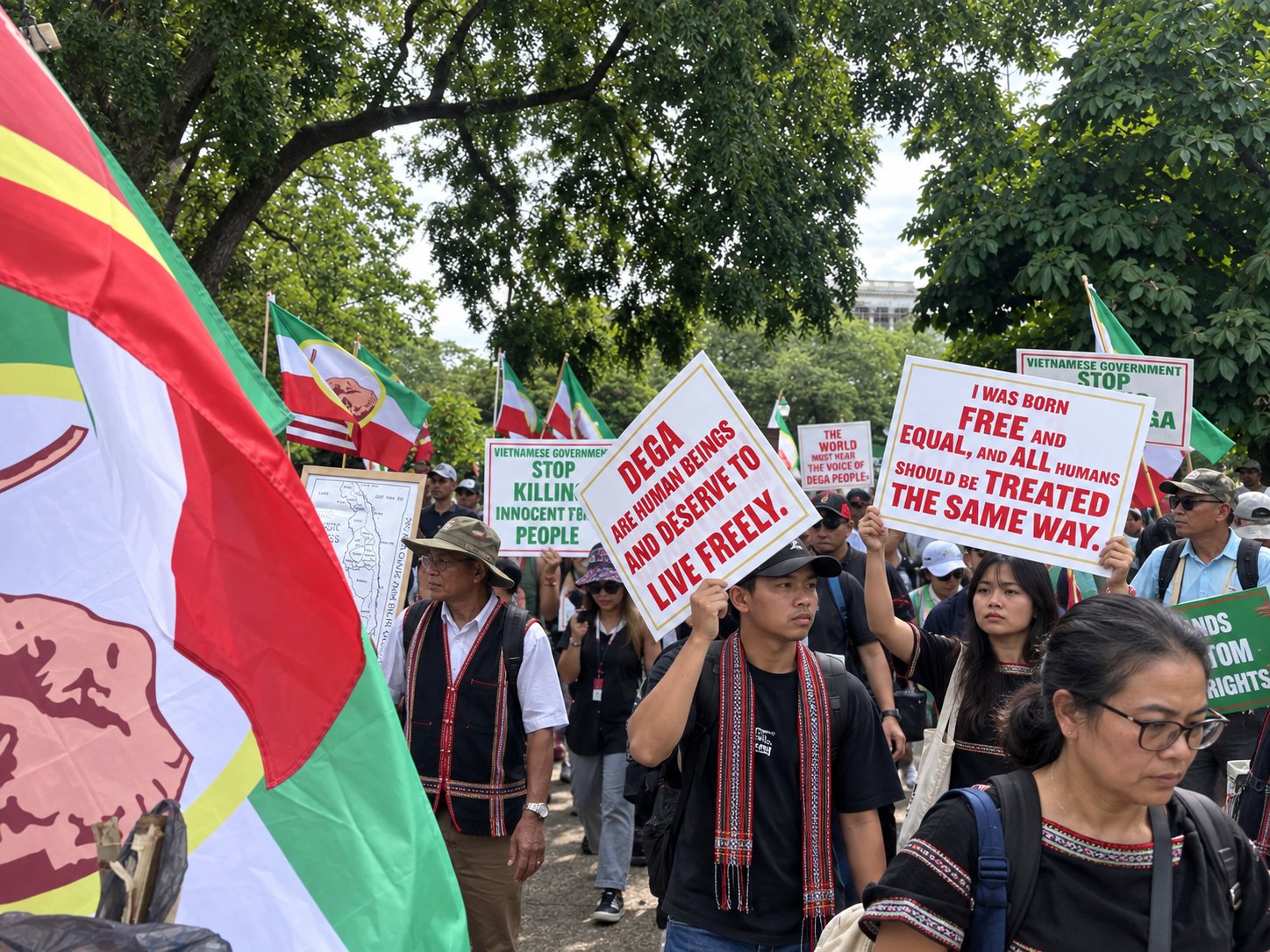
Three aims, stated in 1964 and never withdrawn, pursued since 1992 by peaceful means only. Beneath them, the rights the United Nations has set out for indigenous peoples — every one of which has been taken from us — and, at the end, the four things that could be done next week by a government that wanted to.
What we ask
- That the Dega be recognised as the legitimate owners of the Central Highlands
- That the Vietnamese administration of the Central Highlands be dismantled and the occupying military forces withdrawn
- That Dega sovereignty over the Central Highlands be restored, and the independence of the Dega people guaranteed by the United Nations
The rights these rest on
In 1983 the United Nations set out the following basic rights of indigenous populations. We reproduce them because they are not our invention, and because reading them next to the highlands as they are is the shortest route to understanding our case.
| The right | In the highlands |
|---|---|
| To call themselves by their proper name and express their own identity freely | Our name is contested; the state's word for us is "ethnic minority" |
| To have official status and form their own representative organisations | Montagnards Stand for Justice designated a terrorist organisation, March 2024 |
| To maintain their traditional economic structure and way of life | Replaced by programme, from the 1956 land development centres to Định canh định cư |
| To use their own language in administration and education | Not used in either; 31 per cent of ethnic minority children reach upper secondary school against 63 per cent of Kinh children |
| To enjoy freedom of religion or belief | Dega Protestantism banned by name, February 2005; public renunciation ceremonies |
| To have access to land and natural resources | Village land certified to others; forest cover down from 42.8 per cent to 19 per cent |
| To structure, conduct and control their own educational system | No Dega school system exists |
Seven for seven.
What we do not ask
We do not ask for the removal of the Vietnamese people who now live in the highlands, and we never have. The great majority were moved there by governments, often against their own interests: several hundred thousand resettled from the north under Diem, and a further wave under the New Economic Zones, in programmes that were instruments used on them as much as on us. Many are now three generations in. They are neighbours, not defendants.
We do not ask for reprisals, prosecutions of individuals for the acts of a state, or the redrawing of anyone else's borders. And we do not ask anyone to take our account on trust, which is why every page in this library carries its sources and says where it is thin.
What could be done immediately
The three aims are a settlement. Settlements take a generation. In the meantime there are four things that a government wishing to change the situation could do without conceding anything about sovereignty, and their absence is itself evidence of intent.
- Release the prisoners of conscience. Everyone held under Penal Code articles 87, 89 and 91 for speech, worship or attempted departure, and an independent account of every death in custody since 2001.
- Let the highlands be visited. Unescorted access for UN special procedures, UNHCR, and independent journalists, to the districts of their choosing. A government with nothing to conceal loses nothing by this.
- Recognise communal tenure. A procedure by which a village can register land held in common and contest a certificate issued over it, heard by somebody other than the authority that issued it.
- Stop the forced renunciations. They are already prohibited by Vietnam's own Decree 22 of March 2005. Enforcing an existing decree requires no new law and no admission.
On the word "independence"
It is the word in the 1964 statement and we do not soften it. But the argument in this library does not depend on it, and a reader who rejects it should notice how much is left. Every item in the list above is available to a person who thinks the Central Highlands should remain part of Vietnam. Nothing there requires a border to move. The Vietnamese state's refusal of all four is what turns a dispute about land and worship into a dispute about sovereignty, and it does so from its own side.
How we pursue it
By documenting, publishing and submitting: to the UN treaty bodies, to the special procedures, to the Universal Periodic Review, to governments, and to anyone who will read the record. The armed struggle ended in Mondulkiri in October 1992 and will not resume. That is a permanent decision and it is not conditional on being answered.
Sources
- Statement of aims of the United Front for the Liberation of Oppressed Races, 1964 (archive held by DCHO)
- United Nations Declaration on the Rights of Indigenous Peoples, adopted 13 September 2007
- OHCHR, dialogue between the Committee on the Elimination of Racial Discrimination and Viet Nam, November 2023 — the education figures and the Committee's questions on land and religion
- Human Rights Watch, Montagnard Christians in Vietnam (March 2011) — Instruction No. 1, Decree 22, renunciation ceremonies, Penal Code articles
Compiled September 2026. This is a statement of position, not a report; if you think an item here is wrong or unachievable, we would rather hear it than not.