
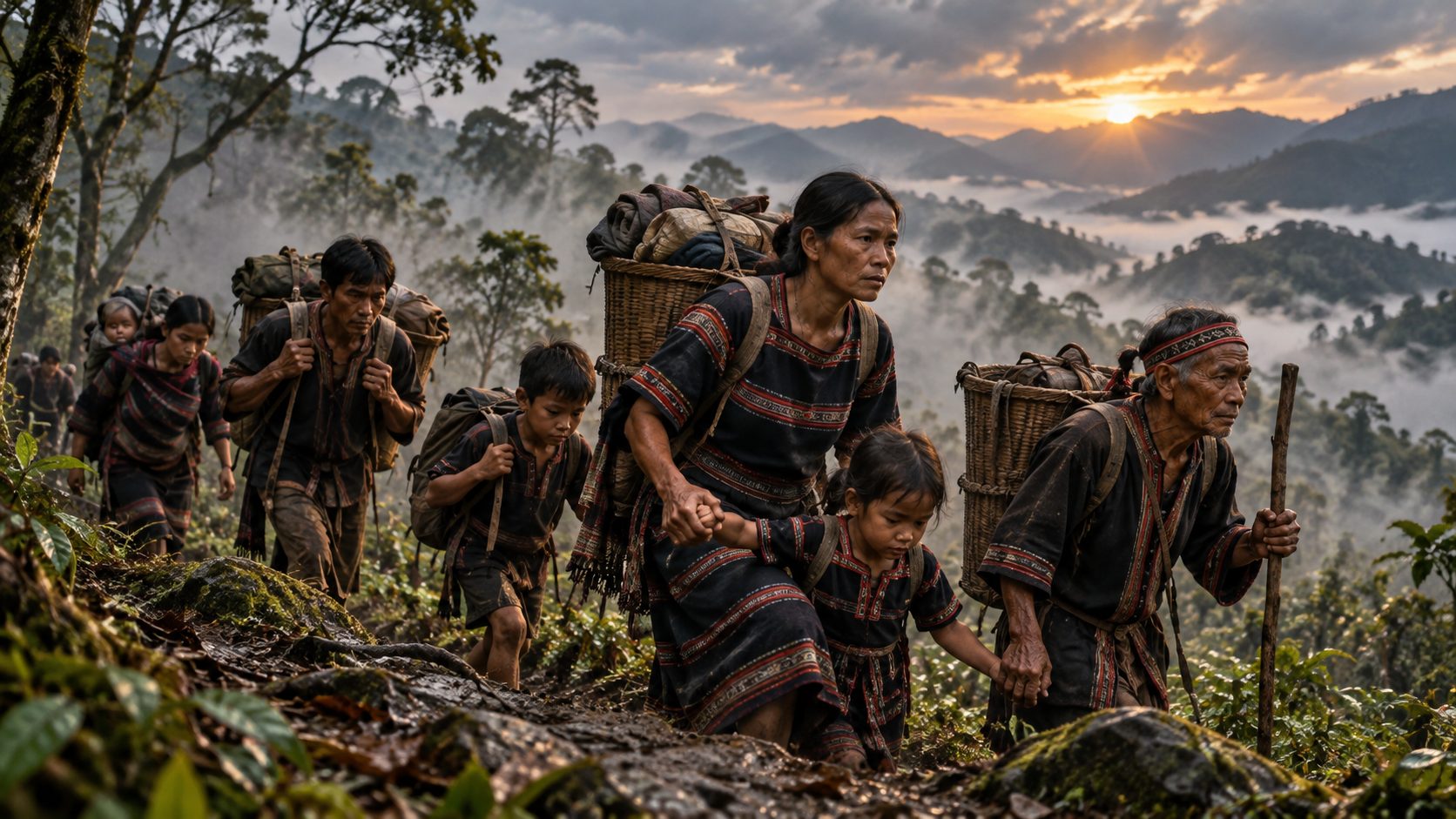
In October 1992 a United Nations patrol in eastern Cambodia found several hundred armed men, with their wives and their children, still fighting a war that had ended seventeen years earlier. They had not been told their leader was dead. They gave up their weapons, asked for asylum, and the Dega armed struggle ended after twenty-eight years and three weeks.
Seventeen years in the forest
When Saigon fell on 30 April 1975, FULRO did not stop. Part of the movement withdrew into the forest along the Cambodian border and kept fighting: against the Socialist Republic of Vietnam, through the Khmer Rouge years, through the Vietnamese occupation of Cambodia from 1979, and through the civil war that followed it.
For a time there was outside support — weapons and cash from China, routed through Cambodia, and at various points supplies from Cambodian factions whose interest was hostility to Hanoi rather than sympathy with us. Estimates for the 1980s put FULRO strength in the low thousands, based principally in Mondulkiri. The Vietnamese invasion of Cambodia in December 1978 and the occupation that followed removed the rear areas and the routes, and after that the movement was being ground down in a forest it could not leave.
Nobody was coming. The Americans had gone. Cambodia changed hands repeatedly. To the outside world the Vietnam War was over and these men did not exist. They stayed anyway, for the length of a childhood and then some, and children were born in those camps who had never seen a town.
What they did not know
They were fighting under the authority of Y Bhăm Êñuôl. He had been killed by the Khmer Rouge in Phnom Penh in April 1975, with his family and around a hundred and fifty followers and theirs. The men in Mondulkiri did not learn this until 1992.
Seventeen years of a command structure reporting to a man who had been dead since the first month of it. That fact is the whole condition of the Dega in the late twentieth century in one sentence: cut off, fighting on, and not told.
1986: the first group out
In 1986 around two hundred FULRO fighters walked west across Cambodia to a refugee camp in Thailand. Arrangements were made for them to enter the United States, and they were resettled in North Carolina — the first Montagnard resettlement, and the beginning of the community described in North Carolina. American Special Forces veterans campaigned for it; a number of them met the arrivals.
October 1992: the last group out
By 1992 the United Nations Transitional Authority in Cambodia (UNTAC) was running the country ahead of elections, with peacekeeping patrols in the border provinces. In Mondulkiri, one of those patrols made contact with what was left of FULRO.
On 11 October 1992 the last FULRO fighters and their families handed their weapons to UN peacekeepers. In December a group of 402 was moved out and resettled in North Carolina: 269 men, 24 women and 80 children. They had very little preparation and arrived at short notice in Raleigh, Greensboro and Charlotte.
The insurgency had lasted from 20 September 1964 to 11 October 1992 — twenty-eight years and three weeks.
What it settled, and what it did not
Since 1992 there has been no Dega armed movement. The aims stated in 1964 have never been withdrawn, but the means have: everything since has been political, legal and documentary. That is a deliberate and permanent choice, and it is stated on what we ask for.
It did not settle the question that produced the movement. Nine years after the surrender, in February 2001, several thousand unarmed people walked out of their villages into the provincial capitals to ask for the land and the church back, and were answered with tanks and twelve-year sentences. Mondulkiri ended the war. It did not end the dispute, and it is worth being clear that the dispute was never the war's cause but the other way round.
The awkward part
Those men fought at times alongside the Khmer Rouge, taking weapons from a regime that murdered their own leader and, at that moment, was killing Cambodians on a scale the world had not yet counted. We do not present that as heroic and we do not hide it. Men in a forest with no state, no ally and no information took what was offered, from whoever offered it, to go on existing. A library meant to be used as evidence has to be able to say that plainly, or nothing else it says can be trusted.
Sources
- FULRO insurgency — duration, external support, the 11 October 1992 date
- United Front for the Liberation of Oppressed Races — the surrender to UN peacekeepers and the 1975 executions
- ANCHOR: A North Carolina History, The Montagnards — the December 1992 cohort of 269 men, 24 women and 80 children
Compiled September 2026. We are looking for accounts from the men who came out in 1986 and 1992, and from the children born in those camps. If that is your family, please write to us.