
Vietnam has ratified the major human rights instruments and sits as a member of the United Nations. The obligations are not disputed and they are not optional. Set against them is the record in the Central Highlands, documented by UN bodies and independent organisations. This page puts the two columns side by side.
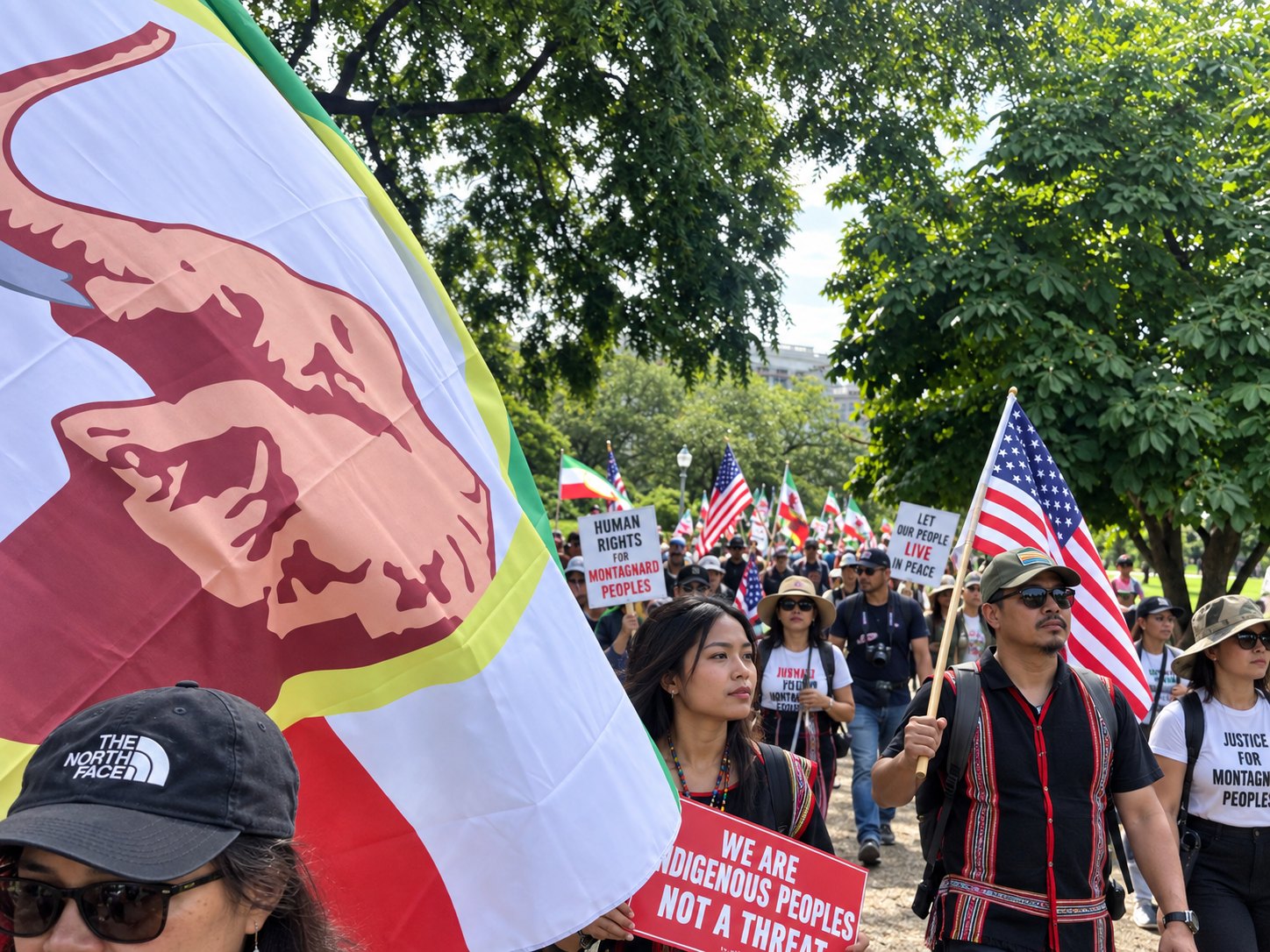
At a glance
| Instrument | What it requires | What is documented in the highlands |
|---|---|---|
| UN Charter, Article 73 | Where peoples are not yet fully self-governing, their interests are paramount and a sacred trust; political advancement and free institutions are to be developed | No act of self-government since 1954; the 1946 federal government dissolved by force in 1955 |
| ICCPR, Article 1 ratified 24 Sept 1982 | All peoples have the right of self-determination and freely determine their political status | Advocating self-determination is prosecuted; organisations that do so are designated terrorist |
| ICCPR, Articles 9 and 14 | No arbitrary arrest; prompt judicial review; a fair trial, with time and facilities to prepare a defence | Around 100 people tried at one sitting of a mobile court, 20 January 2024 — found by twelve UN special procedures to lack legal basis and independence |
| ICCPR, Article 18 | Freedom of thought, conscience and religion, including freedom to manifest it | Dega Protestantism banned by name in Instruction No. 1, February 2005; public renunciation ceremonies; congregations dissolved |
| ICESCR, Article 1 ratified 24 Sept 1982 | All peoples may freely dispose of their natural wealth; in no case may a people be deprived of its own means of subsistence | Village land certified to settlers; farmland taken; families moved to soil that will not support them |
| ICERD ratified 9 June 1982 | Elimination of all forms of racial discrimination | 31 per cent of ethnic minority children reach upper secondary school against 63 per cent of Kinh children; our languages barred from school |
| Genocide Convention ratified 9 June 1981 | No acts intended to destroy a national or ethnical group as such, including deliberately inflicting conditions of life calculated to destroy it | The 1976 programme to eradicate all outmoded customs; the population record; the testimony summarised in How we died |
| Convention against Torture ratified 5 Feb 2015 | No torture; and no return of a person to a state where they face a real risk of it | At least 25 deaths in custody since 2001; Y Bủm Byă on 8 March 2024 after torture, per UN experts; an extradition sought and obtained from Thailand in November 2025 |
| UNDRIP adopted 2007 | Indigenous peoples' rights to their lands, territories and resources, and to their own institutions | Vietnam's position is that it has ethnic minorities and no indigenous peoples — which removes the instrument by definition |
The move that does the work
Notice the last row, because it is the hinge of the whole argument.
Most of the instruments above bind Vietnam whatever we are called: a minority is tortured as unlawfully as an indigenous people. UNDRIP and the body of indigenous rights law are different. They do not apply to a minority. They apply to an indigenous people — one with a prior and continuing relationship to a territory, its own institutions, and a claim to free, prior and informed consent over what is done with its land.
By maintaining that Vietnam has fifty-three ethnic minorities and no indigenous peoples, the state removes that entire body of law from the table without breaching a word of anything. It is the cheapest and most effective move available to it, and it is made in every forum.
That is why our article on names is not cultural sentiment. It is the load-bearing argument.
The machinery has been used
It is sometimes said that these treaties are unenforceable and that citing them is a gesture. The record says otherwise: the questions have been put, formally, by the bodies entitled to put them, and Vietnam has answered on the record.
In November 2023 the Committee on the Elimination of Racial Discrimination examined Vietnam. Committee member Chinsung Chung raised the June 2023 events in Dak Lak, in which around a hundred Montagnards were arrested and prosecuted, and asked what the state did to ensure terrorism provisions were not applied disproportionately to ethnic minorities and how racial profiling was prevented. Chinsung Chung also put to the delegation that authorities had confiscated the land of indigenous people who had lived on it for generations, with only minimal resettlement assistance and compensation.
Committee member Sheikha Abdulla Ali Al-Misnad told the delegation that the Committee had received a large volume of credible reports of the state prohibiting and criminalising religious and cultural activity by ethno-religious minorities, including harassment, intimidation, torture and inhuman treatment used to force people to renounce their faith. Sheikha Al-Misnad also gave the education figures reproduced in the table above.
Vietnam's delegation replied that a list of offenders had been drawn up after the June 2023 incident and that it included ethnic minorities; that over a thousand religious organisations had been registered under the new law, and registration was only intended to ensure that religious organisations did not break Vietnamese law; that Vietnam did not prosecute anyone for religious reasons; and that land reclamation was carried out in close consultation with local communities, with resettlement conditions required to be better than the land being taken.
Why the replies matter more than the questions
A state that denies the facts can be shown to be wrong by evidence. A state that concedes the facts and disputes their character — registration is merely administrative, reclamation is consultative, nobody is prosecuted for religion as such — has moved the argument onto ground where documents decide it. Every renunciation pledge, every refused registration, every compensation notice and land certificate in a family's possession is now directly responsive to something the Vietnamese state has said in Geneva. That is what documenting an incident is for.
What follows from membership
Vietnam joined the United Nations on 20 September 1977 and is bound by the Charter. Article 6 provides that a member which has persistently violated the principles of the Charter may be expelled by the General Assembly on the recommendation of the Security Council. We do not expect that and we do not campaign for it; we note it only to make the point that the Charter treats persistent violation as a real category and not a rhetorical one.
The covenants carry their own machinery: periodic reporting, examination by treaty bodies, the Universal Periodic Review, and the special procedures — twelve of whom issued a joint statement on the Central Highlands on 28 August 2024. The machinery exists. It has been used. The findings are on the record, and they are citable.
What we are not saying
We are not saying that ratifying a treaty is meaningless or that international law is a fiction. We are saying the opposite. These instruments are precise, Vietnam accepted every one of them freely, and the distance between the text and the highlands is measurable rather than rhetorical. That is a stronger position to argue from than outrage, and it is the one we intend to keep.
Sources
- OHCHR, "In Dialogue with Viet Nam, Experts of the Committee on the Elimination of Racial Discrimination…", November 2023 — the exchanges quoted above
- OHCHR, joint statement of twelve UN special procedures on the Central Highlands, 28 August 2024
- Human Rights Watch, Montagnard Christians in Vietnam (March 2011) — Instruction No. 1, Decree 22, deaths in custody
- Human Rights Watch on the November 2025 extradition
- United Nations Treaty Collection — ratification dates
Ratification dates as held in DCHO records and checked against the UN treaty collection; last reviewed September 2026. If you find an error in a date here, tell us — this is the article we least want to be wrong.