
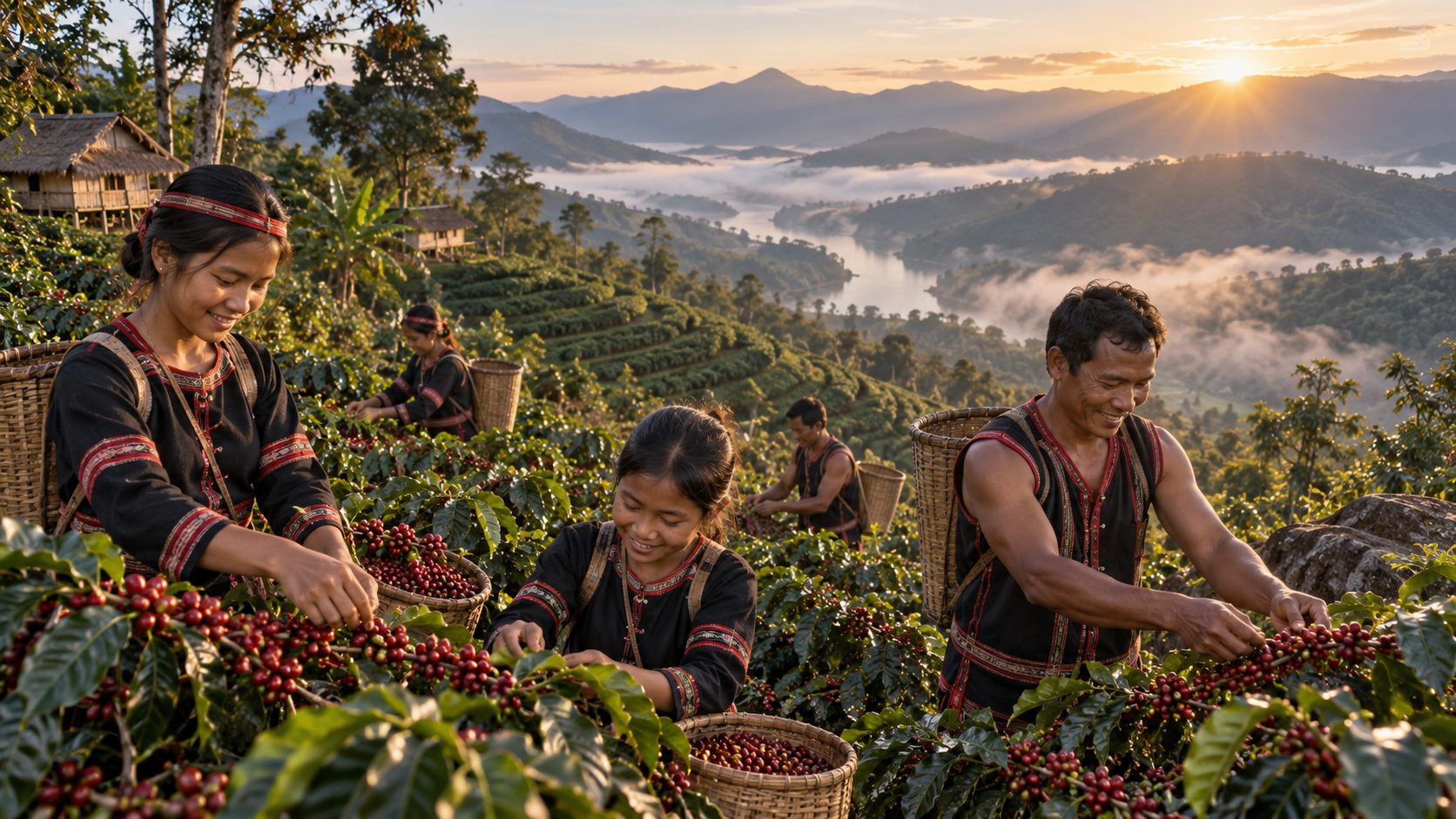
Vietnam went from a marginal coffee producer to the world's second largest in about fifteen years, on red basalt soil in the Central Highlands. The story of how that happened and the story of what happened to the Dega are the same story told from two ends. Forest cover in the highlands fell from 42.8 per cent in 1990 to 19 per cent in 2020.
Why the soil mattered
The plateau is volcanic. Weathered basalt across Dak Lak, Gia Lai and Dak Nong produces some of the best coffee land in Asia, and robusta — hardier and cheaper than arabica — suits it exactly. Today around 95 per cent of Vietnam's coffee is grown in the Central Highlands, on more than 290,000 hectares, of which roughly 170,000 are in Dak Lak. Vietnam supplies something like 40 per cent of the world's robusta.
That is what the land is worth. Every dispossession described below is a rational response to that number by somebody who was not us.
The four transfers
- Resettlement, from 1956
- The Republic of Vietnam's dinh điền land development centres moved Vietnamese settlers, including refugees from the north, onto highland land. Dega records put the figure at around 850,000. Villages were moved to make room.
- New Economic Zones, from 1975
- Between 1975 and 1980 over a million northerners moved south and into the central regions, and between 750,000 and more than a million southerners were displaced into what the planners called uninhabited mountainous forested areas. One published estimate puts the number who moved into the Central Highlands between 1975 and 1985 at four to five million. Human Rights Watch concluded that state resettlement had quadrupled the population density of migrants in parts of the highlands since 1975.
- Fixed field, fixed residence, from 1976
- Định canh định cư. Announced as an end to what officials called an unstable nomadic life, and accompanied by the Ministry of Culture's 1976 statement that it would be necessary to eradicate all outmoded customs. In practice it confined an indigenous population to small controlled areas of poor cropland and released the rest of the plateau.
- Certification, from the 1990s
- Land held by a village in common and farmed on long rotation does not look like property to a land registry. When land use certificates were issued, they were issued over ground that was already in use, to the people who had most recently arrived on it and who could produce the paperwork. Nothing was stolen in a way a court would recognise. That is the point.
What the boom did
Vietnam's economic reforms from the late 1980s turned the basalt into an industry. Planned resettlement was overtaken by spontaneous migration: people came for coffee, cleared land, and planted it. The research literature describes the process as the displacement of shifting cultivation by permanent cash cropping, and the phrase is exact — the long-rotation system that made highland agriculture sustainable requires fallow, and fallow looks like idle land to anyone who wants to plant on it.
Deforestation in the Central Highlands over this period is among the most rapid documented anywhere in Southeast Asia. Tropical forest cover fell from 42.8 per cent of the region in 1990 to 19 per cent in 2020, with the worst losses between 1995 and 2010. What went with the forest was not scenery: it was the hunting, the forest products, the water regulation, the burial groves and the fallow that let a village's fields recover.
What the boom then did to the people who profited from it
The coffee price collapsed at the turn of the century. Human Rights Watch identified the global plummet in coffee prices over the two years before February 2001 as one of the pressures behind the protests, and it fell on everyone — Dega smallholders and Vietnamese migrant growers alike.
It is worth being precise about who suffered what. The migrants were mostly poor people sent or drawn to a frontier and left to manage. Many are now two or three generations in. The quarrel is with the programme and the state that ran it, not with the family on the next plot. What separates the two positions is that the migrant lost money in 2001 and the Dega household had lost its land before the price ever moved.
The nutrient treadmill
The industry built on that soil is now in trouble on its own terms. Analysts describe a nutrient treadmill: depleted soils requiring ever more fertiliser, accelerating erosion, fragmented habitat, disrupted water systems and rising pest pressure. One watchdog estimate holds that half of Vietnam's robusta belt could become unsuitable for coffee as temperatures rise and rainfall becomes less predictable.
We note this without satisfaction. If the plateau becomes unfarmable, it will not be handed back — it will simply be a ruined homeland with more people on it than it can feed, and we will still be the people with the fewest options.
The land claim, stated carefully
We do not ask for the eviction of Vietnamese families who have farmed the highlands for three generations. We ask for four things: that communal and customary tenure be recognised as tenure; that land taken without consent or compensation be acknowledged as taken; that a process exist through which a village can bring a claim and be heard by somebody who is not the provincial authority that issued the certificate; and that what remains of the forest not be cleared over our objection. None of that requires anyone to lose a home.
Sources
- Human Rights Watch, Repression of Montagnards (April 2002) — land certificates, resettlement density and the coffee price collapse, pp. 2, 20, 25–26
- Coffee Watch, Robusta's Reckoning (reported July 2026) — forest cover 1990–2020, the 95 per cent and 40 per cent figures, the nutrient treadmill and the climate projection
- Meyfroidt, Vu and Hoang, "Trajectories of deforestation, coffee expansion and displacement of shifting cultivation in the Central Highlands of Vietnam", Global Environmental Change (2013)
- Central Highlands (Vietnam) — hectarage under coffee
- Coffee production in Vietnam — the 1975–1985 migration estimate
Compiled September 2026. If your family holds a land use certificate, a refusal, a compensation notice or a survey map for highland land, those documents are the evidence this claim most lacks. Read how to document first.