
Among the Rhade and the Jarai, land, livestock and the heirloom jars pass through women. Yet almost every source this library is built from is about men — because soldiers, prisoners and petitioners are who got written down. This page sets out what we can establish, and is explicit about the shape of what is missing.
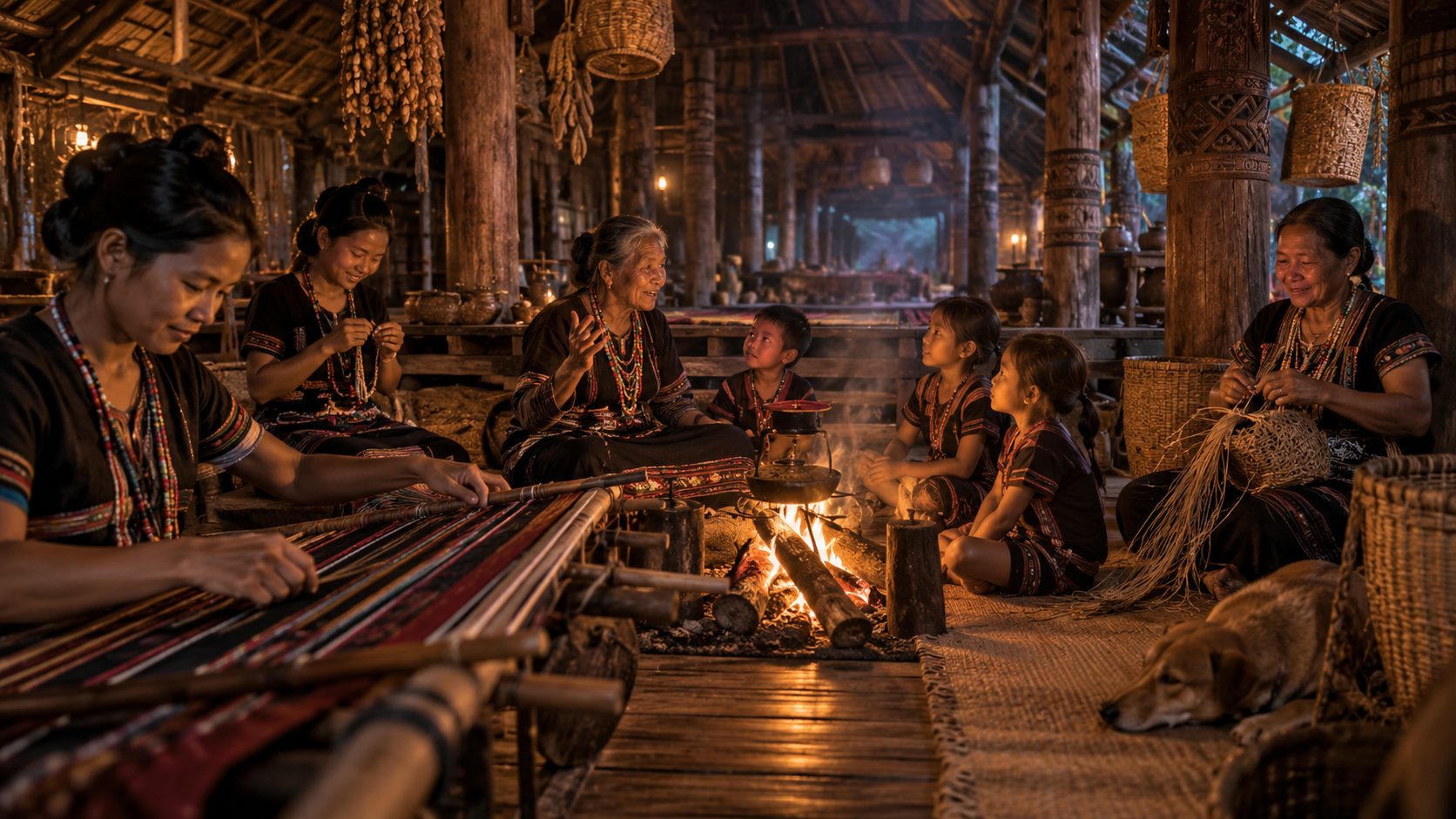
What the position was
The Chamic-speaking peoples — Jarai, Rhade, Raglai, Chu Ru — are matrilineal. Descent runs through the mother. A husband joins his wife's household. The senior women of a longhouse hold the fields, the buffalo and the gong sets, while a male head manages the day's business; the longhouse itself is extended at one end as each daughter marries, so the building is a genealogy in the female line that you can walk down.
Names carry it too: H' before a woman's name, Y‑ before a man's.
It is worth being precise about what this does and does not mean. Matriliny is not matriarchy: public authority, the customary courts and dealings with outsiders were largely male. What it means is that the property a family has, and the continuity of the line, are held by women — and that a system of land tenure which recognises only a registered male head of household does not merely disadvantage Dega women. It misdescribes who owns the land.
What certification did to that
The land articles in this library describe communal, long-rotation tenure meeting a certificate system and losing. There is a second loss inside the first one.
When land is registered, it is registered to a household, and the paperwork asks for a head of household. Where the land had belonged to the women of a longhouse, it now belongs to whoever is on the certificate. Nobody legislated for that transfer. It is what happens when a matrilineal system is recorded by a bureaucracy that does not have a box for it.
The Yali Falls resettlement shows the same machinery from another angle: compensation attached to registered, individually held property, and indigenous households received a fraction of what Kinh households received for the same losses. A system does not need to intend an outcome to produce it reliably.
What is documented about harm
The record is fragmentary and we will not pad it.
Dega accounts of the period after 1975 state that women were raped and forced into prostitution to soldiers. Human Rights Watch documented, in 2003 alone, the rape of a young woman by police during three days in detention. The prisoner records on this site carry women's names — the Dak Lak table opens with H'No Buonya — though women are a small minority of the people listed. The renunciation ceremonies of 2010 were counted in people and in households; when 567 households in Krong Pa district are recorded as renouncing their faith, most of the people in those households are women and children, and none of them are named.
What does not exist is any systematic account of sexual violence in the highlands, in the camps, at the border, or in detention. That absence is not evidence that it was rare. It is evidence about who was asked.
What the health figures show
Where women do appear in the statistics, they appear as outcomes.
| Measure | Ethnic minority communes | National |
|---|---|---|
| Maternal deaths per 100,000 live births | 100–150 | 43 (2017) |
| Births attended by a trained attendant | 34.7% (60 communes, 2020) | 94% |
| Four or more antenatal visits | 17.9% | 74–88% |
| Deliveries at home | 52.8%, and over 80% in twenty of the communes | — |
| Households at or near the poverty line | 56.2% | 4.8% (2020) |
| Improved sanitation | 44.9% | 94% |
These are figures for disadvantaged ethnic minority communes across Vietnam rather than for the Central Highlands specifically — no disaggregated highland series is published, which is itself on the gaps list. A woman in one of those communes is roughly three times as likely to die giving birth as the national average, and more likely than not to give birth at home without a trained attendant.
Alongside that: 31 per cent of ethnic minority children reach upper secondary school against 63 per cent of Kinh children, and among highlanders arriving in the United States, average literacy was around third grade. Where a gender gap is measured nationally it has narrowed — from 10 per cent in 1989 to 4.4 per cent in 2009 — but it narrowed around a much lower baseline for us.
Why this page is short, and what would lengthen it
Because our sources are colonial administrators, military records, court lists, human rights reports and community archives — and every one of those genres records men, either because it is about soldiers and prisoners or because it asked for the head of the household. A library assembled from those sources will reproduce their shape unless somebody says so out loud.
What would change it is testimony, and the people who hold it are mostly alive: grandmothers in Greensboro and Charlotte, women who were moved for a reservoir, women who were in the villages during Easter Week 2004, women who were told to sign a renunciation. None of that is in a document anywhere. It is in houses.
If you can add to this
We want accounts from women and about women: what a longhouse held and who held it, what happened to a family's land when it was registered, what a resettlement site was like to run a household in, what the renunciation meetings were like, and anything from the camps. Read reporting safely first, then how to document.
We will not publish anything that identifies a person still in Vietnam, and we will record an account without a name if that is what is wanted.
Sources
- UNFPA Viet Nam, baseline survey of 60 disadvantaged ethnic minority communes (2019–2021) — maternal mortality, skilled attendance, antenatal care, home births, poverty and sanitation
- UNFPA Viet Nam education factsheet, 2009 census — the gender gap narrowing from 10 per cent (1989) to 4.4 per cent (2009)
- OHCHR, CERD dialogue with Viet Nam, November 2023 — the 31 / 63 per cent schooling figures
- Human Rights Watch, Repression of Montagnards (April 2002) and Montagnard Christians in Vietnam (2011) — detention, the 2003 case, and the renunciation figures
- Rade people and Jarai people — matrilineal inheritance, the longhouse and naming
Compiled September 2026. This is the gap named on what we do not know that we are least equipped to close from documents, and the one most likely to be closed by a conversation.