

























Knowledgebase
Viewing articles tagged 'sabatier'
Viewing articles tagged 'sabatier'
7 articles
The French arrive, 1876–1929
We let the French in. Most of our villages received them, between 1891 and 1899, as men who had come alone, who promised protection against the Lao and Siamese raiders from the west, and who had just taken the coast from the power that had taken it from us. The reasoning was not naive, and for a while it held. What we got over the next thirty ye...
Sabatier, the oath of 1926 and the Rhade law code
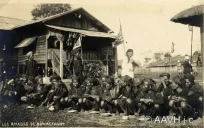
On New Year’s Day 1926 the French résident of Darlac stood in front of the assembled chiefs at Buon Ma Thuot and told them, among other things, that the peoples around us who had let strangers into their country had lost their law and were themselves lost. Ten times he told them to touch the bracelet. Six months later he was quietly relieved of...
The Franco-Rhade school and the Collège Sabatier
Thirty boys from the villages around Buon Ma Thuot were put into a French school in 1915. Attendance was not voluntary; within a few years some of them walked home, and the paramount chief who defended them was accused of inciting disobedience. Out of that school came a written Rhade language, a class of clerks and teachers, and, a generation la...
Roads, taxes and forced labor, 1899–1945
In 1899 the tribute our villages had paid every three years in wax, horn and ivory was abolished and replaced by a tax in cash, on people who did not use cash. Three years later came the days: ten a year of unpaid work on the roads, rising to fifteen, and eight to ten more spent walking to the worksite and back. A man who could not find the mone...
The Rhade (Êđê)
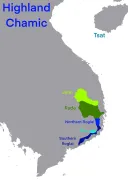
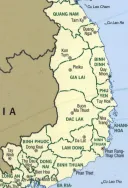
The Rhade are the people of the Darlac plateau, the red basalt shelf around Buon Ma Thuot where the Krong Ana, the female river, joins the Krong No, the male river, and becomes the Srepok. They speak a Chamic language, cousin to Cham and more distantly to Malay. They count descent through women: a house belongs to its women, land belongs to a wo...
Customary law and the village court
Our law was not a book. It was verse, held in the memory of men who could stand up in a village and recite the clause that settled the case. It priced a human life in gongs measured against a man’s own forearm, made failing to help the unfortunate an offense, and devoted more of itself to the wrongs a chief can commit than to theft. The French w...
Writing our languages
Our languages were spoken for thousands of years before any of them was written. Between the middle of the nineteenth century and the 1970s, French missionaries, a French administrator and his teachers, American missionaries and linguists, and our own people put them into the Latin alphabet, one language at a time, each for its own reasons and e...
Powered by WBAMS