
A village, the land around it held in common, kinship that decides obligation, and a moral order older than any state that has claimed us. Around thirty peoples, each with its own building, weaving, music and dance, held together by an animist thread that runs through all of them — and by a gong tradition UNESCO has recognised as a masterpiece of the intangible heritage of humanity.
The village is the unit
Dega life turns on the village — buôn in Rhade, plếi in Jarai and Bahnar, bổn in Mnong. The village is not a place people happen to live near each other. It is the body that holds the land, settles disputes, feeds its old, and answers to the spirits of the ground it sits on.
Land belongs to the community and is worked by families within it, on long rotation that lets forest and fallow recover. Nothing in that arrangement produces a document, which is the single most consequential fact in our modern history: when a land registry arrived, customary tenure met certificated tenure, and the certificates won. Everything in the land articles follows from that sentence.
Among the Rhade and the Jarai, descent and inheritance run through the mother's line. A husband joins his wife's household; the senior women of a longhouse hold the fields, the livestock and the heirloom jars and gongs, while a male head manages the day-to-day. Rhade personal names carry the prefix Y‑ for men and H' for women — which is why almost every name in the prisoner records begins with one or the other.
Obligation is mutual and specific. The Rhade custom of h'rim zít commits a village to build a family's house with it — some collect timber and thatch, others do the labour. A society organised this way does not need a welfare system, and it does not survive being dispersed into scattered plots. Dispersal is not a side effect of resettlement. It is what resettlement does.
Law before the courts came
Disputes went to customary tribunals applying an oral body of law that was long, detailed and memorised in verse. Under the French résident Léopold Sabatier a Rhade court was formally established in 1923, incorporating Rhade legal procedure, and the customary law was written down. The colonial motive was administrative convenience. The effect was that one of our legal traditions exists on paper, and it does not read like the lawless condition that later governments described themselves as civilising. It reads like law: rules of evidence, graduated compensation, and a concern for the standing of the individual that would not embarrass a modern code.
That court, and the customary tribunals of the other peoples, were abolished when Ngo Dinh Diem merged the highlands into the Republic of Vietnam in 1955. A people can lose its land slowly. It loses its jurisdiction in an afternoon.
What is made and played
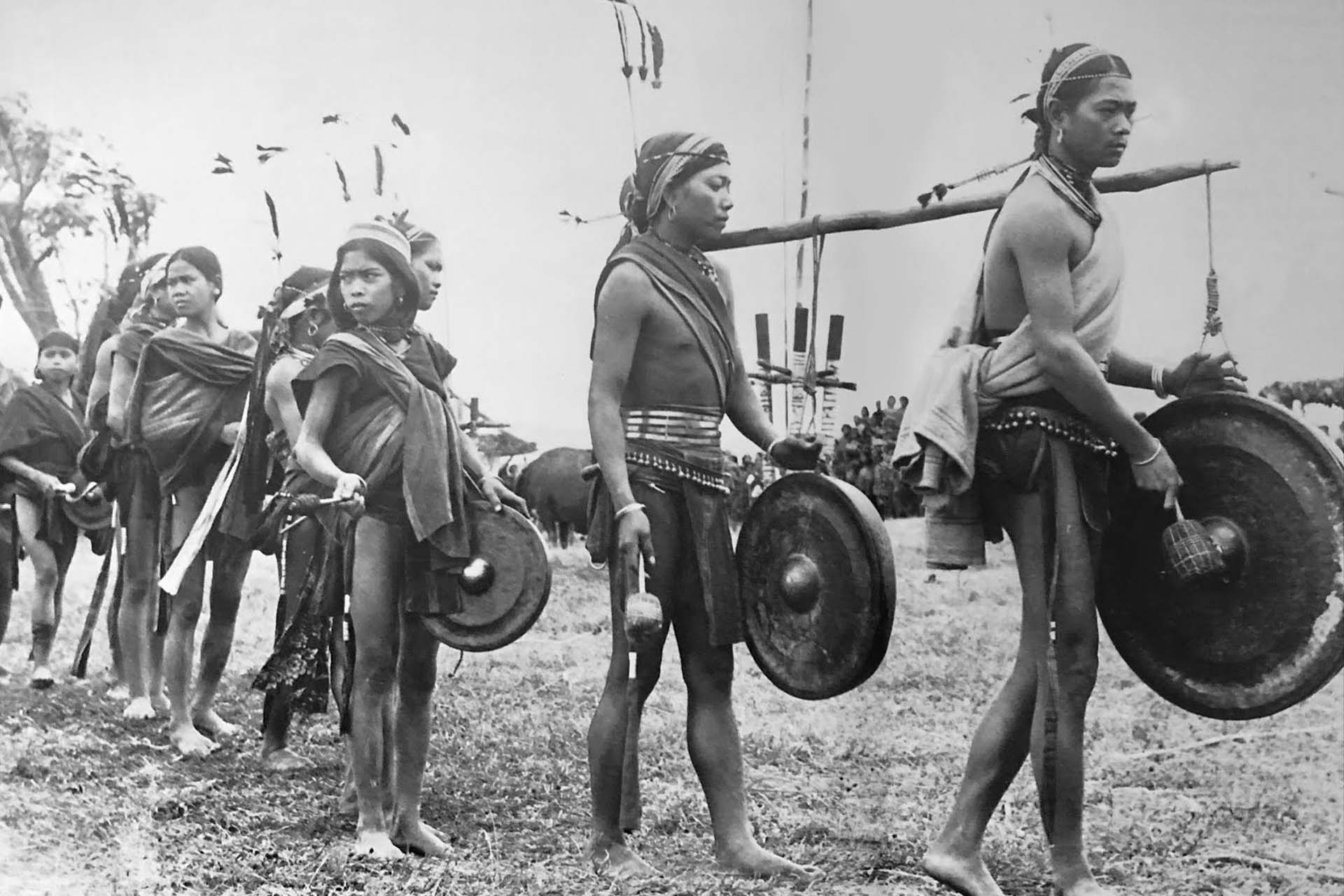
The gongs. Flat and bossed bronze gongs in tuned sets, played by ensembles in which each player holds one note — so a melody exists only in the group and cannot be performed alone. The gong space of the Central Highlands was proclaimed by UNESCO in 2005 as a Masterpiece of the Oral and Intangible Heritage of Humanity. Gongs are also wealth: a set is an inheritance, a bride price, a record of a family's standing, and consequently the first thing looted from a village.
The longhouse. The Rhade sàng dài runs to thirty metres and more, raised on piles, extended at one end as each daughter marries. Its length is a genealogy you can walk down.
The funeral house. Among the Jarai and Bahnar, the dead are housed in carved and roofed tomb structures ringed by wooden figures, and are attended until the tomb-abandonment ceremony releases the household from its obligation to them. The carvings are among the great sculptural traditions of mainland Southeast Asia. They are also, being wood and standing in forests, easy to steal.
The rơng hồuse. The Bahnar and Sedang communal house, with its enormous steep roof, is the civic architecture of the highlands: assembly hall, court, guesthouse and school in one building.
Weaving, rice wine, and the buffalo. Ma and Koho textiles; rượu cần drunk through bamboo straws from a shared jar; and the buffalo sacrifice — among the Bahnar, the Koh Kpo ceremony — which marks the great occasions of a village's life and gathers everyone who owes anything to anyone.
What we believe
We have been animists throughout our existence, and a common animist thread still connects all our peoples: an obligation to keep harmony with the physical world and with the ancient powers, expressed through Yang, the spirits that inhabit places, objects and the dead. The Jarai held two ritual offices — the King of Fire and the King of Water, Pơtao Apui and Pơtao Ia, keepers of a sacred sabre said to have come from the sky — whose authority was acknowledged by Champa, by the Cambodian court, which sent offerings every three years, and by the Nguyen court at Hue, which received their tribute missions. They were not kings in any territorial sense. They were masters of fire, water and wind, and the fact that three neighbouring monarchies all found it prudent to deal with them says something about how the region understood our standing.
From 1851, Catholic missionaries working out of Kon Tum converted many Bahnar and Sedang; from the twentieth century, and especially from the 1980s, evangelical Protestantism spread very widely, particularly among the Rhade and Jarai. A large part of our people is now Christian. Most Dega families do not experience this as a contradiction with what came before. Both have been treated by the state as a threat, which is covered in the church articles.
What has been done to it
The cultural damage of the last seventy years is not incidental. It was policy, stated as policy, by three successive governments.
Under the Republic of Vietnam, assimilation was declared: customary courts abolished, our languages barred from the schools, land expropriated, our existence as distinct peoples denied. In 1976 the Ministry of Culture of the Socialist Republic announced that it would be necessary to eradicate all outmoded customs. The resettlement programme was called Định canh định cư — fixed cultivation, fixed residence — and its stated purpose was to end what officials called an unstable nomadic life. In practice it moved an indigenous population off long-rotation land into small controlled areas of poor cropland, freeing the greater part of the highlands for settlement by others.
Since then: graveyards desecrated and funerary carvings looted for the antiquities trade; elders moved into so-called retirement villages away from their families, which ends the transmission of everything that is learned by living alongside someone; churches closed and congregations fined; and forest that fed our villages for two thousand years cleared for coffee and rubber.
Why culture belongs in a human rights library
Because the two cannot be separated in our case. The gong set that is sold, the tomb figure that is stolen, the longhouse that is not rebuilt because the village was split across four resettlement plots, the grandmother in a retirement village three hours from her grandchildren — none of these is a criminal charge, and together they are the greater part of what has been lost. A people can survive the loss of its property. It is much harder to survive the loss of the things that told it who it was.
Sources
- Gerald C. Hickey, Sons of the Mountains and Free in the Forest (Yale University Press, 1982)
- Oscar Salemink, The Ethnography of Vietnam's Central Highlanders, 1850–1990 (2003) — on Sabatier, the 1923 Rhade court and the codification of customary law
- UNESCO, Space of gong culture in the Central Highlands of Vietnam, proclaimed 2005
- Human Rights Watch, Repression of Montagnards (April 2002) — on Định canh định cư and resettlement, pp. 25–26
- Thủy Xá and Hỏa Xá — the King of Water and King of Fire
Compiled September 2026. This page is short on the Sedang, Ma, Stieng, Raglai and Chu Ru, and on women's knowledge generally. If your family holds a practice, a song cycle or a craft we have not described, we would rather record it from you than from a book.