
The largest Dega community outside Vietnam is in North Carolina. It is there because the American soldiers we fought alongside came from there, and because when the survivors of the resistance walked out of the forest those soldiers remembered and campaigned until something was done.
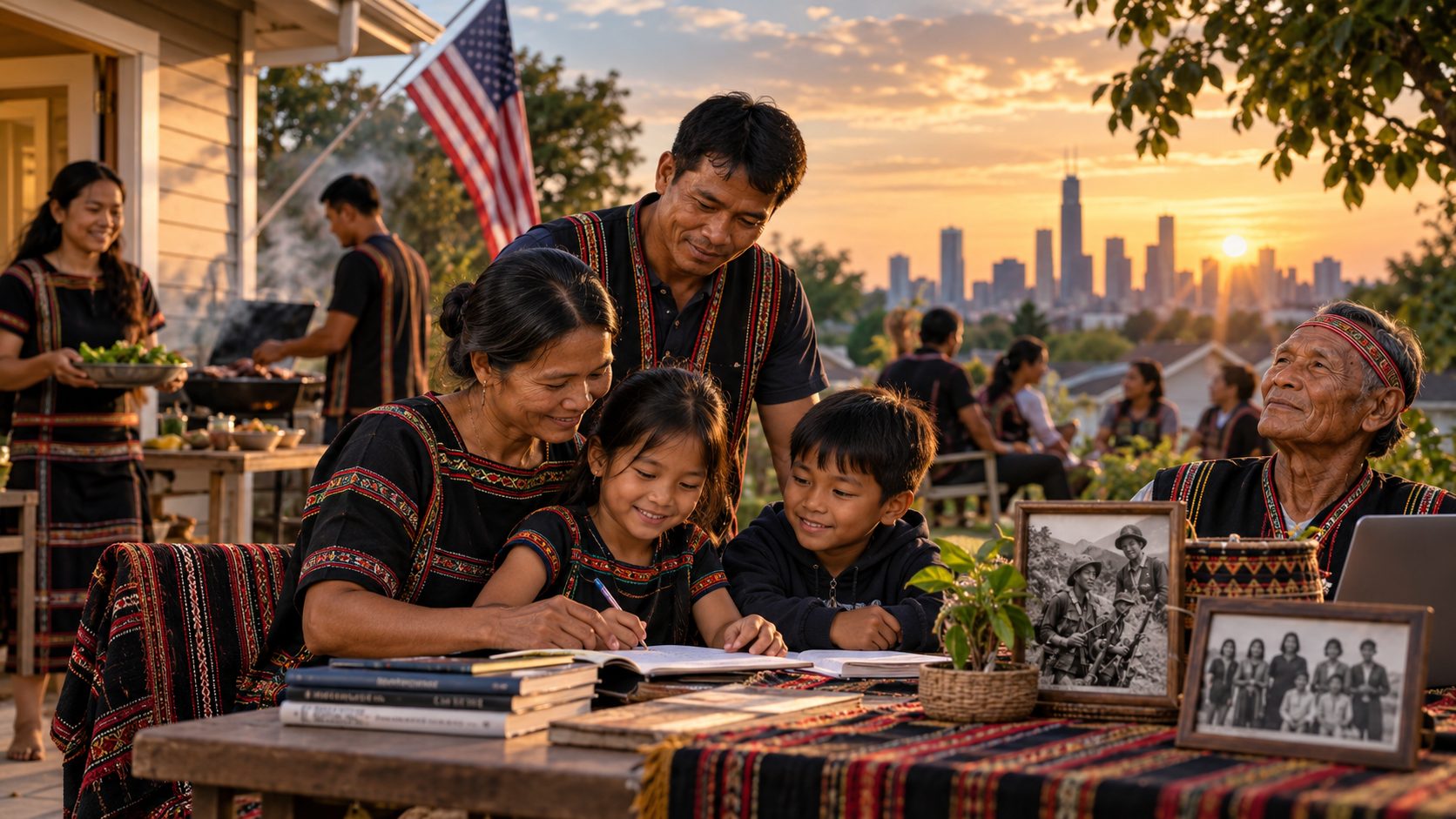
Why North Carolina
Three reasons are usually given and all three are true. Fort Bragg is in North Carolina, and a great many Special Forces veterans — the men who had served with Dega units in the highlands — had settled around it. The piedmont had entry-level work. And the country there is not unlike home.
The first reason is the one that decided it. Montagnard resettlement in the United States happened because a specific group of American veterans would not let the subject drop, and it happened in their state. Lutheran Family Services and Catholic Social Services did the placement work.
The arrivals
| When | Who | Where |
|---|---|---|
| 1986 | Around 200 FULRO fighters who had walked across Cambodia to a camp in Thailand — overwhelmingly men who had served alongside American forces | Raleigh, Greensboro, Charlotte |
| 1987 onward | Growth by family reunification, the Orderly Departure Program, programmes for former re-education camp detainees, and the Amerasian programme for children of Dega mothers and American fathers | The same three cities |
| December 1992 | 402 people found on the Cambodian border by UN peacekeepers — 269 men, 24 women, 80 children — moved at very short notice with almost no orientation | Raleigh, Greensboro, Charlotte |
| Summer 2002 | Close to 900 villagers, following the February 2001 demonstrations and the flight into Cambodia | The three cities, plus a fourth site at New Bern |
By 2000 the community was around 3,000 statewide: roughly 2,000 in the Greensboro area, 700 in Charlotte and 400 in Raleigh. Later arrivals and births have since raised that figure, and estimates in the thousands above it circulate; we have not found one we can source and so do not print one.
What each wave arrived with
The differences between the waves matter more than the dates, and they explain a great deal about the community today.
The 1986 group were soldiers. Most had English from the war, American units in their history, and veterans waiting for them who could vouch for them to an employer. They were also men without families, and a generation of them built households in a country they had reached alone.
The 1992 group came out of seventeen years in a forest, directly into an American city, with very little preparation. Twenty-four women and eighty children among four hundred and two people tells you what those camps had been.
The 2002 group were villagers, not fighters — families who had run for the border after the crackdown, spent time in Cambodian camps, and arrived with the least overseas orientation of any wave and the hardest adjustment. They were also the first arrivals whose reason for leaving was something happening now rather than something that had happened in the war.
What the community became
Dega families in North Carolina work overwhelmingly in manufacturing, food processing, warehousing and construction. The churches — Rhade-language, Jarai-language, Bahnar-language congregations, mostly evangelical Protestant — are the organising centre of community life, as they were in the highlands, and they do a great deal of the work that a state agency would do elsewhere: interpreting, funerals, housing, finding a cousin a job.
A second and now third generation has grown up American. That produces the ordinary diaspora strain — grandparents who speak Rhade and grandchildren who speak English, gong sets that nobody under thirty can play — on top of the unusual one, which is that the older generation's whole adult life was a war that the country they now live in has largely forgotten it fought.
Why this matters to the case
North Carolina is where the documentary record of the Dega survives. Families there hold service papers, camp rosters, photographs, letters, and memories of villages that no longer exist under the names they had. Inside the highlands almost none of that can safely be kept. If the history in this library is ever tested in front of a tribunal, a large part of the evidence will come out of houses in Greensboro, Charlotte, Raleigh and New Bern — which is why how to document is written for that audience as much as for anyone in Vietnam.
Sources
- ANCHOR: A North Carolina History, The Montagnards — the waves, the December 1992 composition, the 2000 city figures and the 2002 arrivals
- NCpedia, Montagnards — 1986 arrangements, the 1992 evacuation, resettlement agencies
- UPI, "Soldiers aid resettlement of Montagnard warriors", 26 November 1986
Compiled September 2026. We would like a current, sourced population figure for the Dega community in North Carolina and elsewhere in the United States. If your church, association or county holds one, send it and we will cite it.