
We let the French in. Most of our peoples welcomed them, believing they would help us recover the coast the Vietnamese had taken. What we got instead was a colonial administration, a plantation economy, the first Vietnamese settlers — and, entirely by accident, a single political identity that we have used ever since.
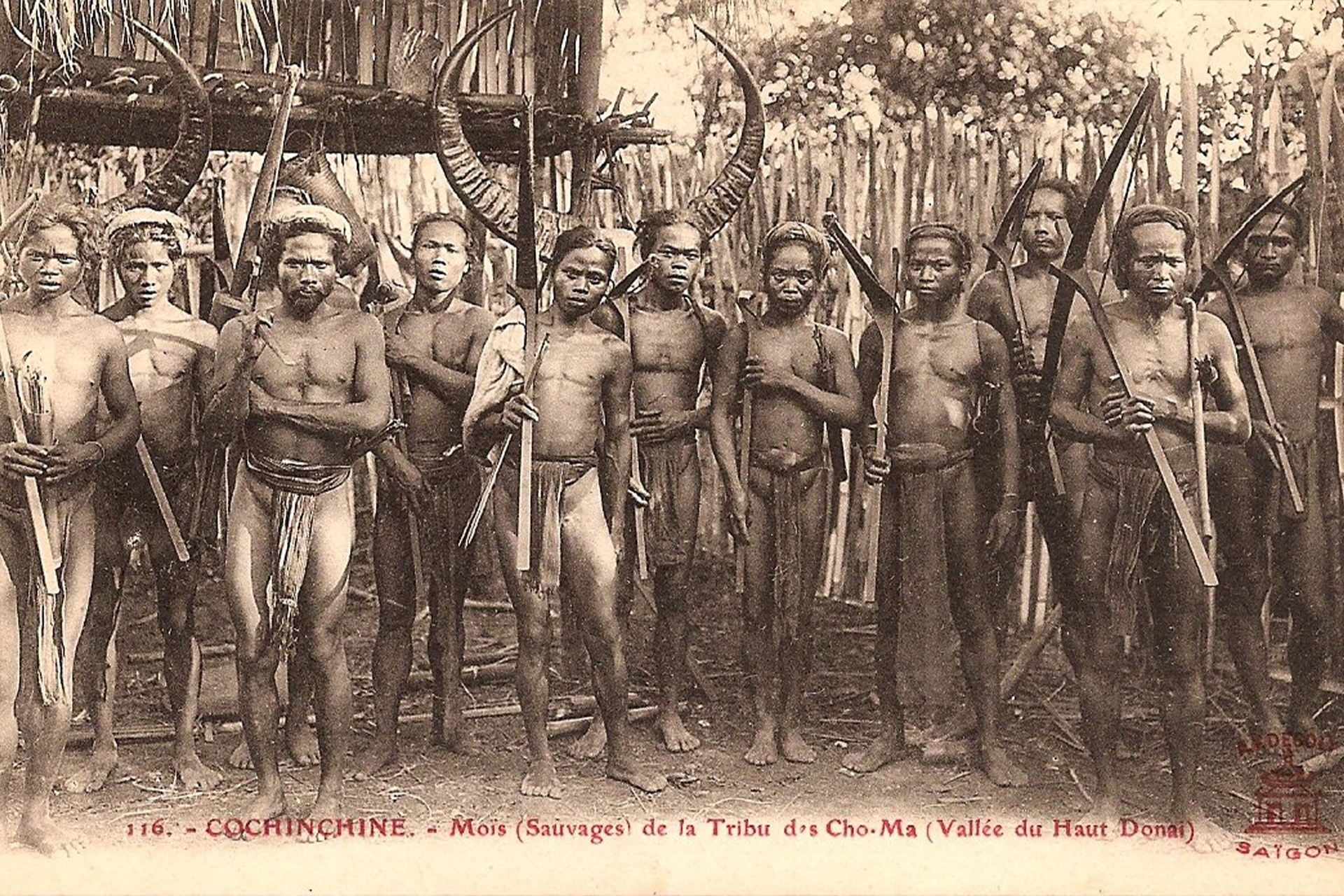
How they came
French penetration of the highlands began in the 1870s and ran on three axes: north into Sedang country toward Kon Tum, west into Rhade country in Darlac, and up from Saigon into the southern uplands. It was not a campaign. It was missionaries, then explorers and naturalists, then commercial agents, then soldiers — in that order, over about twenty-five years.
Not all of it was official. In 1888 a French adventurer named Marie-Charles David de Mayréna persuaded a number of Sedang and Bahnar villages to acclaim him king of an independent Sedang state, complete with flag, decorations and a constitution, and then attempted to sell the territory to the highest European bidder. The episode was farcical and brief, and the French administration repudiated it. Its significance is what it revealed: that the interior was understood in Europe as a place where sovereignty could be picked up by whoever arrived with sufficient confidence.
The serious arrival followed the Franco-Siamese crisis of 1893, which settled the Mekong as the frontier and made the country between the river and the coast strategically French. By January 1897 French forces had brought the Jarai country under control. Active colonisation dates from 1895; a small military and administrative post was established at Ban Don on 31 January 1899, and on 2 November 1899 the French created an autonomous administration for the Montagnard people in the province of Darlac, in the country of the Rhade.
Why we welcomed them
Most of our peoples received the French with open arms, and the reasoning was not naive. The French had just taken the coast from the power that had taken it from us. It was reasonable to hope that the new masters of the lowland would have no particular interest in continuing the old masters' expansion into the hills, and might even restore what had been seized. A few communities resisted the encroachment and were, in the language of the period, pacified.
The clearest single act of resistance came in 1904, when the Fire King killed the French official Prosper Odend'hal, who had come to inspect the sacred sabre. It is the only occasion on which the ritual authority of the pre-colonial highlands directly confronted the colonial state, and the state won: the Fire King fled, a column was sent after him, and the office never recovered its independence.
What they built
From 1914 to 1926 the résident of Darlac was Léopold Sabatier, and the highlands have had no other colonial administrator like him.
Sabatier built the town of Banmethuot — Buon Ma Thuot — and gave it schools, a health service and agricultural services; he had roads, bridges and airstrips built. He opened the Franco-Rhade school, which produced the generation of educated highlanders who would lead BAJARAKA and FULRO thirty years later. In 1923 he established a Rhade court that incorporated Rhade legal procedure, and he had the customary law set down in writing. He learned the language, had a daughter, H'ni, born in 1923 to a Rhade mother, and argued — against French planters, against commercial interests in Saigon and Paris, and against his own administration — that the highlands should be kept for the highlanders and closed to outside settlement.
He lost that argument. Commercial pressure from Saigon and Paris, and a bad relationship with the missions, ended his posting in 1926. He returned to France and died in 1929. The rubber and coffee concessions he had held off arrived immediately afterwards.
How to hold Sabatier in mind
He was a colonial official administering a conquered people, and the protection he offered was paternal: he decided what was good for us, and part of what he decided was that we should be sealed off from the modern economy. Dega families nonetheless remember him better than any other Frenchman, and they are right to. He is also the reason the Rhade customary law exists on paper, that Rhade became the working language of highland politics, and that the men who wrote to the United Nations in 1958 had been to school. An administration that had wanted only to extract would not have produced them. Two things can be true.
The two things that followed
They made us one people. The French organised some thirty separate peoples, speaking languages from two unrelated families, into a single administrative and political unit, and gave it a name: the Montagnards of southern Indochina. They did it for the convenience of governing. The effect was to create a common standing, a common vocabulary of grievance and, eventually, a common politics — the basis on which every Dega claim since 1946 has been made. It is the most consequential thing colonialism did to us and it was not intended.
They brought the settlers. In 1899, when the autonomous administration at Darlac was created, there was effectively no settled Vietnamese population in the highlands. The first arrived from 1918 as servants and staff of French officials; plantation labour followed. The demographic transformation that would swallow us was begun, in a small way, by the same administration that had promised to protect us from it. And when the French left in 1954, the guarantee left with them.
Sources
- Oscar Salemink, The Ethnography of Vietnam's Central Highlanders, 1850–1990 (2003) — the fullest account of Sabatier's policy and its defeat
- Gerald C. Hickey, Sons of the Mountains (Yale, 1982)
- Léopold Sabatier — dates of the Darlac posting, the 1923 Rhade court, the Franco-Rhade school
- Thủy Xá and Hỏa Xá — the 1893 crisis, the January 1897 conquest, the killing of Odend'hal in 1904
- Montagnard Foundation, Inc., historical summaries (archive held by DCHO) — the 1876, 1895 and 1899 dates and the account of the welcome
Compiled September 2026. An earlier version of this page gave Sabatier's posting as 1914–1929; the published record dates his removal to 1926 and his death in France to 1929, and we have corrected it.