
Most Dega are Christians, and the state has decided that one form of our Christianity is not a religion at all but a political conspiracy in religious dress. That decision is the legal hinge on which most of the last twenty-five years of persecution in the highlands turns.
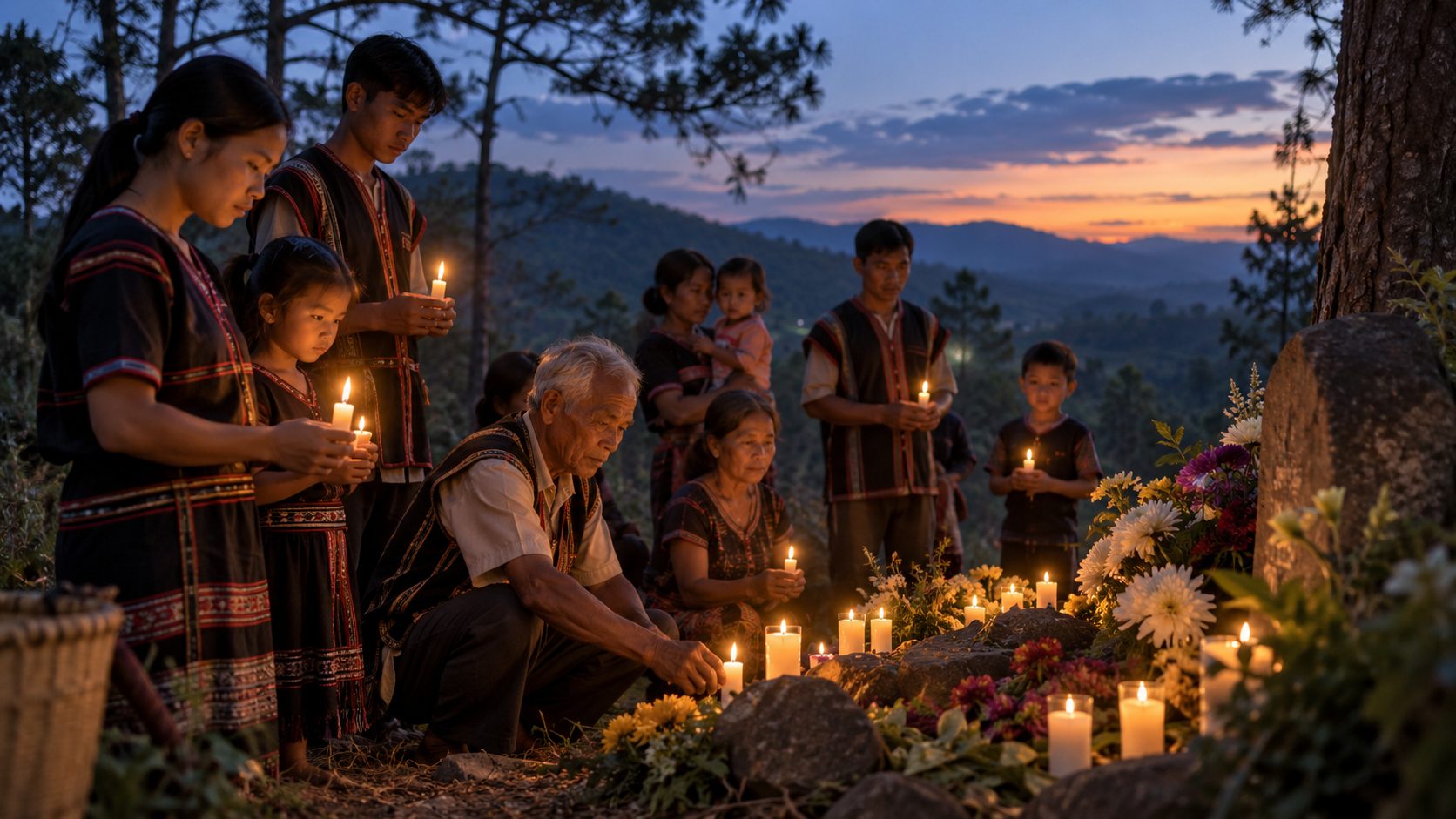
How we became a Christian people
We were animists for the whole of our history, and a common animist thread still runs through all our peoples. Catholic missionaries reached Kontum in the nineteenth century. Protestant mission work followed, and conversion accelerated through the 1950s and 1960s.
The decisive period came later and for a specific reason. After 1975 churches were closed and Dega Christians were accused of having worked for the CIA. Then, in the late 1980s and early 1990s, as the armed resistance collapsed and the last FULRO fighters walked out of the forest, large numbers of Dega converted to Christianity or returned to it. Through the 1990s more and more of our people joined unofficial house churches.
The timing is not a coincidence, and it is worth stating plainly rather than leaving for others to infer: when an armed movement ends, the people who believed in it do not stop being a people. The church became the only institution we still had that was ours, met weekly, and had leaders we chose. Everything that has been done to the church since follows from the state understanding this as clearly as we do.
What "Dega Protestantism" is
Around 2000 a strand of Montagnard church life emerged that the state named Tin Lành Dega — Dega Protestantism. In its own terms it is evangelical Christianity practised by Dega, in Dega languages, connected to our claims about land and standing. In the state's terms it is "a religion with a dubious origin", established by exiled FULRO members as a tool for political schemes.
That characterisation is the whole argument. If Dega Protestantism is a religion, banning it violates freedom of religion, which Vietnam has undertaken to protect. If it is a political front, banning it is national security and no treaty is engaged. Everything downstream — the arrests, the renunciations, the sentences — rests on that classification.
The instruments
- Instruction No. 1, February 2005
- Explicitly banned Dega Protestantism. Required Protestant groups to register with detailed member information and to certify that members would not take part in protests or join "reactionary" organisations.
- Decree 22, March 2005
- Banned religious activity held to threaten national security, public order or national unity. Notably, it also prohibited forcing people to recant — a provision the renunciation ceremonies described below breach.
- Registration
- A congregation must obtain permission and operate under a government-approved body. A house church that has not been granted registration is not merely unapproved; its ordinary Sunday meeting is a criminal act.
Renunciation
The characteristic instrument in the highlands is not the courtroom but the village meeting. People are assembled and required to state publicly that they abandon their faith, sometimes signing a written pledge. The official record describes these as voluntary.
- 6 June 2010, Dak Nong — two men made to confess publicly to supporting Dega Protestantism and FULRO
- 12 July 2010, Gia Lai — 97 households, 297 people, recorded as having "voluntarily" abandoned Dega Protestantism
- 24 September 2010, Gia Lai — 24 people committed to abandoning "FULRO-Dega Protestantism"
- 2 October 2010, Gia Lai — 567 households recorded as renouncing the religion
- 24 November 2010, Dak Lak — followers of the Ha Mon Catholic movement signed pledges to abandon their faith
In May 2001, after the February protests, authorities held what became known as goat's blood ceremonies: participants were made to stand, admit wrongdoing, undertake to cease contact with outside groups and renounce their religion, then drink rice wine mixed with goat's blood to seal it. An oath drawn from our own customary practice was turned into an instrument of recantation. It is worth sitting with what that means about who was advising whom.
The count
One of the dead has a name that should be recorded here. Y Ben Hdok was twenty-nine when he died in May 2008 after being arrested for taking part in a protest. His family described his head broken, his ribs broken, his leg broken and his teeth knocked out. The authorities said he had killed himself.
What is done to find people
The state has deployed specialised units for this work — PA43, the Central Highlands security service, together with mobile intervention police and political security forces — to find activists in hiding, seal the border against people seeking asylum, dissolve house churches and organise public recantations. In 2002, 2,300 additional soldiers were sent to the region, and plans were made to settle 100,000 people in Economic-National Defence Zones along the Cambodian border.
What this is not
Not every Dega Christian belongs to Dega Protestantism, and not every congregation in the highlands is unregistered. Some worship in registered churches under the Evangelical Church of Vietnam and are left largely alone. We say this because the state's case depends on treating all Dega Christianity as one seditious mass, and we are not going to make its argument for it by doing the same.
Sources
- Human Rights Watch, Montagnard Christians in Vietnam: A Case Study in Religious Repression (March 2011) — the source for the figures, the decrees and the dated incidents above
- Human Rights Watch, No Sanctuary (2006)
Compiled September 2026. The figures above are from 2011 and are certainly out of date; we are working to establish current numbers and will publish them with their source when we can stand behind them.