
Between 2001 and 2005 the nearest country stopped being a refuge and became a holding area. Thousands crossed into Cambodia after the February 2001 crackdown; UNHCR opened sites in the border provinces; the sites were closed, protection officers were confined to Phnom Penh, and people were sent back. This is how that happened, in order.
Why people crossed
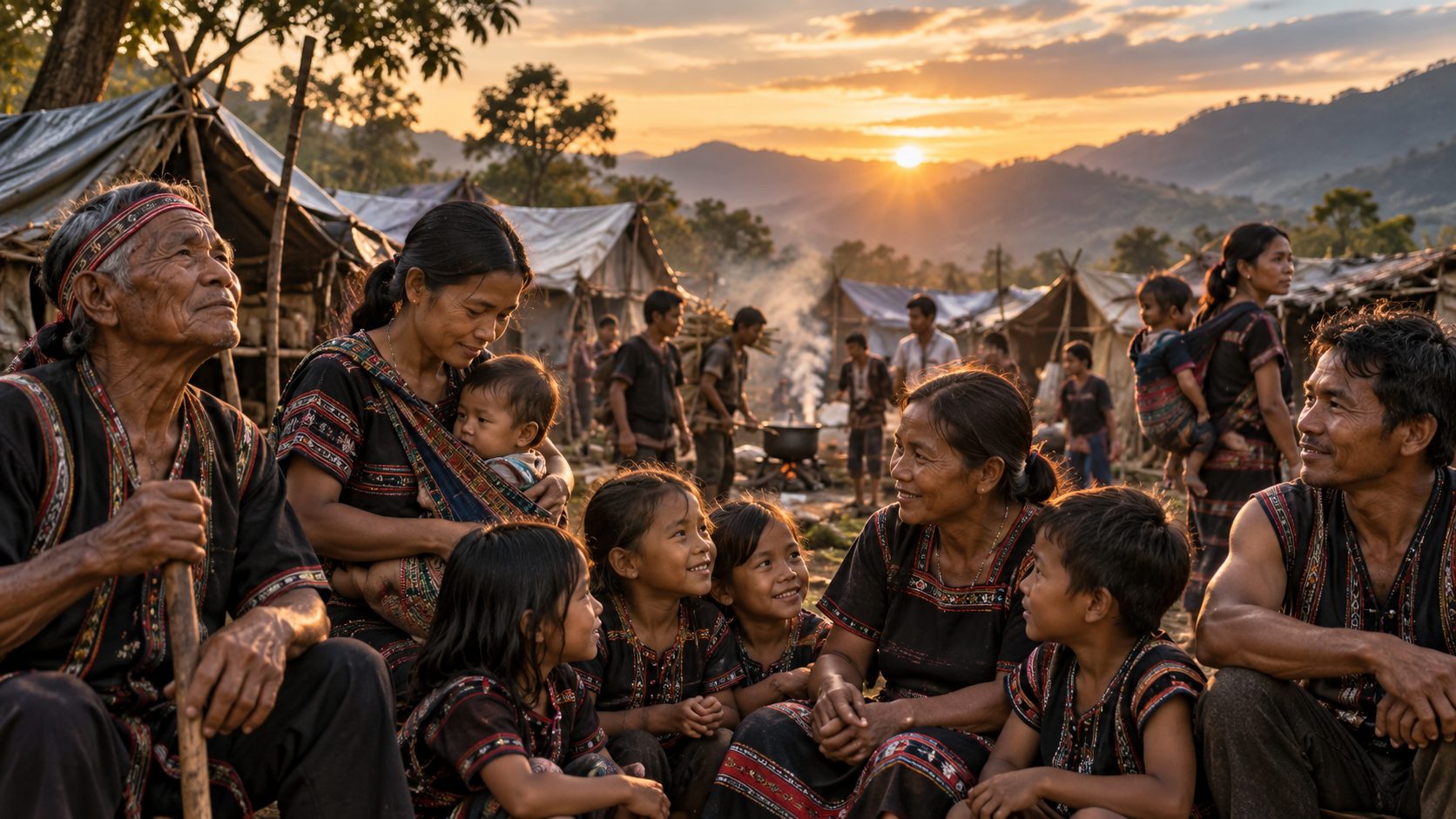
The border between the Central Highlands and the Cambodian provinces of Mondulkiri and Ratanakiri is a line drawn in Paris across a single human landscape. The Mnong of Dak Nong are the Bunong of Mondulkiri; the Jarai are about a quarter of the population of Ratanakiri. Crossing it is not, for most highlanders, entering a foreign country. It is reaching the other half of the family.
That is what made it the obvious route after February 2001, and it is why the people who took it included, as Human Rights Watch noted, a great many who had never been near a demonstration.
What happened, in order
- 2001 — Highlanders cross in numbers after the February protests and the crackdown that followed. UNHCR opens sites in Mondulkiri and Ratanakiri.
- 2002 — Cambodia closes the border-province sites and restricts UNHCR protection officers to Phnom Penh. Resettlement to the United States takes close to 900 people to North Carolina that summer. By March 2002 more than a thousand of those who had fled remain in political limbo.
- 2003 — Deportations. At least 270 Dega are returned to Vietnam over the year.
- April 2004 — After Easter Week, Cambodian border police are put on alert and ordered to expel anyone crossing without documents. The door closes from both sides in the same week.
- 2005 — A tripartite arrangement between Vietnam, Cambodia and UNHCR governs screening and return. On the Vietnamese side, Instruction No. 1 of February 2005 bans Dega Protestantism and Decree 22 of March 2005 restricts religious activity judged to threaten national security.
The arrangement, and what was wrong with it
The tripartite memorandum was presented as an orderly solution: people would be screened, genuine refugees resettled, and the rest returned voluntarily with monitoring of what happened to them afterwards.
Three things were wrong with it in practice. Screening happened in a country that had already shown it would close sites and restrict the agency doing the screening. Returns described as voluntary were made by people who knew the alternative was an immigration cell. And monitoring of returnees depended on access that the Vietnamese side controlled — in a region closed to independent observers since 2001.
Human Rights Watch recorded what returning meant: at least 65 Montagnards arrested between 2001 and 2011 while trying to reach Cambodia, hundreds repatriated, and returnees imprisoned under Penal Code article 91 — fleeing abroad to oppose the People's Administration. A charge that exists specifically to punish leaving is not compatible with a return described as voluntary.
Non-refoulement, plainly
No state may return a person to a country where they face a real risk of persecution or torture. The rule is customary international law, binding whether or not a state has signed the Refugee Convention, and it is also in the Convention against Torture, which Cambodia, Thailand and Vietnam have all ratified. It is not conditional on the person's paperwork being in order or on the receiving state's assurances. The assurances are the point at which it is usually broken.
Where those people are now
Three outcomes, roughly. Some were resettled — close to 900 in the summer of 2002, to Greensboro, Charlotte, Raleigh and a new site at New Bern. Some were returned, and the prisoner records carry names of people arrested at the border. And some went further, to Bangkok, where the story continues in Asylum today — and where, in February 2025, 68 Montagnards were detained at a funeral service, 43 of them holding UNHCR refugee cards.
Twenty-four years after the first crossings, the same families are still moving and the legal position has not improved. It has moved one country further away.
Sources
- Human Rights Watch, Repression of Montagnards (April 2002) — the 2001 flight and the March 2002 position
- Human Rights Watch, Montagnard Christians in Vietnam (March 2011) — border arrests, returnees, article 91, Instruction No. 1 and Decree 22
- Human Rights Watch, "Montagnard Refugees Need International Support", 5 April 2005
- ANCHOR: A North Carolina History, The Montagnards — the summer 2002 resettlement
- BenarNews, 26 February 2025 — the Nonthaburi detentions
Compiled September 2026. The text of the tripartite memorandum, and any record of what happened to individual returnees, are both on what we do not know. If you were in the Mondulkiri or Ratanakiri sites, or were returned, we would like your account — read reporting safely first.