
On 20 September 1964 five armed camps in Darlac rose at once, and a movement was announced: the United Front for the Liberation of Oppressed Races. It lasted twenty-eight years and three weeks, longer than the war that produced it, and ended in October 1992 when its last fighters walked out of the Cambodian forest and handed their rifles to United Nations peacekeepers.
What it was
FULRO — Front Unifié de Lutte des Races Opprimées — was formed in September 1964 from the merger of three organisations: the Front for the Liberation of the Highlands (FLHP), which was BAJARAKA reconstituted the previous March; the Front for the Liberation of Champa, led by Les Kosem, a Cham officer of the Royal Cambodian Army; and the Front for the Liberation of Kampuchea Krom, led by Chau Dara. Its nominal head was Y Bhăm Êñuôl, the Rhade schoolteacher who had led BAJARAKA and spent five years in Diem's prisons for it. Its headquarters were in Cambodia, for security.
The three-front structure is why the name speaks of oppressed races in the plural rather than of the Dega. It was a claim on behalf of the indigenous and dispossessed peoples of the whole peninsula — highlanders, Cham, and the Khmer of the Mekong delta. It also meant that from the first day FULRO contained men whose principal interest was Cambodian and not ours, which shaped a great deal of what followed.
The three aims
- That the Dega be recognised as the legal and rightful masters of the Central Highlands
- That the Vietnamese administration of those lands be dismantled and its military forces withdrawn
- That Dega sovereignty be restored and the independence of the Dega people guaranteed
These were adopted by what the movement described as the free representatives of the Dega people. Our position has been that they cannot be rescinded by any assembly sitting under the control of an occupying power, which is why they are still quoted sixty years on by an organisation that has had no army since 1992. What has changed is the means, not the aims: since 1992 they are pursued politically and by peaceful means only.
September 1964: the revolt
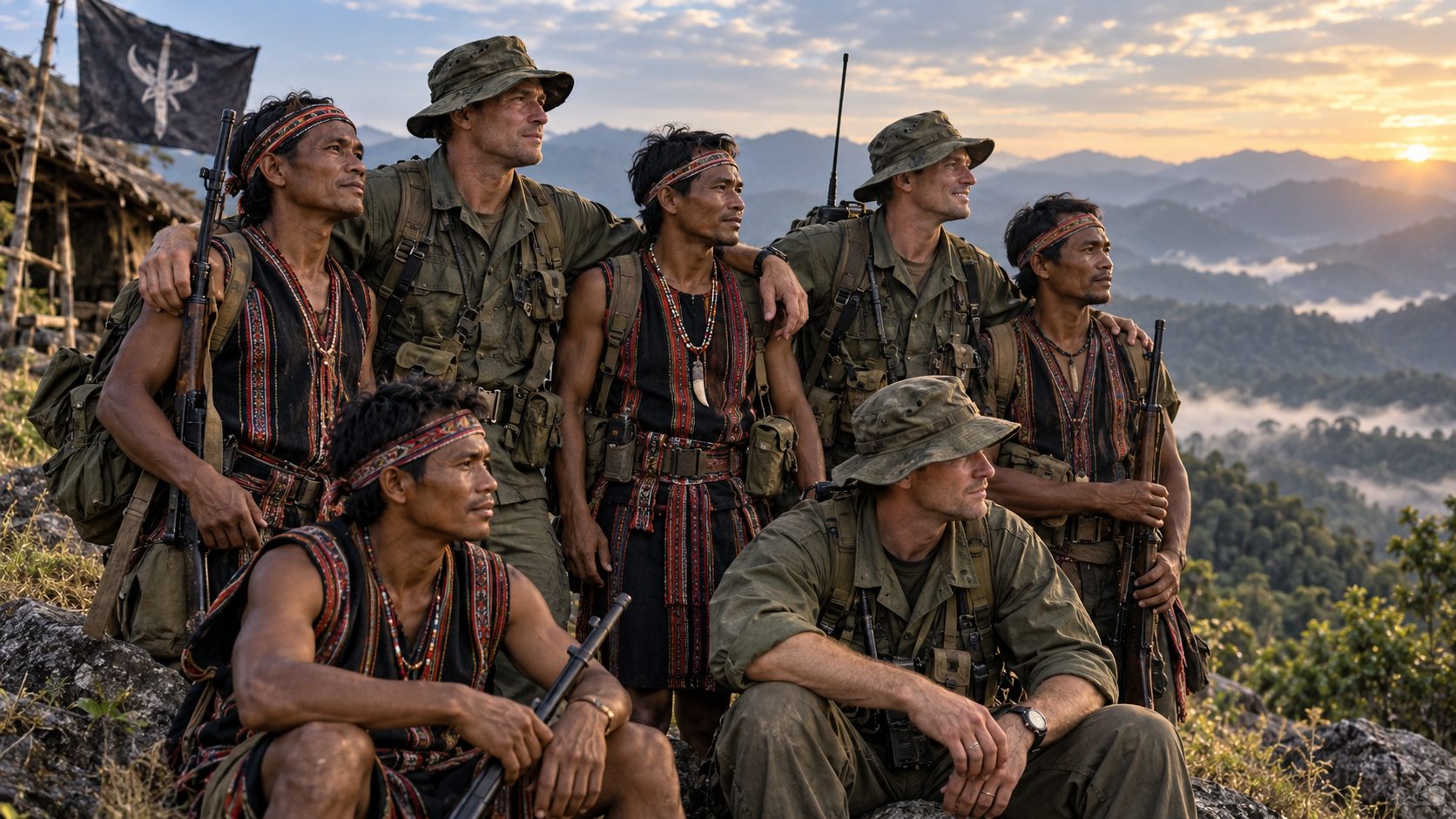
On 19–21 September 1964, five camps of the American-trained Civilian Irregular Defense Group near Buon Ma Thuot rose against their South Vietnamese commanders: Buon Sar Pa and Bu Prang in Quang Duc, and Buon Mi Ga, Ban Don and Buon Brieng in Darlac. Several Vietnamese soldiers were killed. The American Special Forces advisers were disarmed but not harmed, and in several camps were the ones who then mediated.
The revolt lasted about ten days and came close to destroying the CIDG programme altogether. It ended through American mediation rather than by force. Y Bhăm Êñuôl was taken out of the highlands to Cambodia, and the fighters who did not stand down established bases in Mondulkiri. Five camps were closed within a year.
A second rising in December 1965 was far bloodier: thirty-five Vietnamese, including civilians, were killed, and it was suppressed with four FULRO commanders publicly executed.
1965: the name
At the Conference of Indochinese Peoples in Phnom Penh in 1965, Y Bhăm Êñuôl used the word Dega to describe our people before an international gathering. It was the first time our own name for ourselves had been placed on that kind of record. Every page on this site that says Dega rather than Montagnard traces to that moment.
1968–69: the settlement, and the split
From August 1968 a South Vietnamese delegation negotiated with FULRO at Buon Ma Thuot. On 11 December 1968 an agreement was reached recognising minority rights and establishing a ministry for ethnic minorities in Saigon.
It held for nineteen days. On 30 December 1968 Les Kosem, whose objectives were Cambodian and who had no interest in a Dega settlement inside South Vietnam, seized Camp le Rolland and placed Y Bhăm Êñuôl under house arrest in Phnom Penh. Y Bhăm Êñuôl never left Cambodia again. On 1 February 1969 a final treaty was signed between Paul Nưr for the Republic of Vietnam and Y Dhơn Adrong for FULRO, and a large part of the movement came in. That is generally taken as the end of FULRO as a political movement in South Vietnam. It was not the end of FULRO.
After 1975
FULRO units fought the Socialist Republic for another seventeen years. The movement received weapons and cash from China, routed through Cambodia, and at various points from Khmer Rouge and other Cambodian elements whose motive was hostility to Hanoi rather than sympathy with us. Strength estimates for the 1980s run to several thousand fighters based principally in Mondulkiri. The Vietnamese invasion of Cambodia in 1979 removed the rear areas and the supply routes, and from then on the movement was being slowly ground down in a forest it could not leave.
The men in Mondulkiri did not learn until 1992 that Y Bhăm Êñuôl, whose authority they had been fighting under, had been dead for seventeen years. In October 1992 the last 407 FULRO fighters and their families handed their weapons to United Nations peacekeepers of UNTAC and came out. That story is told in full in Mondulkiri, 1992.
What we do not claim
FULRO was an armed movement and it fought a long war. At times it fought the South Vietnamese army while other Dega were serving in it. At times it took weapons from forces whose own purposes were not ours and were, in the Khmer Rouge's case, monstrous. People were killed who had not chosen any of this. A library that intends to be used as evidence cannot present that record as unblemished, and we do not. What we do say is that every peaceful route had been tried first, by the same men, and that the prison sentences of 1958 are the reason the rifles of 1964 exist.
Sources
- United Front for the Liberation of Oppressed Races — the three-front merger, the September 1964 camps, the 1968–69 negotiations and the 1992 surrender
- FULRO insurgency — duration, external support, and the post-1975 phase
- US Army Special Operations History, Civilian Irregular Defense Group: The First Years, 1961–1967 — the September 1964 revolt from the American side
- Gerald C. Hickey, Free in the Forest (Yale, 1982)
Compiled September 2026. The internal history of FULRO between 1975 and 1992 is thinly documented and most of what exists is hostile. If you served, or your father did, we would like to record it.