
Reading about the Dega means reading four vocabularies at once — ours, the French, the Americans' and the Vietnamese state's — and they do not agree. This is what the words mean here.
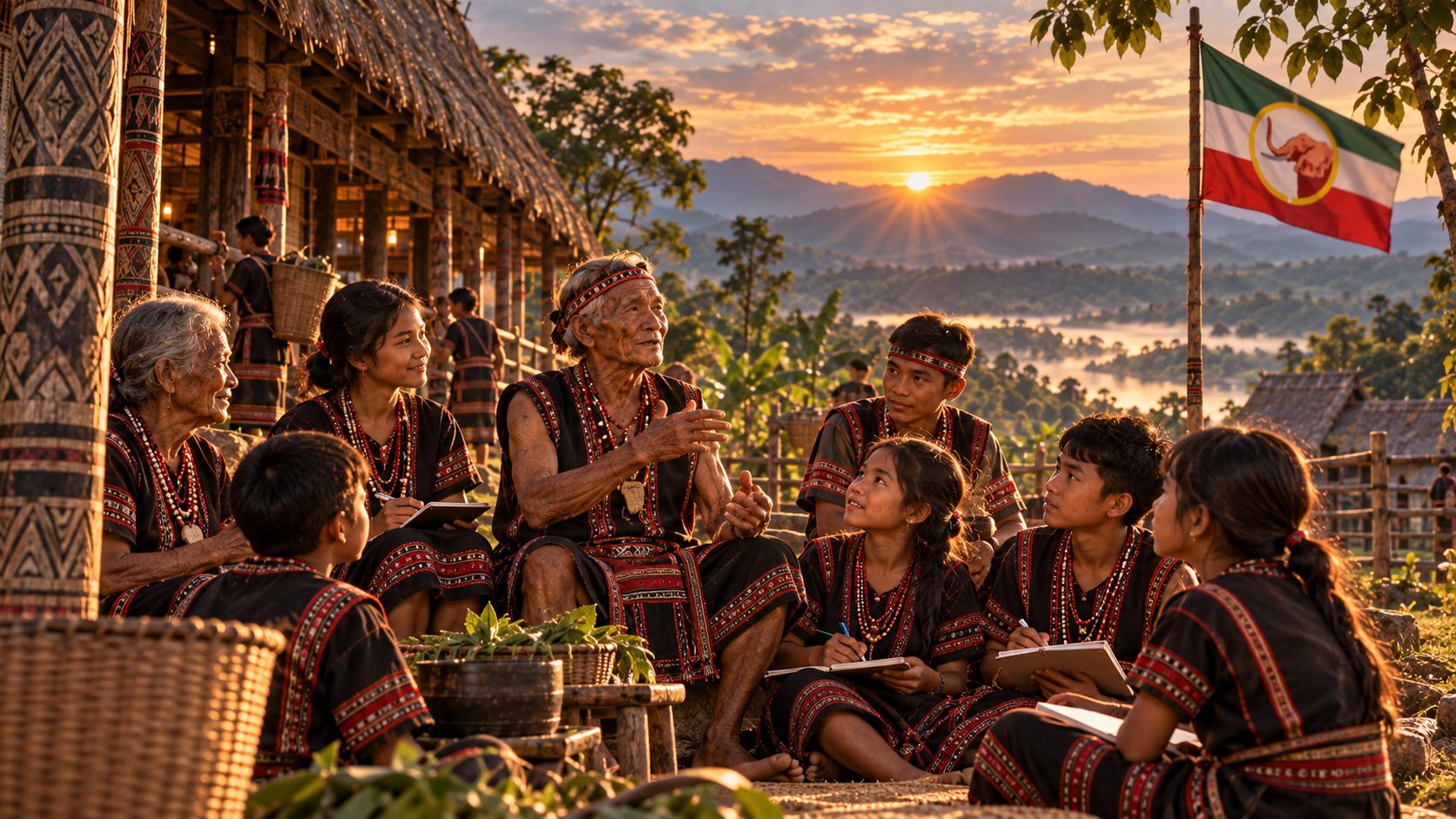
What we are called
- Dega, Degar
- Our own name for ourselves, meaning the sons and daughters of the mountains. Put before an international meeting for the first time by Y-Bham Eñuol at Phnom Penh in 1965. Both spellings are correct.
- Montagnard
- French for mountain people. Given by the colonial administration, and the name under which our history is recorded in most outside sources. We use it where the record uses it, and it is not an insult.
- Yard
- American shorthand from the war. Used by the soldiers who served with us, and generally affectionately.
- Moi
- Vietnamese for savage. Applied to us after 1954. It is a slur, and it did a job: a savage has no government to negotiate with and no title to the ground.
- Ethnic minority — dân tộc thiểu số
- The Vietnamese state's classification of us, introduced under Diem. It describes the result of a century of resettlement as though it were a fact of nature, and it removes indigenous rights law from the table by definition.
- Indigenous people
- What we say we are: first, continuous, with our own institutions. The word carries rights that "minority" does not. Vietnam's position is that it has no indigenous peoples.
Places and polities
- P.M.S.I. — Pays Montagnards du Sud Indochinois
- The Montagnard country of southern Indochina, created by ordinance on 27 May 1946. Also written P.M.S.
- Crown Domain
- The status given to the highlands in 1950, placing them under Bao Dai personally rather than under the Vietnamese state.
- Tây Nguyên
- The Vietnamese name for the Central Highlands: "western plateau". The provinces are Kon Tum, Gia Lai, Dak Lak, Dak Nong and Lam Dong.
- Annamitic Ridge
- The mountain chain running down the spine of Indochina; the eastern boundary of the 1946 territory.
Movements and organisations
- BAJARAKA
- From Bahnar, Jarai, Radé, Kaho. Our first modern political movement, 1957–58. Unarmed; crushed with tanks.
- FULRO
- Front Unifié de Lutte des Races Opprimées — United Front for the Liberation of Oppressed Races, founded 20 September 1964. Armed struggle ended at Mondulkiri in 1992.
- Montagnards Stand for Justice
- A documentation and advocacy group founded in Thailand by Y Quynh Bđăp. Designated a terrorist organisation by Vietnam in 2024; UN experts warned the designation may violate freedom of expression, assembly, association and religion.
- Tin Lành Dega — Dega Protestantism
- Evangelical Christianity as practised by Dega, in Dega languages. Banned by Instruction No. 1 in February 2005 on the grounds that it is a political front rather than a religion.
- ECVN
- The Evangelical Church of Vietnam, the state-recognised Protestant body. Registering with it is the lawful route; refusing to has been a stated reason for arrest.
The machinery
- Dinh Canh Dinh Cu
- Fixed field, fixed residence. The 1976 programme that confined our people to small areas of poor cropland and released the rest for settlement.
- Public self-criticism session
- A compulsory village meeting at which people renounce their faith and undertake to cease political or religious activity, often in writing. Recorded officially as voluntary.
- Goat's blood ceremony
- Renunciation sealed by drinking rice wine mixed with goat's blood — our own oath practice, used against us, after February 2001.
- Mobile court
- A court convened outside a courthouse as a public event. Used for the mass trial of 20 January 2024, which UN experts described as a prejudicial tool to collectively shame the defendants.
- Unit 113, PA43
- Ministry of Public Security units documented operating in the highlands.
- Non-refoulement
- The rule that no state may return a person to a country where they face a real risk of persecution or torture. Breached by Thailand in November 2025.
See also
- Who are the Dega — why the name is the argument
- The tribes and the languages — the thirty-two, and their spellings
Spellings you will have to search
Names in the records on this site were written down by many hands, from several languages, over sixty years. If a search fails, the name is probably present under another spelling. These are the variations that actually occur.
| Element | Variants you will meet | Why |
|---|---|---|
| Men's name prefix | Y-, Y , Y joined to the name | Rhade and Jarai gender prefix, punctuated differently by each source |
| Women's name prefix | H', H , Ho | The same, with the apostrophe often lost in typing |
| Diacritics | Byă / Bya · Đăp / Dap · Êñuôl / Enuol / Eñuol · Nưr / Nur | Vietnamese and Rhade orthography against plain ASCII |
| "Village" | Buôn / Buon · Plei / PLei / Plếi / Plây · Bon / Bổn | Rhade, Jarai, Bahnar and Mnong words, plus Vietnamese làng and thôn on official maps |
| Districts | Dakdoa / Đăk Đoa · Krong Pac / Krông Pắc · Chu Se / Cu Se / Chư Sê · Cu Kuin / Cư Kuin | Re-spelled repeatedly; some districts were also re-drawn |
| Provinces | Daklak / Dak Lak / Đắk Lắk · Kontum / Kon Tum · Gialai / Gia Lai | Dak Nong was separated from Dak Lak in 2004, inside the period the prisoner records cover |
| Peoples | Rhade / Rhadê / Rade / Ê Đê / Ede · Jarai / Gia Rai / Jrai · Bahnar / Ba Na · Mnong / M'nông / Bunong | French, American, Vietnamese and self-designations, all in circulation |
| Buon Ma Thuot | Banmethuot · Ban Mê Thuột · Buon Ama Thuot · Buon Me Thuot | The colonial spelling, the wartime American one, and two modern ones |
The practical rule: search the distinctive part of a name, without prefixes, without diacritics, and in more than one province's table. The prisoner records explains the search in full.
Words the state uses
- Định canh định cư "fixed cultivation, fixed residence"
- The post-1975 resettlement programme. Presented as ending an unstable nomadic life; in practice it moved villages off long-rotation land onto plots that could not feed them.
- Dinh điền "land development centre"
- The Diem-era equivalent, from 1956.
- Vùng kinh tế mới "New Economic Zone"
- The post-1975 settlement programme that moved lowland populations into the highlands and other frontier regions.
- Tin Lành Dega "Dega Protestantism"
- The state's name for our independent evangelical congregations, banned by name in Instruction No. 1 of February 2005.
- Undermining national solidarity Penal Code article 87
- Together with article 89 (disrupting security) and article 91 (fleeing abroad to oppose the People's Administration), the three charges that account for almost every Dega prosecution since 2001. None requires an act of violence to be proved.
- Mobile court tòa án lưu động
- A court convened outside a courthouse, often in a public space. Around a hundred defendants were tried at one sitting on 20 January 2024; twelve UN special procedures found the proceedings to lack legal basis and independence.
- Public self-criticism session
- A compulsory village meeting at which people renounce Christianity and undertake to cease religious or political activity, sometimes by signing a pledge. Prohibited on paper by Decree 22 of March 2005.