
In 1954 the French lost and left. In 1955 Ngo Dinh Diem merged our country into the Republic of Vietnam. From 1956 his land development centres moved Vietnamese settlers onto highland soil in numbers our records put at around 850,000. No government objected, and the word the policy used for itself was assimilation.
1954: the country changes hands
The Viet Minh defeated the French at Dien Bien Phu and the Geneva Accords partitioned Vietnam at the 17th parallel. The north went to Ho Chi Minh; the south to the State of Vietnam under Bao Dai, who still held our highlands as his personal Crown Domain and who had signed, three years earlier, a statute guaranteeing our free evolution according to our own traditions.
The French departure removed the only party with any obligation to enforce that guarantee. Our men had fought in the French army across Indochina and thousands had died in it. Nothing was asked in return, and nothing was left behind.
1955: the merger
In October 1955 Diem displaced Bao Dai by referendum and proclaimed the Republic of Vietnam. The Crown Domain ended with the Crown, and the Central Highlands were merged into the Republic. The 1951 statute was set aside. The seizure went unopposed by any other government, in a decade when a great many governments were watching Vietnam closely.
The instrument was not only territorial. Diem's administration classified us as an ethnic minority within a Vietnamese nation. That single administrative decision removed the ground from under every claim we had: a minority has no territory to be dispossessed of and no government to be abolished, only a culture that may be respected at the state's discretion. Everything since has turned on that reclassification, which is why the argument over what to call us is not a quarrel about words.
1956–57: the land programme
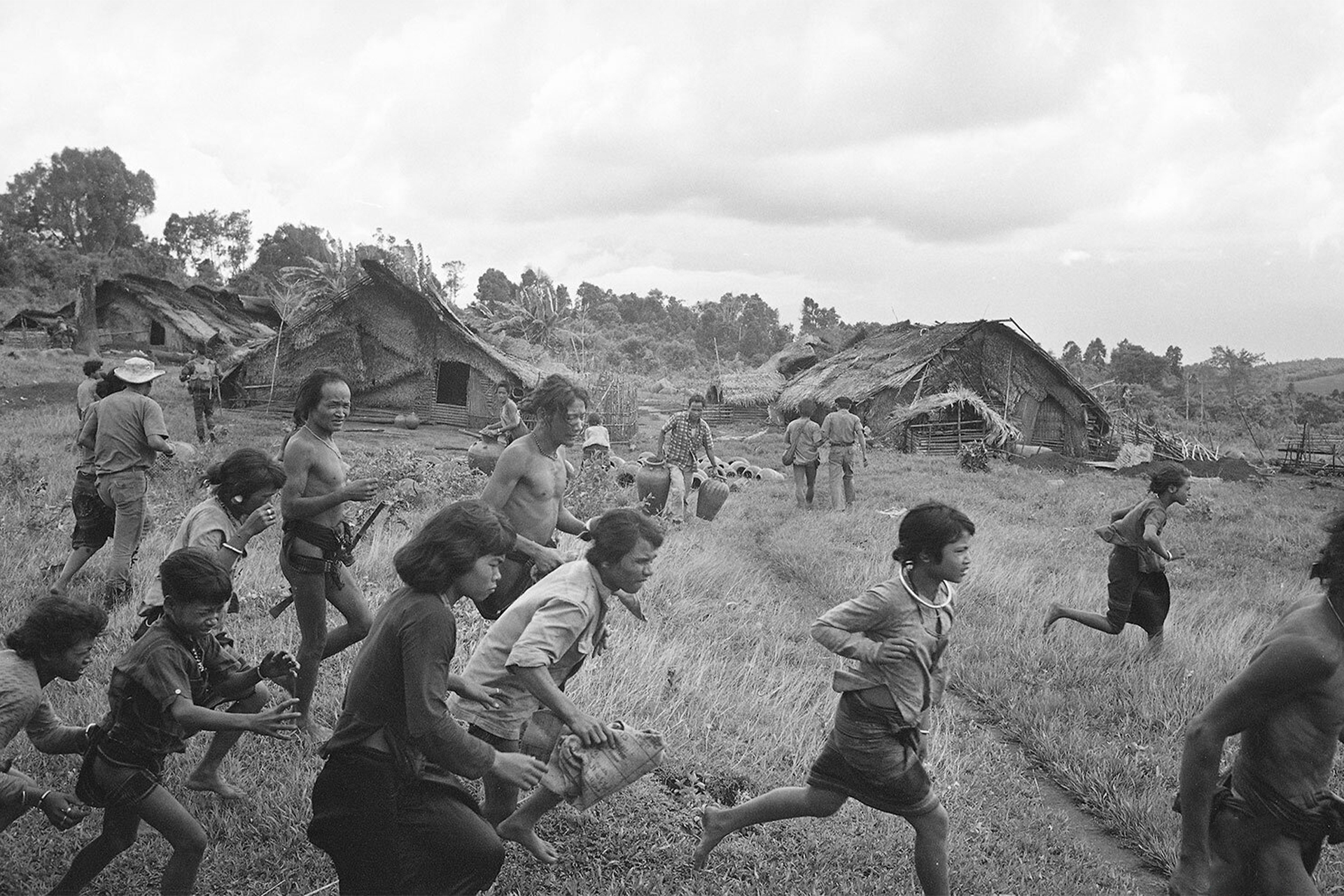
From 1956 the Republic established dinh điền — land development centres — across the Central Highlands, and moved Vietnamese into them, including large numbers of refugees who had come south from the north after partition. Human Rights Watch records the programme as beginning in 1956 and continuing through the Diem years. Dega records put the total resettled onto our land at around 850,000; we give that as our own figure because we have not been able to match it to a published government series, and it should be read as our archive's number rather than a verified one.
The land had to come from somewhere, and it came from us. Villages were moved to make room. The programme was funded in large part by the United States government, and was later widely judged, including by Americans who had backed it, to have been both a failure on its own terms and culturally destructive.
It also had a consequence its planners did not intend. Many of those resettled, finding themselves on poor plots in a region they had not chosen, were later recruited by the National Liberation Front. So the highlands received first the settlement and then the insurgency that grew out of it, and both were fought across our villages.
What assimilation meant in practice
- Our customary courts abolished, and their jurisdiction transferred to Vietnamese provincial courts
- Our languages barred from the schools; instruction in Vietnamese only
- Village land expropriated and issued to settlers, with no procedure by which communal tenure could be registered
- Our existence as distinct peoples with a distinct territory denied as a matter of policy
- Highland place names replaced with Vietnamese ones on every official map
The word the policy used for itself was assimilation, and it should be taken at face value. Assimilation is not a side effect of development; it is a stated intention that a people should cease to exist as a distinct people. A government that says so, in its own documents, has told you what it is doing.
Why 1957 mattered more than 1955
The merger of 1955 was a change of flag, and our people had lived under several. What made 1956–57 different was that it was irreversible. A statute can be restored and an administration can be replaced, but once several hundred thousand families have been settled on a plateau, cleared its forest and registered its fields, no subsequent government can undo it without doing to them what was done to us. That is why our claim is against the state and its policies and not against the neighbours those policies produced — and it is why every later programme, from the New Economic Zones to the coffee boom, was building on a foundation laid in these three years.
What followed
Within a year of the land programme beginning, the first generation of Dega educated in the French schools had drafted letters to Paris, Washington and the United Nations. Within two, some of those men were in prison. That is BAJARAKA.
Sources
- Human Rights Watch, Repression of Montagnards (April 2002) — the 1956 land development centres and the resettlement of northern refugees, p. 20
- Gerald C. Hickey, Free in the Forest: Ethnohistory of the Vietnamese Central Highlands, 1954–1976 (Yale, 1982) — the standard account of the Diem years in the highlands
- Oscar Salemink, The Ethnography of Vietnam's Central Highlanders (2003)
- Montagnard Foundation, Inc., historical summaries (archive held by DCHO) — the 850,000 figure
Compiled September 2026. We would like to source or retire the 850,000 figure. If you can point us to Republic of Vietnam or USAID records for the dinh điền programme, please write.