
It began in one Rhade village in October 1961 with two Americans and no authority to speak of, and grew within a year into an armed network covering 200 villages and 60,000 people. Dega soldiers became among the most reliable troops in the highlands. By the end, over 200,000 of our people were dead and 85 per cent of our villages destroyed or abandoned, and the autonomy we had been promised was not restored.
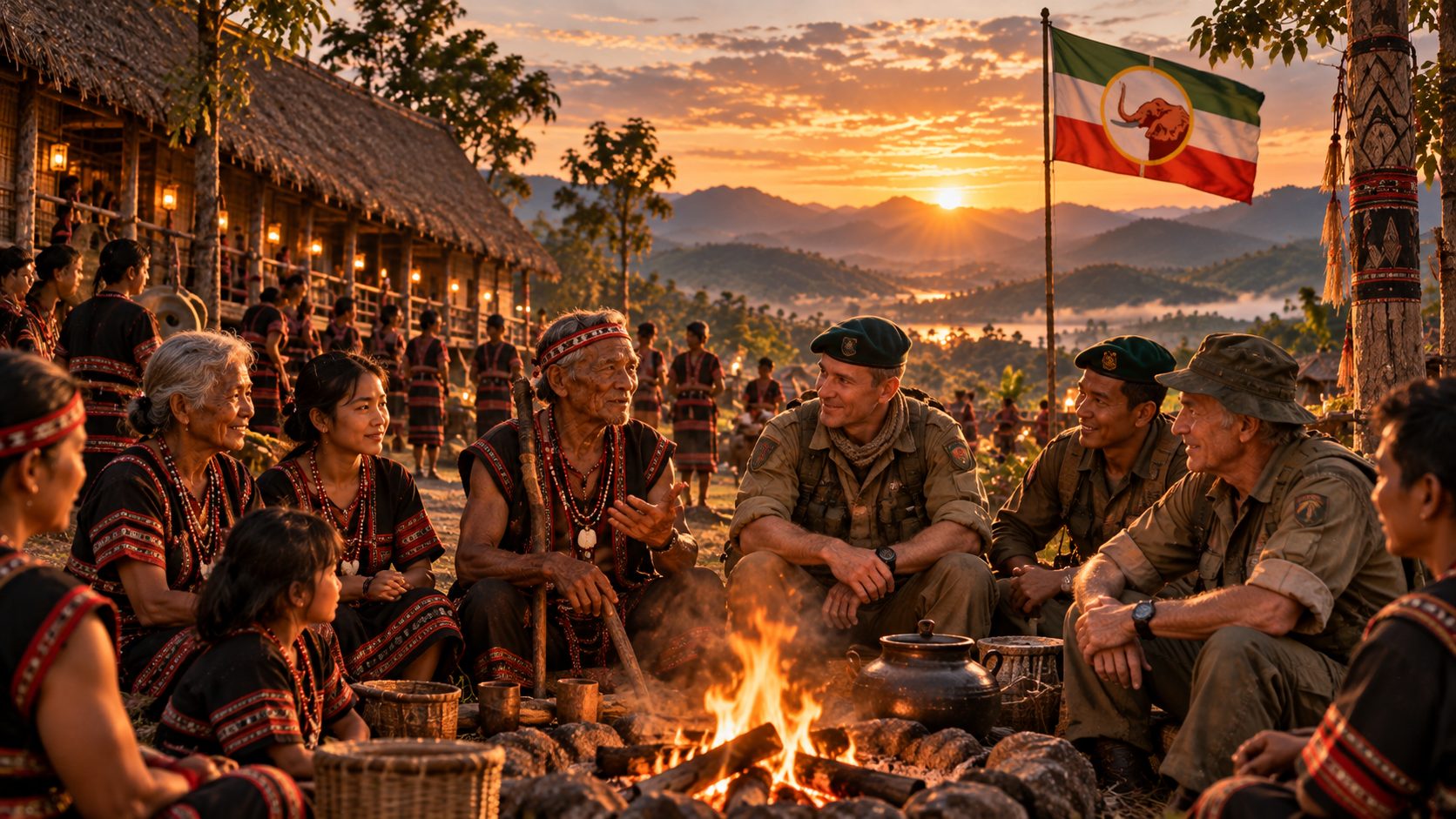
Buon Enao, October 1961
The programme that became the Civilian Irregular Defense Group started as a Central Intelligence Agency experiment. In October 1961 two Americans — David Nuttle of International Volunteer Services and Staff Sergeant Paul F. Campbell of the 1st Special Forces Group — arrived at the Rhade village of Buon Enao in Darlac, a village of some 400 people. The Rhade were chosen because they were the most organised of the highland peoples in colonial terms, with many veterans of the French Expeditionary Corps among them.
By mid-December 1961 the village was fortified, with shelters dug and a perimeter built, and fifty trained fighters drawn from neighbouring villages had formed a strike force. In January 1962 the Village Defense Program was formally renamed the Civilian Irregular Defense Group, and Captain Ronald A. Shackleton brought in Detachment A-113 of the 1st Special Forces Group — eight men — to run the prototype camp.
The expansion was extraordinarily fast. By October 1962 roughly 200 Rhade villages across some 4,000 square kilometres had been brought in, protecting over 60,000 highlanders in Darlac alone.
Why it worked
Most Dega men had no wish to join the South Vietnamese army after the French left. Diem's government had merged our country by force, imprisoned our leaders and settled our land. There was no reason to fight for it.
The Americans offered something different in kind: weapons, training, pay, a measure of respect, and — explicitly, in the field — the prospect that the autonomy the French had granted would be restored. Dega units delivered. Highland scouts rescued downed pilots, held camps that were repeatedly overrun elsewhere, and produced intelligence that saved a great many American lives. Dega men served in the CIDG strike forces, in Mike Force, as Kit Carson Scouts, in the Provincial Reconnaissance Units and in the Truong Son cadre programme.
What changed it
- 23 July 1962 — National Security Action Memorandum 57 transfers the CIDG from the CIA to the military. Operation SWITCHBACK begins; it completes on 1 July 1963.
- 1 October 1964 — The 5th Special Forces Group, 1,297 strong, takes over. By February 1965 it fields four C-teams, twelve B-teams and 48 A-detachments.
- January 1965 — General Westmoreland redirects Special Forces from village defence to offensive operations: the mission becomes finding and destroying the enemy. The programme stops being about protecting villages and becomes about generating infantry.
That shift is the whole story in one line. Under the CIA the programme's purpose was that a Rhade village should be able to defend itself; under MACV its purpose was that Rhade men should be available to fight elsewhere. SWITCHBACK also came with an instruction that minority populations were not to be further mobilised politically — the armed part of the arrangement was kept and the political part was dropped.
September 1964
The contradiction broke open on 19–21 September 1964, when five CIDG camps near Buon Ma Thuot rose against their South Vietnamese commanders. The revolt lasted about ten days, nearly ended the programme, and was resolved by American mediation rather than force. Five camps were closed within a year. It is covered in full in FULRO, 1964–1992.
Why the highlands
Both sides agreed that whoever held the Central Highlands would decide the war. The plateau controlled the infiltration routes from Laos and Cambodia, the approaches to the coastal cities, and the road south. That is why the largest battles of the war — Plei Me, the Ia Drang, Dak To, Kontum, and finally Ban Me Thuot — were fought across our country, and why our villages sat on exactly the ground both armies had decided everything depended on.
The cost
| Measure | Figure | Source |
|---|---|---|
| Dega killed | over 200,000 | Gerald C. Hickey |
| Estimated highland population | about 1 million | Gerald C. Hickey |
| Villages destroyed or abandoned | 85 per cent | Gerald C. Hickey |
One person in five killed, and five villages in six gone. There is no comparable ratio for any other population of that war. It was not incidental damage: we were living on the ground both armies had decided the war would be settled on, and the strategic hamlet programmes, the free-fire zones, the defoliation and the bombing all fell on a plateau whose inhabitants had no say in any of it.
The promise
In 1966 the Republic of Vietnam created a Ministry for the Development of Ethnic Minorities, and in 1968–69 signed an agreement with part of FULRO recognising minority rights. Both fell well short of the autonomy that had been held out in the field, and both were overtaken by events within a few years.
When the Republic collapsed in 1975 the highlands were where it collapsed first. The Americans left. The men who had been recruited, armed, trained and paid from 1961 onward were still there, holding weapons and, in a great many cases, American unit papers — which is the subject of 1975, and what came after. A promise that is not written down is not enforceable; a service record, unfortunately, is.
The debt, stated plainly
Thousands of Americans came home from the Central Highlands because Dega soldiers held a perimeter, walked a trail first, or carried them. The United States has acknowledged this in part — through the resettlement of Montagnard veterans and their families in North Carolina from 1986 onward, and through the work of individual Special Forces veterans who have never let the subject drop. It has not been acknowledged in the one form that would matter most, which is sustained diplomatic pressure on behalf of the people who stayed.
Sources
- US Army Special Operations History Office, Civilian Irregular Defense Group: The First Years, 1961–1967 — Buon Enao, Nuttle and Campbell, Detachment A-113, the October 1962 figures, SWITCHBACK and the 1965 change of mission
- Gerald C. Hickey, Free in the Forest: Ethnohistory of the Vietnamese Central Highlands, 1954–1976 (Yale, 1982) — casualty and village-destruction figures
- Gerald C. Hickey, Window on a War: An Anthropologist in the Vietnam Conflict (Texas Tech University Press, 2002)
- Montagnard Foundation, Inc., historical summaries (archive held by DCHO)
Compiled September 2026. We are collecting unit histories, camp rosters and discharge papers. If your father served with a CIDG camp, Mike Force or a PRU, those documents matter for asylum and family-reunification cases now — see how to document before you send anything.