








Where the evidence of our history is kept: the archives of the governments and armies that dealt with us, the mission libraries, the museums that hold our objects, the sound archives that hold our music, and the community organizations that keep what the institutions did not. Most can be searched online; many documents are free.
A warning about the archives
Almost everything here was collected by outsiders, and many of the documents were written by people who were fighting over our land. Read them as evidence of what those people knew and wanted, not only as evidence of what happened. And remember that much of the colonial record for the highlands stayed in Vietnam, where it is not open to us.
American archives
- Texas Tech University, The Vietnam Center and Sam Johnson Vietnam Archive
The largest Vietnam War archive outside the US government, in Lubbock, Texas, and searchable online through the Virtual Vietnam Archive. Search for “Montagnard,” “FULRO,” “CIDG,” “Buon Enao,” “Darlac” or “Hickey.” It holds Gerald Hickey’s papers and highland artifacts, and a free oral history interview with Hickey (OH0786). - US National Archives, Record Group 472: Records of US Forces in Southeast Asia, 1950–75
About 9,000 cubic feet at College Park, Maryland, including MACV, CORDS and US Army Vietnam records; the 5th Special Forces Group and CIDG records are among them. Search the online catalog at catalog.archives.gov. - CIA Freedom of Information Act Reading Room
Declassified documents; search “FULRO,” “montagnard,” “highlanders,” “Ban Me Thuot.” Many are mirrored on the Internet Archive, for example the History of the Mountain Scout Program, 1961–1963. - RAND Corporation
Gerald Hickey’s reports for the US government, free as PDFs: RM-4041 (1964), RM-5281/1 (1967) and P-4708 (1971) on land, credit and farming since 1955. - US Army Special Operations Command History Office, Veritas
Free articles on the CIDG, Buon Enao and the September 1964 revolt, notably “A Team Effort: The Montagnard Uprising of September 1964.” - Foreign Relations of the United States (FRUS)
The published diplomatic record. Document 358 of the 1964–68 volume I is Ambassador Taylor’s cable on the September 1964 revolt. - Library of Congress, Veterans History Project
Interviews with American veterans; search for “Montagnard,” “CIDG” or “Mike Force.” Dega veterans who served with US units can record their own. - University of Nebraska–Lincoln, Beverly Deepe Keever papers
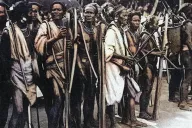
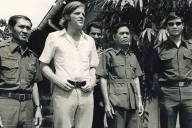
A Saigon correspondent’s digitized archive from the 1960s, with photographs of Montagnard soldiers. - Smithsonian National Anthropological Archives, Photo Lot 73-34
Gerald Hickey’s photographs of Jarai, Jeh and Stieng people in the 1960s, including a Jarai Master of Fire. By appointment. - Edwin Moïse, Bibliography: The Montagnards, Clemson University
The best single finding aid we know: books, articles, RAND numbers and links to documents held at Texas Tech.
French archives and scholarship
- Archives nationales d’outre-mer (ANOM), Aix-en-Provence
The French colonial archives. The fonds of the Gouvernement général de l’Indochine and the Haut-commissariat (1945–54) cover the Pays Montagnard du Sud and the Crown Domain. Search with the online tool IREL; no appointment needed to visit. - Institut de recherche France-Asie (IRFA): archives of the Missions Étrangères de Paris
The records of the Kon Tum mission are series 17C-KT, with the early Bahnar, Sedang and Rhade dictionaries and the mission’s own history; see the inventory of series 17C. Jacques Dournes’s personal papers are also here. - École française d’Extrême-Orient (EFEO)
Publisher of Paul Guilleminet’s Coutumier de la tribu Bahnar, des Sedang et des Jarai de la province de Kontum (1952), the customary law of Kon Tum’s courts, 1908–39, still in print. - Persée: the Bulletin de l’École française d’Extrême-Orient
Decades of French scholarship on the Rhade, Jarai, Bahnar and Mnong, free to read: agrarian rites, epics, languages, the Ndut Lieng Krak lithophone. The link is Jacques Dournes’s author page; Georges Condominas’s is here. - Ordinance No. 16/QT/DT, Dalat, May 21, 1951
The French text of the statute of the Pays Montagnards du Sud, held by the Montagnard Human Rights Organization. See A country of our own. - Université du Québec à Montréal, Dictionnaire historique de la guerre d’Indochine
Entry on the Pays Montagnards du Sud, 1946–55. - Gallica, Bibliothèque nationale de France
Digitized French books and newspapers, including Maître’s Les Jungles Moï and Dournes’s Pötao.
Museums, sound and film
- CREM-CNRS sound archive, Paris
Georges Condominas’s 1953 recordings of the Mnong Gar lithophone, free to listen, and the LP Musique Mnong Gar du Vietnam (1974). - Musée du quai Branly – Jacques Chirac, Paris
Holds about five hundred Mnong Gar objects collected by Condominas at Sar Luk in 1948–50, shown in the 2006 exhibition Nous avons mangé la forêt. - Smithsonian National Museum of Natural History, anthropology collections
Search by people: “Rhade,” “Jarai,” “Montagnard.” - North Carolina Museum of History, Collecting Carolina: Montagnards, Vietnam’s Central Highlanders
Textiles, tools, weapons and instruments collected by a Vietnam veteran. - Greensboro History Museum, This Is My Home Now
A thirty-minute documentary following four Montagnard young people in Greensboro, made with the Center for Asian American Media. Trailer. - The Big Picture: Operation Montagnard
US Army film on Special Forces training highland troops (National Archives 111-TV-607), free to watch. - UNESCO, Space of Gong Culture
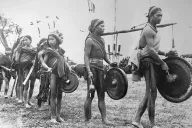
Description, photographs and video of highland gong music. See Gongs and epics.
See also: Films and recordings, Where to find photographs.
North Carolina and the diaspora
- NCpedia, “Montagnards”
From the Encyclopedia of North Carolina: the 1986 and 1992 resettlements. - ANCHOR, State Library of North Carolina, “The Montagnards”
A history for schools, with a map and primary-source guidance. - Montagnard Human Rights Organization
Chronology, historical documents, advocacy reports and music recordings. - Save the Montagnard People
Founded in 1986 by Special Forces veterans to help resettle and support Montagnard families. - Montagnard Association of North Carolina
Community association founded in 1988. - DEGAR Foundation
News and statements. - Unrepresented Nations and Peoples Organization
The Degar-Montagnards member page, 2003–2016.
A note on the Montagnard Foundation’s old website
The domain once used by the Montagnard Foundation no longer belongs to it and now carries unrelated material. Do not rely on old links to it. Where we cite the Foundation’s historical summaries, we mean copies in our own archive or in the UNPO and European Parliament records linked in Reports and documents.
Compiled September 2026. If you have family papers, photographs, recordings or unit records and would like them kept safely, please read how to document and then contact us.