









Where to see and hear the Dega: American wartime films now in the public domain, later documentaries, community videos made in our own languages, and the field recordings of our music held in Paris, some of them free to listen to online. We list what we have been able to find and check.

Films
| Title | Made | What it is | Where |
|---|---|---|---|
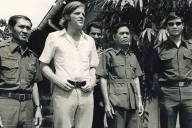
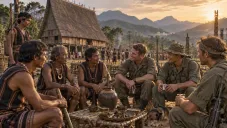
| The Big Picture: Operation Montagnard | US Army, Vietnam War era | A 28-minute Army television film on Special Forces training highlanders to fight the Viet Cong. Wartime propaganda; it calls us a “primitive tribe.” | Internet Archive (National Archives 111-TV-607), public domain |
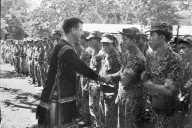
| Montagnard Congress, Pleiku, South Vietnam | US Army, June 25, 1967 | Six minutes of silent color footage of the Pleiku conference and an artillery demonstration, with General Vĩnh Lộc, Premier Nguyễn Cao Kỳ and General William Peers. | Internet Archive, public domain |
| Special Ops: Mike Force Vietnam | 2001 | A 44-minute television documentary on the Mobile Strike Forces (see Mike Force and SOG). | Internet Archive; rights unclear |
| All the Way | Australia, 1998; extended 2013 | Paul Ham’s documentary on highlanders who fought alongside Australian forces. | Broadcast; not online that we know of |
| Rhade COVID-19 videos | City of Greensboro, 2020 | Public-health messages recorded in Rhade for the North Carolina community — “Stay at home,” “What to do if you get sick,” housing rights. | Internet Archive |
In Apocalypse Now (1979), Kurtz commands American, Montagnard and Khmer troops. It is fiction, filmed in the Philippines, and the people in the ritual scenes were Ifugao, not Dega.
Published recordings
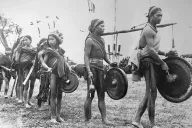
- Musique Mnong Gar du Vietnam, recorded by Georges Condominas. OCORA OCR-80, 1974. Gongs, drums, mouth organs, zithers and the lithophone; Mnong Gar, Mnong Bu Nor and Maa. Catalog entry.
- Chants et danses des montagnards du Viet-Nam, collected by Maurice Bitter. Riviera LP 421.075, 1967. Fifteen tracks, including a Rhade xylophone, a Sedang orchestra, Bahnar gongs and a Jarai ensemble. Catalog entry.
- Viet Nam: Musiques des Montagnards, edited by Hugo Zemp. Le Chant du Monde, CNRS–Musée de l’Homme collection, CNR 2741085/86, 1997. Two CDs, 53 tracks recorded between 1958 and 1997 by Jacques Dournes, Georges Condominas and others, with a 124-page booklet; Bahnar, Jarai, Rhade, Sre, Maa and others. Catalog entry.
- Gongs of the Bahnar: A Buffalo Sacrifice Ceremony, recorded by Vincenzo Della Ratta in the village of Plei Hven in 2019. Akuphone, 2024. Bandcamp.
Field recordings in the Paris sound archive
The CREM-CNRS sound archive, formerly the Musée de l’Homme’s, whose recordings are now kept at the Bibliothèque nationale de France, holds unpublished field collections from the highlands. Some items can be played online; the catalog entries are free to read.
| Collection | Recorded by | Year |
|---|---|---|
| Jeu du lithophone mnong gar — the prehistoric stone xylophone of Ndut Lieng Krak | Georges Condominas | 1953 |
| Viet Nam center — Mnong and neighbors, Lac, Maa, Sre | Georges Condominas | 1958 |
| Mnong Gar narrative | Georges Condominas | 1967 |
| Musiques des Edê sur les Hauts plateaux du Centre — Rhade music | Anne de Hauteclocque | 1961 |
| Les diverses expressions orales des Jaraï — narratives, invocations, healing texts, the ddong zither | Jacques Dournes | 1966 |
| Musiques des montagnards du Centre | Geneviève de Chambure | 1960 |
| Musiques des Stiêng et Maa | Jean-Paul Lefèvre | 1962 |
More can be found by searching the archive for Mnong, Bahnar or Montagnards. On the instruments and the epics themselves, see Gongs and epics; on other archives, Archives and collections.
The gongs at UNESCO
UNESCO lists the “Space of Gong Culture” of the Central Highlands on its Representative List of intangible heritage (proclaimed 2005, inscribed 2008). Its own page names the threats: the disappearance of old craftsmen, and gongs sold for recycling. UNESCO.
Help us add to this
We know there are films and recordings we have not found: community videos from North Carolina, church recordings, radio programs in Rhade and Jarai, family cassettes. If you have one, or know where one is kept, tell us. Recording your own elders is the most valuable thing of all; see How to record an elder.
See also: Instruments beyond the gongs.
Compiled September 2026. We list only items we have seen cataloged; an unauthorized copy of the 1997 CD circulates online and we do not link it.