


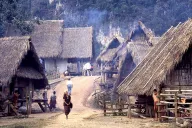

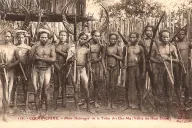
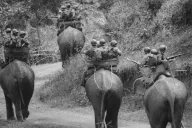

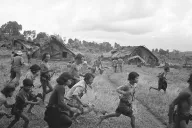


























Shortly before midnight on December 5, 1967, some six hundred Viet Cong soldiers carrying flamethrowers came into the Montagnard settlement of Dak Son in Phuoc Long province. By morning more than 250 people were dead, most of them burned in their houses or suffocated in the shelters they had dug to protect their children. TIME magazine called it the worst atrocity yet committed in the war.
Who lived there
Dak Son was a highland settlement of about two thousand people. Some eight hundred of them were refugees who had walked out of Viet Cong-controlled country fourteen months earlier and asked for the protection of the Saigon government. The village had a defense force of about 140 men, which had beaten off four attacks earlier in 1967.
That is the context everything else depends on. Dak Son was not a random village on a front line. It was a place where highlanders who had left the communist side had gone to live, and the reports at the time were explicit that the attack was meant to be seen by the roughly twenty thousand Montagnards still under Viet Cong control who might be thinking of doing the same.
What happened
Two Viet Cong battalions — about six hundred men, with some sixty flamethrowers — surrounded the village late on December 5. The defenders were called on to surrender. The attack came at midnight. Houses were set alight with the families inside them. People who had taken shelter in the family foxholes dug under and beside their homes were burned or suffocated where they lay.
The counts published in the following week were 252 dead, around a hundred people taken away, and some five hundred missing — dead or fled into the forest.
How it has been told
At the time the massacre was reported in the American press, most prominently by TIME on December 15, 1967, and it has been treated in later histories of the war. Hanoi has always disputed that account, attributing the deaths to American incendiary bombing. We record that denial because a library meant to be used as evidence should say what the other side says. We do not find it credible, and neither did anyone who reported from the scene.
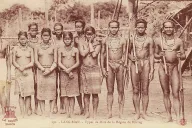
What is missing is the one account that matters most: the names. We have found no published list of the dead of Dak Son, no record of what happened to the hundred taken away, and no survivors’ testimony in any language of ours. Most published sources describe the villagers only as “Montagnards”; some later ones identify them as Stieng, which fits the location, but we have not been able to confirm it.
Why this page is here
Much of this library is about what the Vietnamese state has done to the Dega since 1975. Dak Son is a reminder that it did not begin in 1975, and that the Dega were killed by both sides of a war neither side had asked us about. We keep both records because they are both true.
Further reading
- TIME, “The War: The Massacre of Dak Son,” December 15, 1967 — the contemporary report: numbers, flamethrowers, the refugees
- Đắk Sơn massacre — summary with references to Ronald Spector, After Tet (1993), and later scholarship
- 11th Armored Cavalry veterans, “Dak Son” — American unit account of the aftermath
- Ronald H. Spector, After Tet: The Bloodiest Year in Vietnam (Free Press, 1993)
Compiled September 2026. If your family came from Dak Son, or you know of a list of the dead, please contact us safely. The names are the part of this record that is still missing.