




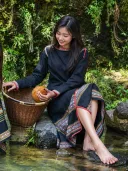

In the written record of the war, highland women appear mostly in the background: as the families in the camps, as the dead in the villages. When the record lets them come forward, they are nurses and midwives in training, and in one case a woman speaking for herself. This page gathers what we have found, and says plainly how much is missing.

Ami Yoh, 1966
In 1966 the American writer Susan Sheehan interviewed a Rhade woman in Buôn Ma Thuột, through a Rhade-English interpreter. “Ami Yoh is a montagnard. She belongs to the Rhade tribe.” She was born H’Kloin in 1934 at Buon Jak Jin, learned to read Rhade after her marriage, and was the wife of Ama Yoh, a pastor in Darlac villages from 1950 to 1962. They moved to the town because “Christians were a particular target of the Viet Cong.”
She was not taken in by either side. “At first, the Viet Cong seemed better than the government,” she said. “It wasn’t surprising that many Rhade were won over by them. I didn’t believe their sweet talk simply because they were Vietnamese, just as the government people were …” Her son Y’Yoh had left school and, she knew, was “a member of Fulro and that he is off in the jungles with Y’Bham.” Sheehan wrote that Ami Yoh, “who is very sympathetic to Fulro, believes the organization could be a useful ally of the United States if the Americans made the Vietnamese redress some of the montagnard grievances.” See FULRO.
Nurses and midwives
At Kon Tum, the American doctor Patricia Smith wrote in her letters of 1959–61 that she hoped “to develop a full scale program for Montagnard girls,” and took girls from the Sisters’ school with her on village calls. Her Minh Quy hospital came to depend on the highland staff she trained; a US Army magazine, Typhoon, counted “60 Montagnard nurses and aides” on its staff in 1970.
At Buôn Ma Thuột the Protestant mission ran a leprosarium and trained Rhade nurses to run it. A missionary nurse “taught classes in midwifery for the Raday girls,” first letting them assist at births and then only supervising. After the missionaries there were abducted in 1962, the leprosarium “has been operated by Raday tribal nurses,” James Hefley wrote in 1969. See Missions and doctors.
In the camps
When highland men joined the Civilian Irregular Defense Group, their families usually came with them. The Army’s official history records camps that “often housed more than 1,000 civilian irregulars and their dependents.” In the villages it was women and children who were sent to the family shelters when an attack came. See The American years and Highland refugees of the war years.
The dead
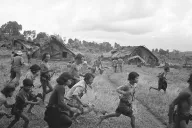
- Night attacks on villages. Gerald Hickey describes Communist attackers using grenades “(and in one case flamethrowers) against the elderly, women, and children huddled in bunkers”; the worst, he writes, was at Dak Son on December 5, 1967. See Dak Son, 1967.
- Buôn Ma Thuột. Hickey also records a grenade thrown into Rhade villagers forced to march on the town: “Most of the Rhade were elderly, women and children.”
- Tet, 1968. In a missionary house at Buôn Ma Thuột, four Rhade young people were found dead; “the two girls were sisters and daughters of devout Christian parents.” See Tet 1968 in the highlands.
- After the war. The American investigator Garnett Bell was told by highland informants that remains dug up at the mission compound after 1975 included those of “several young female Montagnard nurses” who had been shot. It is second-hand, and we record it as such.
On the other side
The Communists also sought highland women. The journalist Denis Warner wrote in 1964 that cadres living in the villages adopted highland dress, learned the crossbow and “married montagnard girls and had families,” to root themselves among the people. The women who served with the Communist forces are written about mainly in Vietnamese state publications, which we do not use as sources; their story, told by themselves, is still to be recorded.
After 1975
Few women reached safety. Of the FULRO survivors found in Cambodia in 1992 and resettled in North Carolina, Raleigh Bailey counted “269 males, 24 females, and 80 children.” In a matrilineal people, the imbalance mattered: “The shortage of women in the Montagnard community is an ongoing problem,” Bailey wrote. “It poses extraordinary challenges for the men because traditionally women are the family leaders and decision makers in many ways.” See Dega women and North Carolina.
What is missing
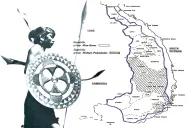
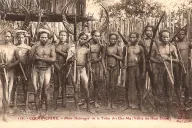
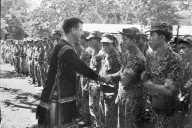
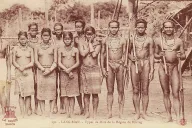
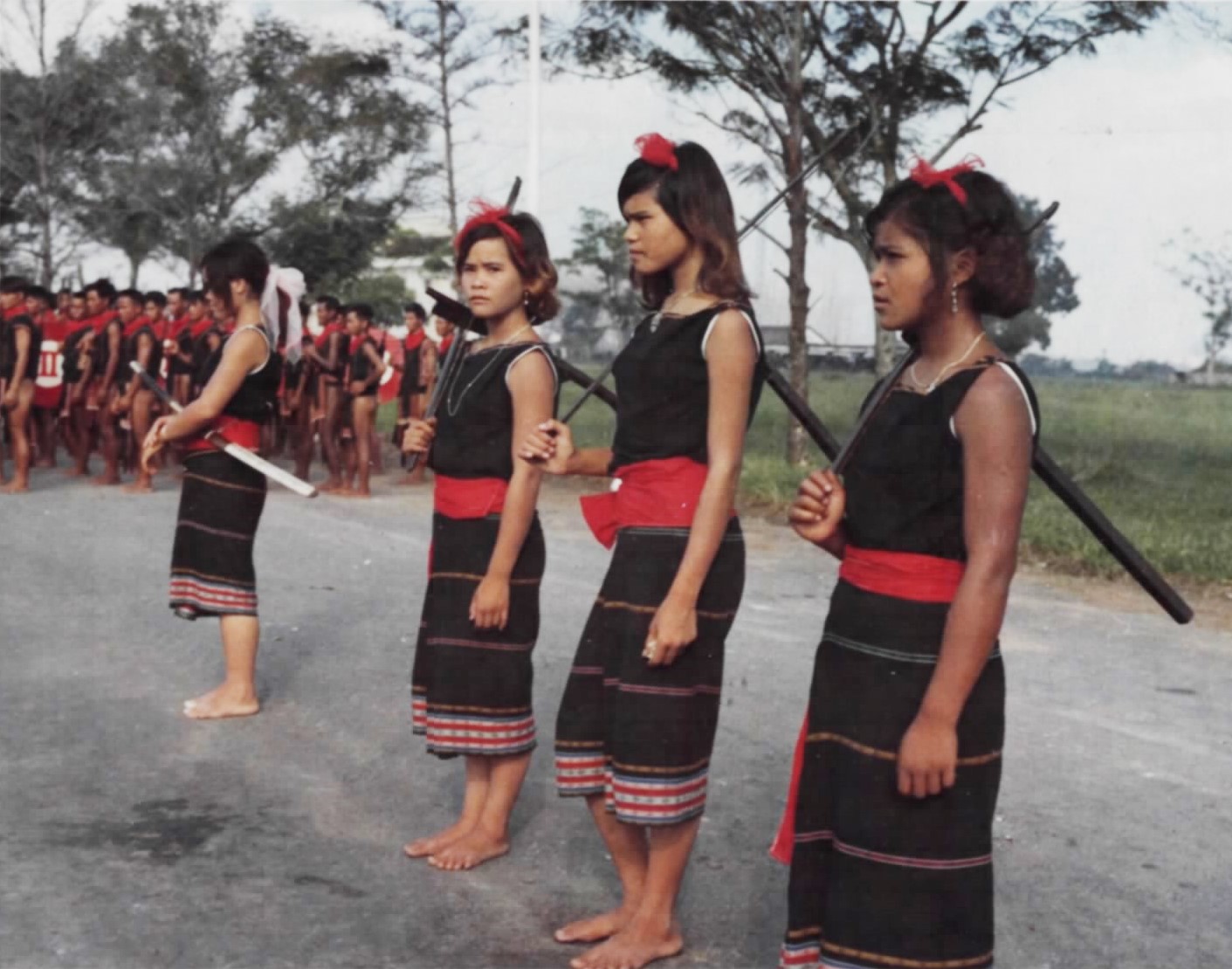
We have found no highland woman named as a nurse at Minh Quy or at the leprosarium, no woman named among FULRO’s officers, and no account of the militiawomen in the photograph above beyond its caption. These women existed and some are still alive. If you or your mother nursed, fought, carried or buried during the war, we would like to record it in your own words. See How to record an elder.
Sources
- Susan Sheehan, Ten Vietnamese (Knopf, 1967), chapter “A Montagnard”
- Elizabeth Reid, I Belong Where I’m Needed (1961) — the letters of Dr. Patricia Smith
- James C. Hefley, By Life or By Death (Zondervan, 1969)
- Gerald C. Hickey, Window on a War: An Anthropologist in the Vietnam Conflict (Texas Tech University Press, 2002)
- Francis J. Kelly, U.S. Army Special Forces 1961–1971 (US Army Center of Military History, 1973)
- Denis Warner, The Last Confucian (1964)
- Garnett Bell with George J. Veith, Leave No Man Behind (2004)
- Raleigh Bailey, Montagnards: Their History and Culture (Center for Applied Linguistics, 2002)
Compiled September 2026.