




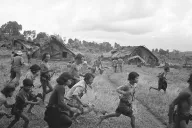









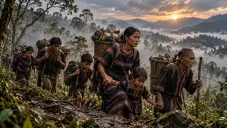
















Between the early 1960s and 1975 most of our people were driven from their villages at least once. The anthropologist Gerald Hickey estimated that at least 200,000 highlanders were killed in the war and that more than 85 percent were displaced as refugees. This page gathers what the record shows about how that happened, and what it leaves out.

The scale
Human Rights Watch, summarizing Hickey’s Free in the Forest, wrote in 2002 that “at least 200,000 highlanders were killed during the Second Indochina War, and more than 85 percent of the population forced from their villages and displaced as refugees.” Higher figures circulate: in testimony to the US Senate in 1998, a highland leader spoke of more than a million dead. Hickey’s is the scholarly estimate and the one we use.
How it happened
- Early 1960s — Villages are moved into strategic hamlets and regrouped along the roads (see Moved by force). Along Route 9 in Quảng Trị, the government resettles many Bru in a three-mile strip each side of the road.
- Mid-1960s — A US Senate report of 1966 records that highlanders “fled from Vietcong-dominated areas in the mountains of central Vietnam.”
- January 1966 — The same report’s map counts about 124,000 refugees in the seven highland provinces — 44,609 in Pleiku alone — out of 771,054 nationally. The count is of all refugees in those provinces, not of highlanders only.
- 1964–70 — The Army’s official history of the Special Forces records support for 479,508 refugees across their area of operations. After the siege of Bu Prang in late 1969, refugee villages are set up near Bu Prang and Đức Lập, in Mnong and Rhade country.
- 1972 — In the Easter Offensive, Kontum is besieged. By April 19 its rice reserves have fallen from 700 tons to 19; refugees stranded in the city are evacuated in stages to Pleiku.
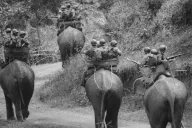
- March 1975 — Pleiku and Kontum are abandoned. Soldiers and civilians flee together down Route 7B toward the coast, in what became known as the “convoy of tears.” Estimates of the civilians on the road and of those killed vary widely, and none says how many were highlanders.
Who the refugees were
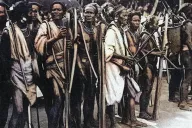
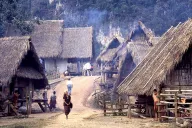
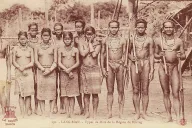
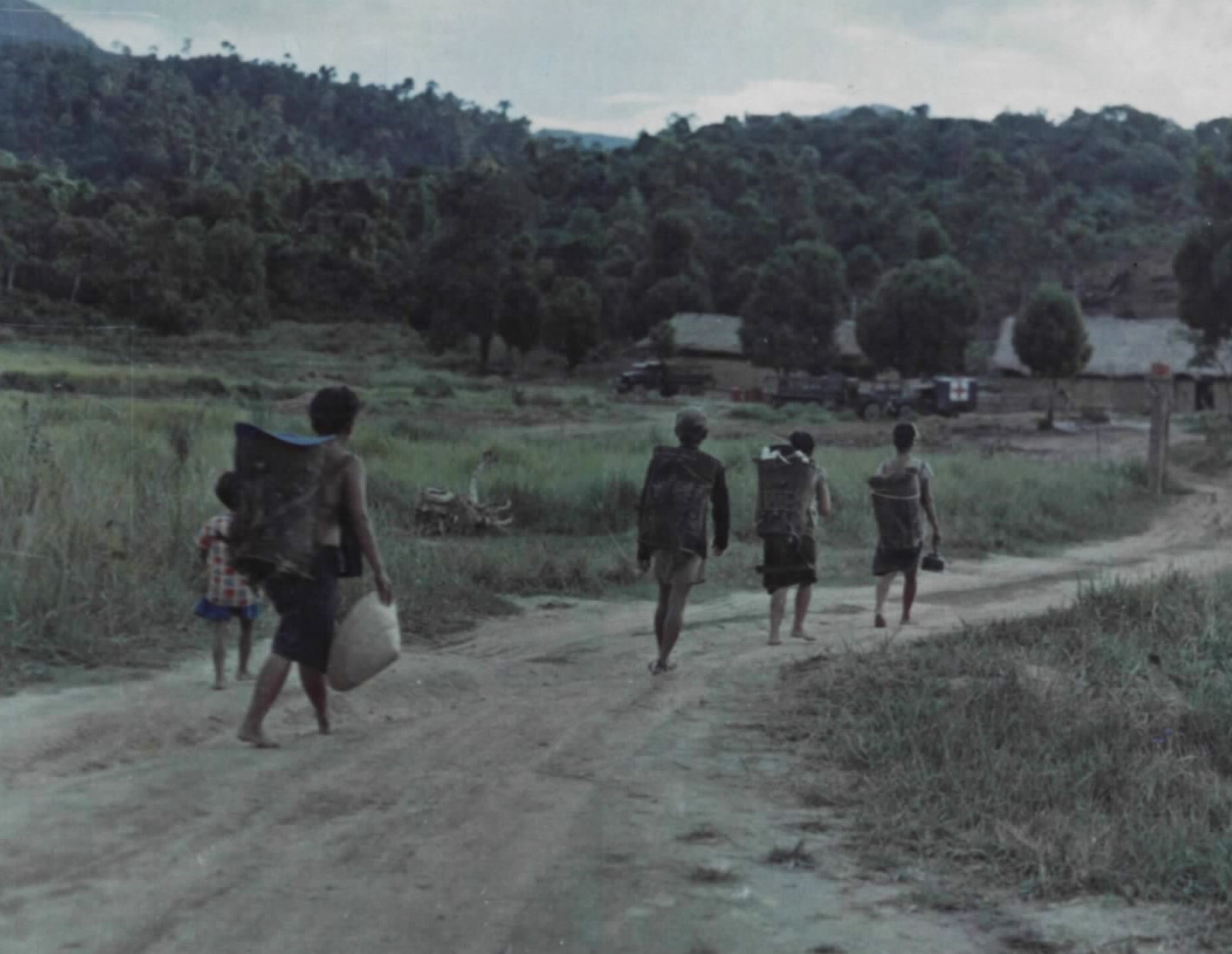
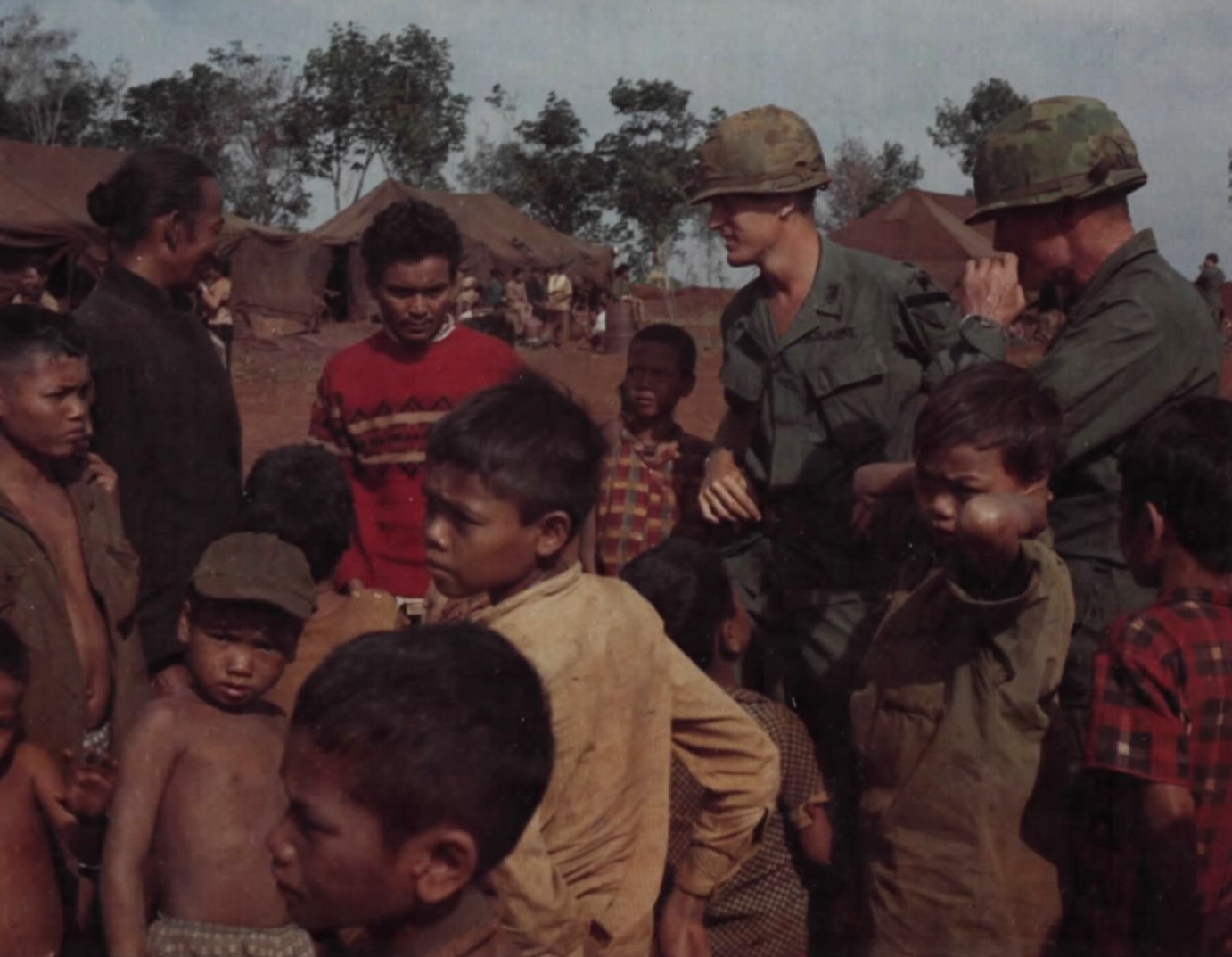
The 1966 Senate report described the refugees of South Vietnam as “mostly children, women, older persons,” with few men between sixteen and forty. The highland villages were the same: the photograph above, from 1964, was captioned by the US Army as a village of old people and children. Irregulars recruited by the Special Forces were often moved to the camps “along with their families,” so that women and children lived in or beside the camps.

After the war
When the war ended almost none of our people could leave: a report for the Center for Applied Linguistics noted that “almost none of them joined the exodus” from South Vietnam in 1975. Those who kept fighting went to the forest (see Re-education and the forest).
What is missing
We have not found an independent count of highland refugees by people or by year, a description of any highland refugee camp by name, or a reliable figure for the highlanders on Route 7B in 1975. The relocations of 1971–72 in Pleiku and Kontum are likely covered in Hickey’s later books and in Louis Wiesner’s Victims and Survivors (1988), which we have not yet been able to consult. If your family was moved during the war, we would like to record where and when.
Sources
- Human Rights Watch, Repression of Montagnards (2002), chapter III, citing Gerald C. Hickey, Free in the Forest (Yale, 1982)
- US Senate, Subcommittee on Refugees, Refugee Problems in South Vietnam (1966)
- Francis J. Kelly, U.S. Army Special Forces 1961–1971 (US Army Center of Military History, 1973)
- Department of the Army, Minority Groups in the Republic of Vietnam, Pamphlet 550-105 (1966) — the Bru chapter
- Project CHECO, Kontum: Battle for the Central Highlands (1972); Ngô Quang Trưởng, The Easter Offensive of 1972 (US Army, 1980)
- Cao Văn Viên, The Final Collapse (US Army, 1983)
- US Senate hearing, The Plight of the Montagnards (1998)
- Raleigh Bailey, Montagnards: Their History and Culture (2002)
Compiled September 2026.