






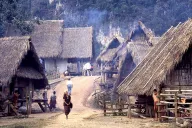




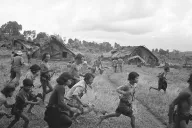



































During the American war more of our people were moved than were killed, and more than two hundred thousand were killed. Villages were emptied into land development centers, strategic hamlets, refugee camps and resettlement sites, sometimes to protect them and sometimes to clear the land for someone else. By the end of the war, according to Gerald Hickey, more than 85 percent of highlanders had been driven from their villages.
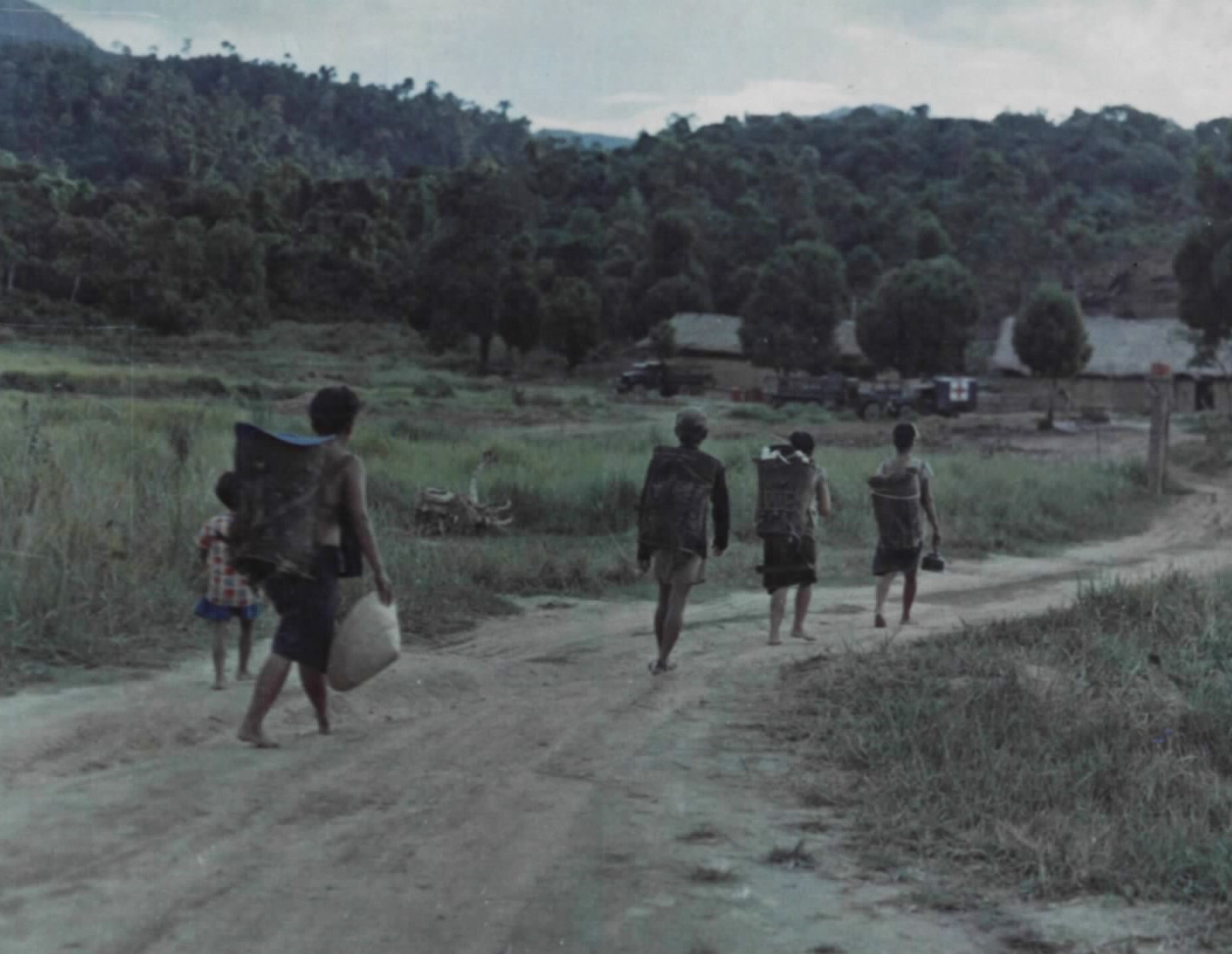

Diệm’s centers, 1957–62
From the mid-1950s the Saigon government settled lowland Vietnamese in “land development centers” in the highlands; by the end of 1962, Human Rights Watch records, more than 100,000 people had been placed in 117 of them. Highlanders were moved too. Stan Tan’s archival research found that by June 1959 some 80,000 highlanders — perhaps a sixth of the highland population — had been “sedentarized” in 108 centers, on plots smaller than the government’s own standard. See Pushed off, 1954–57.
Strategic hamlets, 1962–64
The Strategic Hamlet program regrouped rural people behind fences and ditches to cut them off from the Viet Cong. Stan Tan cites archival reports of about 153,000 highlanders in 596 strategic hamlets, and another 214,000 displaced highlanders in 483 refugee resettlement centers. Villages were moved off their customary land and regrouped along the main roads.
The CIA and US Special Forces at first tried the opposite: arming villages where they stood. The Buôn Enao program, begun in a Rhade village in November 1961, covered about 200 villages by October 1962. It was soon handed over to Saigon’s control (see The American years).
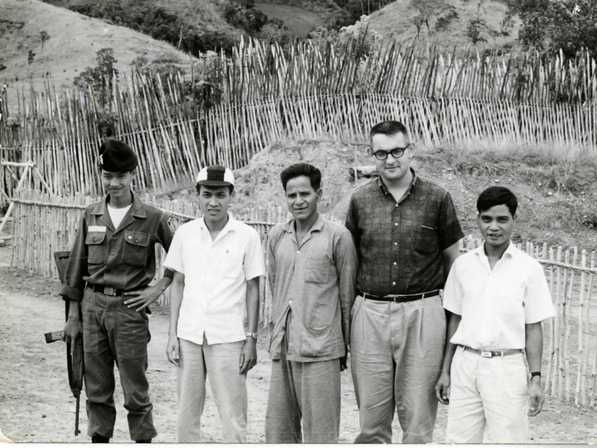

Edap Enang, 1967–69
On April 2, 1967, the Saigon government began the Edap Enang resettlement program in Pleiku province, to move about 8,000 highland villagers, most of them Jarai, “from insecure areas, south of Thanh An District Headquarters, to the secure resettlement area along Route 19 West.” The US 4th Infantry Division helped: in a few weeks its 2nd Brigade moved 18 villages — 2,757 people — with more than ninety helicopter sorties. American civil affairs officers who worked there in 1968–69 later described children scooping pig swill from the troughs to eat, local officials who stole building materials and made the refugees buy them back, and their own conclusion that neither Washington nor Saigon understood the Jarai. The Viet Cong, for their part, kept up threats and rice levies against the people inside. We have found no count of the deaths at Edap Enang.
The 1970–71 relocations
In 1970 Lieutenant General Ngô Du, commanding the highland military region, ordered the relocation of contested highland hamlets. A 1971 news report put the number moved at 45,000. The largest site, Buôn Kli B in Darlac, held nearly 7,000 people. The moves were made at harvest time, so families lost the year’s rice; livestock was left behind, and soldiers were reported to have taken gongs and animals. Families were given about a fifth of a hectare where they needed two. That September Gerald Hickey published a RAND paper reviewing the government’s treatment of highlanders since 1955, with recommendations for the future.
The toll
Hickey estimated that at least 200,000 highlanders were killed in the war and that more than 85 percent were forced from their villages. In 1972 the fighting and B-52 bombing around Kon Tum drove whole peoples from their territories. See Battles on our land and How we died.
See also: Highland refugees of the war years.
Sources
- Human Rights Watch, Repression of Montagnards (2002)
- Stan B-H Tan, “Swiddens, Resettlements, Sedentarizations, and Villages: State Formation among the Central Highlanders of Vietnam under the First Republic, 1955–1961,” Journal of Vietnamese Studies 1 (2006)
- HQ 4th Infantry Division, Operational Report – Lessons Learned, quarter ending April 30, 1967
- Troy J. Sacquety, “We’re not in Kansas anymore: The 41st Civil Affairs Company in Vietnam, Part II,” Veritas 10:1 (2014)
- CIA, field report on Pleiku, January 1968
- Dispatch News Service, “45,000 Montagnards: S. Viets order forced relocation,” The Michigan Daily, March 27, 1971
- Gerald C. Hickey, Some Recommendations Affecting the Prospective Role of Vietnamese Highlanders in Economic Development, RAND P-4708 (1971); Free in the Forest (Yale, 1982)
- HistoryNet, on Buôn Enao
Compiled September 2026.