











































The gongs are the voice of the highlands, but they are not the only one. Our peoples made music from bamboo, gourds, stone and a single string: xylophones, mouth organs, tube zithers, one-string fiddles, jaw harps and panpipes. Most were recorded by outsiders in the 1950s and 1960s, and their names survive in those recordings.
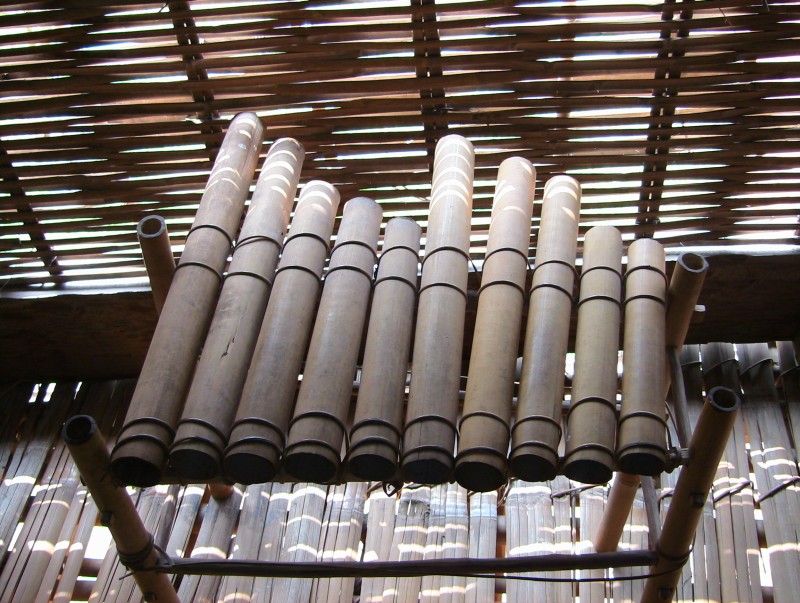

The instruments and their names
The names below are as they appear in the catalog of the CNRS–Musée de l’Homme sound archive in Paris, and on the published recordings listed on Films and recordings. Spellings are the recordists’.
| Instrument | Names in our languages | Recorded |
|---|---|---|
| Bamboo xylophone | trüng (Jarai); kok (Laac) | Jarai, Gia Lai, 1963 (Dournes); Laac, 1960 |
| Mouth organ, gourd and bamboo pipes | ding nam (Rhade); rökel (Sre); kombuot (Laac) | Rhade, 1961 (Hauteclocque); Sre, 1960; Laac, 1959 |
| One-string fiddle | köni (Jarai) | Jarai, Gia Lai, 1963 (Dournes) |
| Bamboo tube zither | gông (Jarai); bro (Rhade) | Jarai, Buôn Kênh, 1960; Rhade, 1961 |
| Two-string zither on a gourd | ddong (Jarai) | Jarai, Gia Lai, 1963, and in Dournes’s 1966 collection |
| Zither | dding dhüt (Maa) | Maa, Lâm Đồng, 1960 |
| Jaw harp | goc (Rhade); gôc (Laac) | Rhade, 1961; Laac, 1960 |
| Panpipe, bundle | dding dek (Jarai) | Jarai, Gia Lai, 1963 (Dournes) |
| Flutes | ding tut, buôt (Rhade) | Rhade, 1961 |
| Stone lithophone | gôec (Mnong Gar) | Mnong Gar, 1953 (Condominas) |
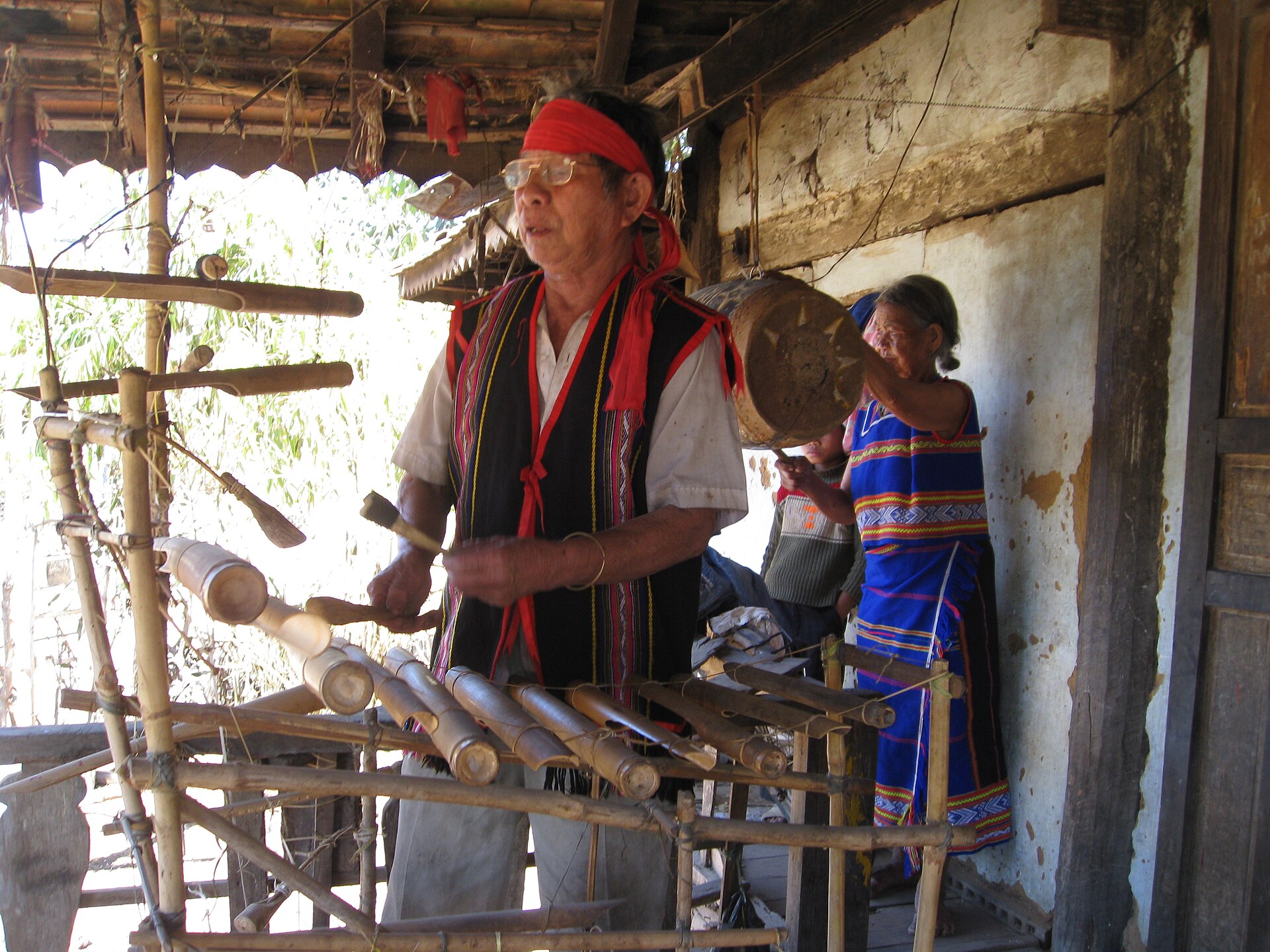

The xylophone and the clapping tubes
The t’rưng — the Jarai trüng — is a set of bamboo tubes of graded lengths, hung or laid on a frame and struck with sticks. The klông pút of the Bahnar and neighboring peoples is played without touching the bamboo at all: the player claps cupped hands in front of the open tube ends and the air sounds the note. The 1966 US Army handbook describes a Rengao instrument, the ding but, “a series of hollow tubes,” which girls were forbidden to beat during the planting season for fear of displeasing Yang Xo’ri, the goddess of rice and the hearth.
The stone that sings
At the Mnong Gar village of Ndut Lieng Krak the ethnologist Georges Condominas found prehistoric cut stones used as a lithophone, the gôec, and recorded it being played in 1953. The story is on Gongs and epics.
Where to hear them
Several of the recordings in the table are on Viet Nam: Musiques des Montagnards (Le Chant du Monde, 1997), and the catalog entries of the Paris archive are free to read; some items can be played online. Links to both are on Films and recordings.
Help us
The catalog gives names and places, not how the instruments were made or when each was played. If you or your parents make or play any of these, we would like to record how, and in whose words. See How to record an elder.
See also: Before history.
Sources
- CREM-CNRS sound archive: Viet Nam: musiques des Montagnards (1997); Musiques des Edê, Hauteclocque, 1961; Les diverses expressions orales des Jaraï, Dournes, 1966; Jeu du lithophone mnong gar, Condominas, 1953
- Department of the Army, Minority Groups in the Republic of Vietnam, Pamphlet 550-105 (1966)
Compiled September 2026. The description of how the t’rưng and klông pút are played is our own; the names and recording details are the archive’s.