
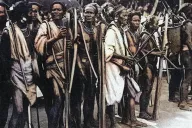


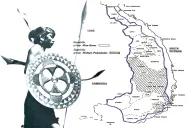


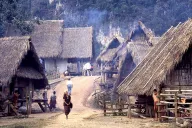

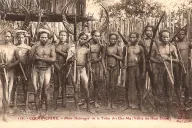









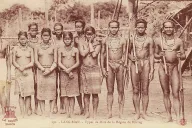


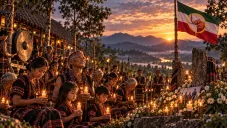

























On June 3, 1888, at the village of Kon Gung north of Kon Tum, chiefs of the Bahnar, the Rengao and the Sedang proclaimed a Frenchman their king. The Kingdom of the Sedang lasted about two years, issued stamps and orders of chivalry, and is usually told as a comic episode. It is worth telling from our side, because it was the first time highland chiefs' consent was sought by a European, and the first time it was set aside.

The adventurer
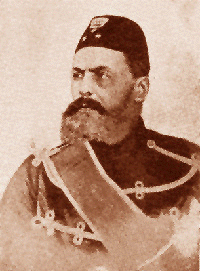
Marie-Charles David de Mayréna was born in Toulon on January 31, 1842. By the 1880s he had served in the French army, failed in business, and left France under a cloud; in 1883 he fled to the Dutch East Indies to escape charges of embezzlement and was expelled from there the following year. In 1888 he came up into the highlands north of Kon Tum with a small party, ostensibly on a mission of exploration, and with the help of the Catholic missionaries who had been working among the Bahnar since 1851 (see The Kon Tum mission).

June 3, 1888
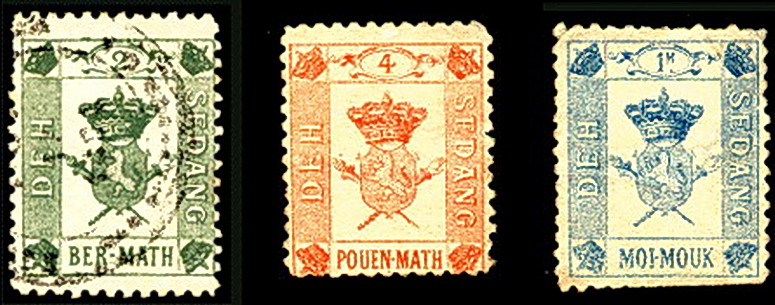
At Kon Gung — today Dak Mar, in Kon Tum — chiefs of the Bahnar, Rengao and Sedang met and elected Mayréna as Marie I, King of the Sedang. Kon Gung was renamed Pelei Agna, the Great City. A constitution followed and was published in French newspapers: an absolute hereditary monarchy, Catholicism as the state religion, and a prohibition of human sacrifice. The kingdom had a flag — blue, with a white cross and a red star — orders of chivalry manufactured in Hong Kong, and postage stamps, which are today its best-known relic.

What the chiefs understood themselves to be doing is not recorded in any of their own words. What is clear is that the Bahnar–Rengao confederation around the Kon Tum mission had reasons of its own to want a powerful ally against its neighbors, and that the Sedang had a long record of resisting outsiders. An election by chiefs was, in highland terms, a real political act.
How it ended
Mayréna’s aim was not to govern the highlands but to sell them. He offered his kingdom to France in exchange for trade monopolies; France declined. He tried Britain in Hong Kong in 1889 and was turned down again. A Belgian financier offered arms in return for mining rights; the French blocked the ports and seized the weapons at Singapore. Mayréna never returned to his kingdom. He died on the island of Tioman, off Malaya, on November 11, 1890 — of poison, a snakebite or a duel, depending on who tells it.
Meanwhile France, alarmed that a private adventurer had nearly handed the highlands to a rival power, moved to establish its own authority there. Within a few years the country around Kon Tum was administered by France, and annexed to it and to Annam without anyone asking the Sedang.
Why it matters to us
Every serious telling of the Kingdom of the Sedang is about Mayréna — his debts, his vanity, his stamps. Almost none is about the people who elected him. Yet the episode shows three things that recur through everything else in this library: that highland chiefs were political actors who made agreements; that outsiders sought those agreements when they were useful and discarded them when they were not; and that the great powers took the highlands as something to be settled among themselves. The anthropologist Gerald Hickey, who spent decades among the Bahnar and Sedang, wrote a whole book about the episode for that reason.
See also: The Sedang.
Further reading
- Gerald C. Hickey, Kingdom in the Morning Mist: Mayréna in the Highlands of Vietnam (University of Pennsylvania Press, 1988) — borrow from the Internet Archive
- J. P. Daughton, “Kings of the Mountains: Mayréna, Missionaries, and French Colonial Divisions in 1880s Indochina,” Itinerario 25:3–4 (2001) — the missionaries’ role, and the French view of the highlands as pays moï
- Marie-Charles David de Mayréna and Kingdom of Sedang — dates, the constitution and the end
- Historic Vietnam, “King of the Sedang” — Kon Gung, the flag and the stamps
- Gerald C. Hickey, Sons of the Mountains: Ethnohistory of the Vietnamese Central Highlands to 1954 (Yale, 1982)
Compiled September 2026. If Sedang, Bahnar or Rengao oral tradition in your family remembers Kon Gung or the man the French called Marie I, we would very much like to hear it.