


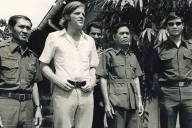







A Jarai from Cheo Reo who joined BAJARAKA as a schoolboy, served FULRO as its chief of staff, and spent the second half of his life in South Carolina making the case for our people at the United Nations and in the parliaments of Europe. For three decades Kok Ksor was the Dega most foreign governments had heard of, and the one Vietnam most often named.
In the highlands
Kok Ksor was born in the Jarai village of Bon Broai near Cheo Reo. Joe P. Dunn’s biographical study gives the year as 1944, and his obituary the date as February 26; Vietnamese officials have given 1945. As a secondary-school student in Ban Me Thuot he joined BAJARAKA in 1958. He joined FULRO in 1964, the year of its revolt. He served with American Special Forces during the war, and was awarded the Purple Heart. Dunn records that he was captured by North Vietnamese troops during Tet 1968 while defending his wife H’li’s village near Ban Me Thuot. In 1974 Y Bham Enuol made him FULRO’s chief of staff.
Exile
When the Khmer Rouge took Phnom Penh in April 1975, the FULRO leaders who stayed in the city were killed. Kok Ksor, according to Dunn, was already in the United States. His family was brought out to Thailand by World Vision before the city fell, and they were resettled in Charleston, South Carolina, with a Baptist church as sponsor. He studied at Trident Technical College, and in 1988 moved to Spartanburg, where he lived for the rest of his life.
The foundation
In 1990 he founded the Montagnard Foundation, Inc., registered as the Degar Foundation, which received US tax-exempt status in 1992. From Spartanburg it did what no Dega organization had done before: it took our case, in English and in the language of international law, to the places where states have to listen.
- 1993 — By Kok Ksor’s own account, given to UNPO, the foundation is first recognized at the UN Working Group on Indigenous Populations.
- 2000 — Speaks at a United Nations indigenous forum in New York, where he meets members of the Nonviolent Radical Party, who become long-standing allies.
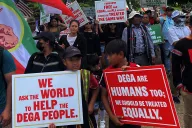
- 2001 — The mass protests in the highlands. See The 2001 protests.
- 2002 — Brings the Dega case to the UN Commission on Human Rights in Geneva and to the European Parliament, according to UNPO’s account, and speaks at the Radical Party congress in Tirana.
- November 14, 2003 — The Degar-Montagnards, represented by the foundation, are admitted to the Unrepresented Nations and Peoples Organization (UNPO). The membership ends on April 29, 2016.
- 2004 — After the Easter protests, Vietnam blames him. See Easter week 2004.
- November 19, 2009 — Addresses the human rights committee of the Italian Parliament.
- February 20, 2012 — Addresses the UN Committee on the Elimination of Racial Discrimination. See What the United Nations has said.
What Vietnam said about him
Vietnam accused Kok Ksor of organizing the 2001 and 2004 protests from abroad, of spreading false information, and of running the foundation as a continuation of FULRO’s armed separatism. UNPO reports that he was also accused of proclaiming an independent Dega state, which he denied, as he denied advocating violence. Human Rights Watch, in its 2002 report on the highlands, said it had found no evidence that the foundation advocated violence.
Whatever view one takes of his politics — and within our own community there were many views — the protests of 2001 and 2004 were made by thousands of people in the highlands, with their own grievances about land and faith. They were not made in Spartanburg.
Death
Kok Ksor died of liver cancer in Spartanburg on January 9, 2019, aged 74. His funeral was held at Covenant Baptist Church on January 13. He was survived by his wife, H’li, four sons and seven grandchildren.
Sources
- Joe P. Dunn, “Kok Ksor and the struggle for cultural survival, human rights, and political self-determination of the Montagnard/Degar people of Vietnam,” Athens Journal of History 10:1 (2024), 9–26
- J. F. Floyd Mortuary, obituary of Y’Kok Ksor, January 2019
- UNPO, “Montagnard Foundation president replies to the Vietnamese government” (2004) and “Degar-Montagnards”
- Human Rights Watch, Repression of Montagnards: Conflicts over Land and Religion in Vietnam’s Central Highlands, April 2002
- Global Committee for the Rule of Law “Marco Pannella,” “In memory of Kok Ksor”
- DEGAR Foundation, “About us”
Compiled September 2026. We have not found a freely licensed photograph of Kok Ksor. If his family or the foundation would allow one to be used here, please get in touch.