
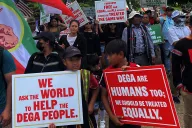


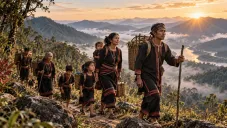
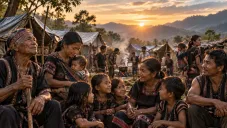



Thousands of highland families in Vietnam have no identity papers. Without them a child cannot go to school, a couple cannot register a marriage, a family cannot hold land, see a doctor on insurance or open a bank account. Our people were born in the highlands, as were their parents, and they have never lived anywhere else. Many of them are stateless because of their faith.
How it happens
In Vietnam almost everything passes through the household registration book and the citizen identity card. According to a 2023 report to the United Nations by BPSOS and highland church groups, highland Christians who belong to unregistered churches — and families of people who have fled abroad — are refused these papers, have them confiscated, or are told they will get them once they give up their faith. The papers are withheld at commune and district level, and there is no practical appeal.
The result is statelessness in everything but name: people who are Vietnamese by birth, and who have no other nationality, but cannot prove it to their own government.
How many
- The BPSOS submission counted more than 1,000 stateless households of highland Christians in Ia Grai district, Gia Lai alone, commune by commune.
- At Vietnam’s review by the UN Committee on the Elimination of Racial Discrimination (CERD) in November 2023, committee members cited reports of about 20,000 stateless households in the Central Highlands. Vietnam’s delegation replied that there were “less than 20,000 stateless persons in the Central Highlands,” and said that most stateless people in Vietnam were ethnic Vietnamese from Cambodia.
- The US Commission on International Religious Freedom said in 2024 that tens of thousands of Hmong Christians who have moved to the Central Highlands are denied identity documents and are “practically stateless.” The same practices are reported against highland Christians in the BPSOS submission.
The figures are not the same kind of count and should not be added together. What they agree on is the order of magnitude: thousands of families, not dozens.
Three people
The BPSOS report names individuals. We record three, as the report gives them:
- Y Muel Knul, born 1978, a Rhade Protestant from Ea Yông commune, Krông Pắc, Đắk Lắk. Never issued an identity card despite repeated requests; refused a marriage certificate. His daughter’s birth record lists her as having no father.
- H’Yo Bkrông, born 1999, a Rhade Protestant from Ea M’đroh commune, Cư M’gar, Đắk Lắk. Kept out of school for lack of papers.
- Ksor Y Chiec, born 2004, a Jarai Christian from Ia Piar commune, Phú Thiện, Gia Lai. Expelled in the middle of the sixth grade after his father fled to Thailand; the family’s papers were reportedly confiscated and his mother pressed to make the father return.
What it costs
| Without papers you cannot | What that means |
|---|---|
| Enroll a child in school | Children leave education early or never start; exams and certificates are out of reach. |
| Register a marriage or a birth | Children are recorded without a father, or not at all, and the problem passes to the next generation. |
| Hold land | Families farm land they cannot prove is theirs. See Pushed off our land. |
| Use public health insurance | Treatment is paid in cash or not received. |
| Work formally, borrow or bank | Families are confined to day labor and informal credit. |
| Travel | A person without papers cannot lawfully leave the country, and one who leaves anyway is treated as having fled. |
What Vietnam says
At the 2023 CERD review Vietnam’s delegation said it was issuing identity cards to stateless persons so they could use social services, that guidance on household registration for “vulnerable groups” had been developed, and that it had agreements with Laos on unregistered migrants across the border. We record these statements. We have not seen evidence that the families named above, or the Ia Grai households, have been given papers.
What Vietnam has undertaken
Vietnam is party to the International Covenant on Civil and Political Rights, which gives every child the right to be registered at birth and to acquire a nationality, and to the Convention on the Rights of the Child, which says the same. See What Vietnam signed and What the United Nations has said.
Sources
- BPSOS, Evangelical Church of Christ of the Central Highlands, Montagnards Stand for Justice and H’mong for Human Rights, “Statelessness of H’mong and Montagnards resulting from racial discrimination,” submission to CERD, September 2023
- OHCHR, meeting summary of CERD’s dialogue with Viet Nam, November 2023
- US Commission on International Religious Freedom, State-Controlled Religion and Religious Freedom in Vietnam, September 2024
- Christian Solidarity Worldwide, “General Briefing: Vietnam,” 2025
Compiled September 2026. If your family has been refused papers, you can document it safely: see Documenting an incident.