
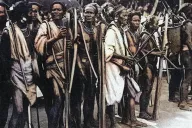

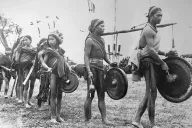

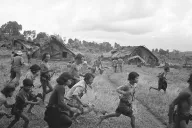
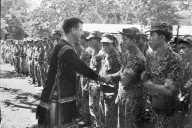
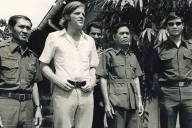
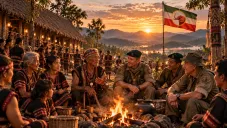
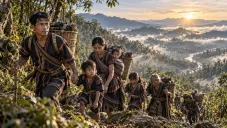

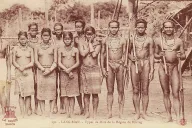





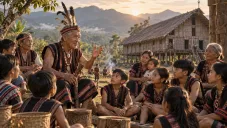

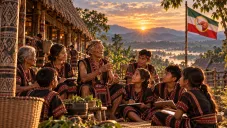
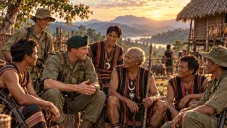

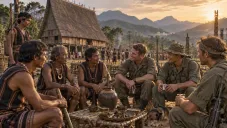



Between 1946 and 1954 France and the Viet Minh fought for the highlands, and both courted the highland peoples with the same offer: autonomy, in return for soldiers. Thousands of highlanders fought for the French, some for the Viet Minh; in 1954 the war ended on our roads, with the destruction of a French column at the Mang Yang pass, and several thousand highlanders went north.
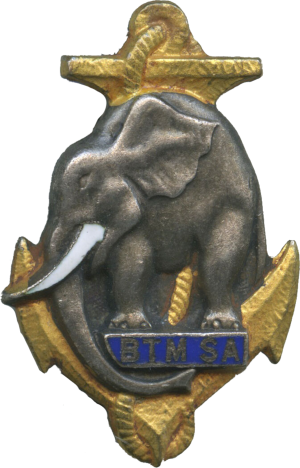

Soldiers before the war
France began raising highland soldiers in the 1930s, first as auxiliaries and then as regulars, to fight “dissidence and communist infiltration.” The Bataillon de tirailleurs montagnards du Sud-Annam, garrisoned at Ban Me Thuot, was made up largely of Rhade and Jarai; sources date it to 1931 or 1938. It was dissolved when Japan took over Indochina in March 1945.
A country for the soldiers to fight for
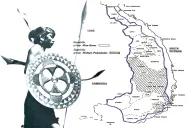
When the French came back in 1946 they created, by an ordinance of May 27, the Pays Montagnard du Sud-Indochinois: a highland territory under direct French rule, with its own special status (see A country of our own, 1946). Oscar Salemink has shown how closely the two things were tied: to answer Viet Minh nationalism, the French needed to give their highland battalions a homeland to fight for, and the territory and the army reinforced each other. A highland delegation, led by Ma Krong, president of the Darlac customary court, attended the Franco-Vietnamese conference at Dalat in August 1946.
In 1950 the territory became the Crown Domain of the Emperor Bảo Đại, still under French administration and with its special status guaranteed. Salemink notes the irony: in fighting to keep Vietnamese influence out of the highlands, French policy confirmed that they belonged to Vietnam. Ngô Đình Diệm abolished the Crown Domain in 1955 (see Pushed off, 1954–57).
Who fought
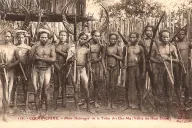
- The Division Montagnarde. From late 1950 the Bảo Đại government, with French backing, built a highland division — the 4th Light Division — from Rhade, Jarai, Bahnar, Mnong, Sedang, Maa and Hre recruits. It reached about 9,000 men; in at least three of its four battalions the rank and file were entirely highlanders, while most officers were French or Vietnamese.
- The mobile groups. Several French mobile groups in the highlands were largely highland, among them Groupement Mobile 41 and 42. GM 42, which Bernard Fall called the “Mountaineer” group, fought heavily in the last months of the war.
- Commandos. French special forces raised highland commando units of between ten and a thousand men; in 1954 Captain Vitasse’s Bahnar commando served as Groupement Mobile 100’s screen north of Route 19.
- The Viet Minh. Viet Minh cadres worked hard to live as highlanders lived, and recruited highland units in Kon Tum that the French found dangerous. The Bahnar Núp became a Viet Minh hero; the Rhade Y Ngông Niê Kdăm joined in 1945. In April 1954 the Viet Minh sent Nay Der, a Jarai teacher from Cheo Reo, into Kon Tum to speak for them at a pig sacrifice while everyone drank from the jars.
Every side, Guérin and his colleagues write, ended up offering the highlands autonomy as bait. The communists’ promises undermined the loyalty of highlanders serving the French; the French promises were abandoned by the state they handed the highlands to.
1954
- February 1 — Dak To falls to the Viet Minh. The French abandon Kon Tum on February 7.
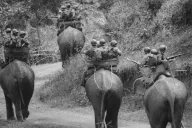
- June 24 — Groupement Mobile 100, built around the French battalion that had fought in Korea, evacuates An Khê. At kilometer 15 on Route 19 it is ambushed; Fall wrote that it “had ceased to exist.” French veterans’ accounts claim nearly a thousand dead or missing.
- June 28–29 — The survivors, making for the Mang Yang pass, are ambushed again at Đắk Ya-Ayun.
- July 17 — The remnants of GM 100 and the highland GM 42 are ambushed at the Chư Drêh pass on Route 14, three days before the Geneva agreements.
- July — At the ceasefire only a few highland towns remain in French hands: Ban Me Thuot and Dalat, and by some accounts Pleiku and Cheo Reo.
North and south
Under the Geneva settlement fighters could regroup to either half of the country. Highlanders went north: Guérin and his colleagues put their number at six to ten thousand; a CIA estimate cited by the historian J. P. Harris gave about ten thousand, half of them Rhade. They were trained at a special school for minorities and from about 1956 sent back down the trails as cadres. At the same time tens of thousands of northern minority people — Nùng above all — came south. What happened to the highlanders on the communist side is told in Highlanders on the other side; what happened to the rest, in Pushed off and BAJARAKA.
What we do not know
We have found no count of highland dead for this war. Estimates exist only for the later one: at least 200,000 highlanders killed between 1954 and 1975, according to Gerald Hickey.
Sources
- Oscar Salemink, The Ethnography of Vietnam’s Central Highlanders (2003), ch. 5; and “Primitive Partisans,” in H. Antlöv and S. Tønnesson (eds), Imperial Policy and Southeast Asian Nationalism (1995)
- J. P. Harris, Vietnam’s High Ground: Armed Struggle for the Central Highlands, 1954–1965 (University Press of Kansas, 2016), ch. 1
- Bernard B. Fall, Street Without Joy, “End of a Task Force”
- Kirk A. Luedeke, “Death on the Highway: The Destruction of Groupement Mobile 100,” Armor (2001)
- Guérin et al., Des montagnards aux minorités ethniques (IRASEC, 2003), §§106–124
- Gerald C. Hickey, Sons of the Mountains and Free in the Forest (Yale University Press, 1982); the war-dead estimate is quoted in Human Rights Watch, Repression of Montagnards (2002)
Compiled September 2026.