
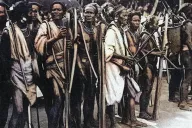
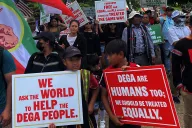

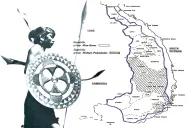
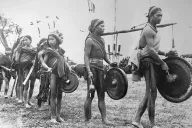
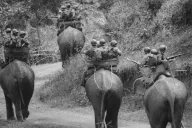

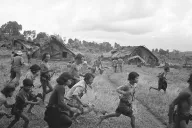
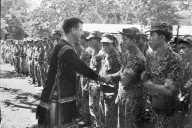
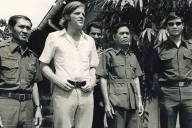

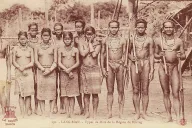


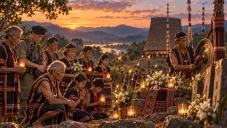
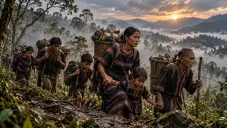

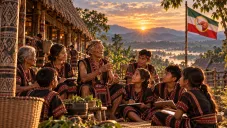
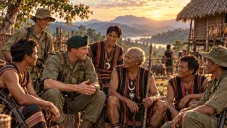

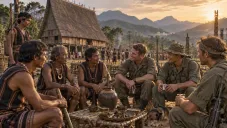
Not every highlander who took up arms between 1945 and 1975 fought beside the French, the Americans or FULRO. Some fought with the Viet Minh, and later with the National Liberation Front, because they were promised what BAJARAKA also wanted: a country of our own inside Vietnam. This page is about them, about the autonomy that was promised, and about what became of the promise.
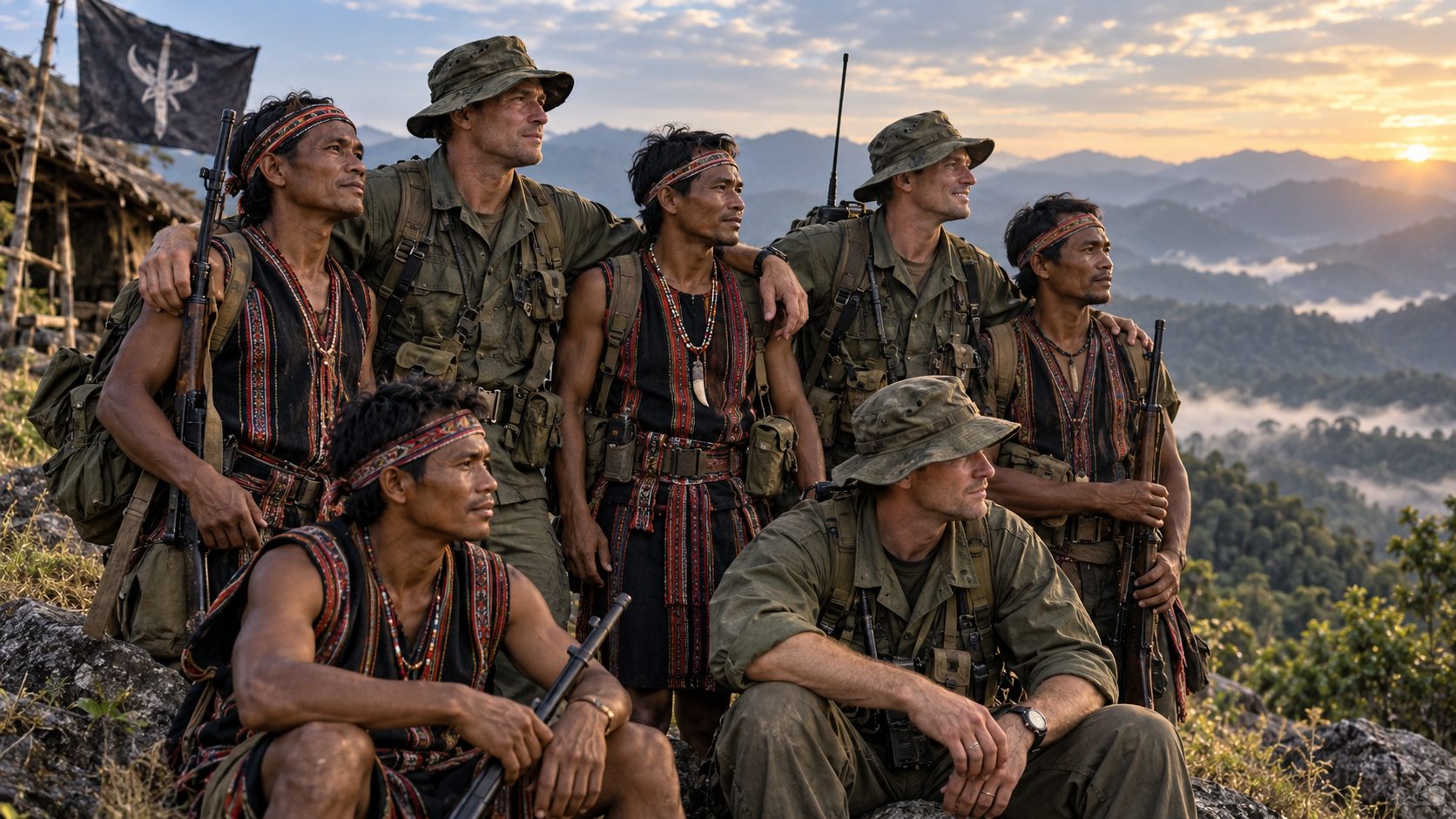
A divided people, not a single camp
It is easy, from the diaspora, to tell our war history as one story: the Special Forces camps, the Mike Force, FULRO, the long resistance in the forest. That story is true, and we tell it in The American years, Mike Force and SOG and FULRO. But it is not the whole story. Villages were divided, families were divided, and some of our people went the other way.
They went for reasons that anyone who has read our history will recognize. Under Ngô Đình Diệm, lowland Vietnamese were settled on highland land, highland courts were abolished and highland languages were pushed out of the schools. The Saigon government was, for many villages, the government that took. The communists said they would give back.
What the North did with its own highlands
The promise was not only words. In the North, after 1954, the Democratic Republic of Vietnam set up autonomous regions for its mountain minorities:
- the Việt Bắc autonomous zone, formally established on July 1, 1956, covering the Tày and Nùng country of Cao Bằng, Bắc Cạn, Lạng Sơn, Tuyên Quang and Thái Nguyên, with Hà Giang added later;
- the Thái–Mèo autonomous region in the north-west, set up in the mid-1950s and renamed the Tây Bắc (North-West) autonomous region in the early 1960s.
For highland cadres in the South these zones were the proof that the Party meant what it said. Communist organizers in the Central Highlands told villages that a similar autonomous region would be created for the Tây Nguyên once the war was won. Human Rights Watch, drawing on the history of the period, records the promise of autonomy and the visits highland leaders made to the northern autonomous zones in the mid-1960s. A CIA analysis of highland politics from the war years, now declassified, discusses the same promise.
Y Bih Aleo and the autonomy movement
The best-known highlander on the communist side was Y Bih Aleo, a Rhade. He had been one of the leaders of BAJARAKA; Human Rights Watch calls him one of the movement’s former leaders, and some accounts call him a co-founder. In 1961 he became the head of the NLF’s Highland Autonomy Movement, and he is described in several accounts as a vice-president of the Front. The Montagnard Human Rights Organization, a diaspora source, describes him as the “puppet chairman” of a highland front backed by Hanoi.
His career is a mirror of Y Bham Enuol’s. Both were Rhade, both wanted the highlands governed by highlanders, and both concluded that they needed an outside power to get it. They chose different outside powers.
The men who went north
When Vietnam was divided in 1954, the Geneva settlement allowed fighters on each side to “regroup” to the other half of the country. Highland men who had served with the Viet Minh went north — six to ten thousand, by the estimate of Mathieu Guérin and his colleagues; about ten thousand, half of them Rhade, by a CIA estimate cited by the historian J. P. Harris. Among them was the Rhade Y Ngông Niê Kdăm, who had joined the Viet Minh in 1945 (see The first war in the highlands). Gerald Hickey, in Free in the Forest, follows how highlanders trained in the North came back down the trails in the early 1960s as cadres, interpreters and organizers. They were the link between the Party and the villages, and without them the NLF could not have worked in the highlands at all.
The war also produced highlanders who guided North Vietnamese units, and highland informants inside the Special Forces camps. Some attacks on camps in the 1960s were helped from inside. The same war produced Dắk Sơn, where the victims were highlanders and the attackers were communist troops. Neither fact cancels the other.
After 1975
No autonomous region was created for the Central Highlands after the war. The two northern regions were abolished after reunification, in 1975–76. The new state organized the highlands as ordinary provinces, opened them to migration from the lowlands and treated highland political organization of any kind — including among former allies — with suspicion. What followed is told in 1975, Pushed off our land and The church they closed.
So the highlanders on both sides of the war ended in the same place: without the self-government that each side had promised them.
A note on sources
Several highlanders who served the communist side are now honored in Vietnam, and their biographies are published by provincial governments and state media. We do not use those sources (see Sources and method), so we have not written about individuals for whom they are the only record. If you know of an independent account — a memoir, an academic study, a family history — we would like to hear of it.
Sources
- Gerald C. Hickey, Sons of the Mountains: Ethnohistory of the Vietnamese Central Highlands to 1954 and Free in the Forest: Ethnohistory of the Vietnamese Central Highlands, 1954–1976 (Yale University Press, 1982) — review in BSOAS
- Oscar Salemink, The Ethnography of Vietnam’s Central Highlanders: A Historical Contextualization, 1850–1990 (RoutledgeCurzon, 2003)
- Po Dharma, Du FLM au FULRO: une lutte des minorités du sud indochinois, 1955–1975 (2006), listed in Edwin Moïse’s Montagnard bibliography
- CIA, “The Highlanders of South Vietnam: A Review of Political Developments and Forces,” CIA reading room
- Human Rights Watch, Repression of Montagnards, April 2002 — background chapter
- Wikipedia, “United Front for the Liberation of Oppressed Races,” “Việt Bắc” and “Northwest (Vietnam)” — used as pointers to the published literature
- Encyclopedia.com, “Vietnamese Highlanders” (Worldmark Encyclopedia of Cultures and Daily Life)
- Montagnard Human Rights Organization, “Montagnard History” — an advocacy source
Compiled September 2026.