


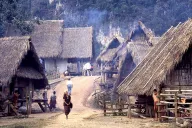

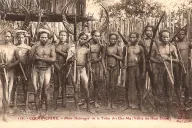







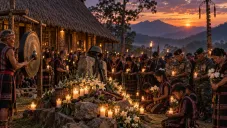
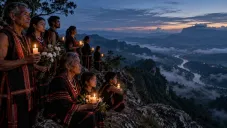









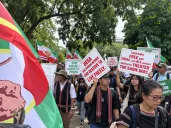
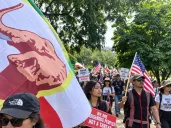











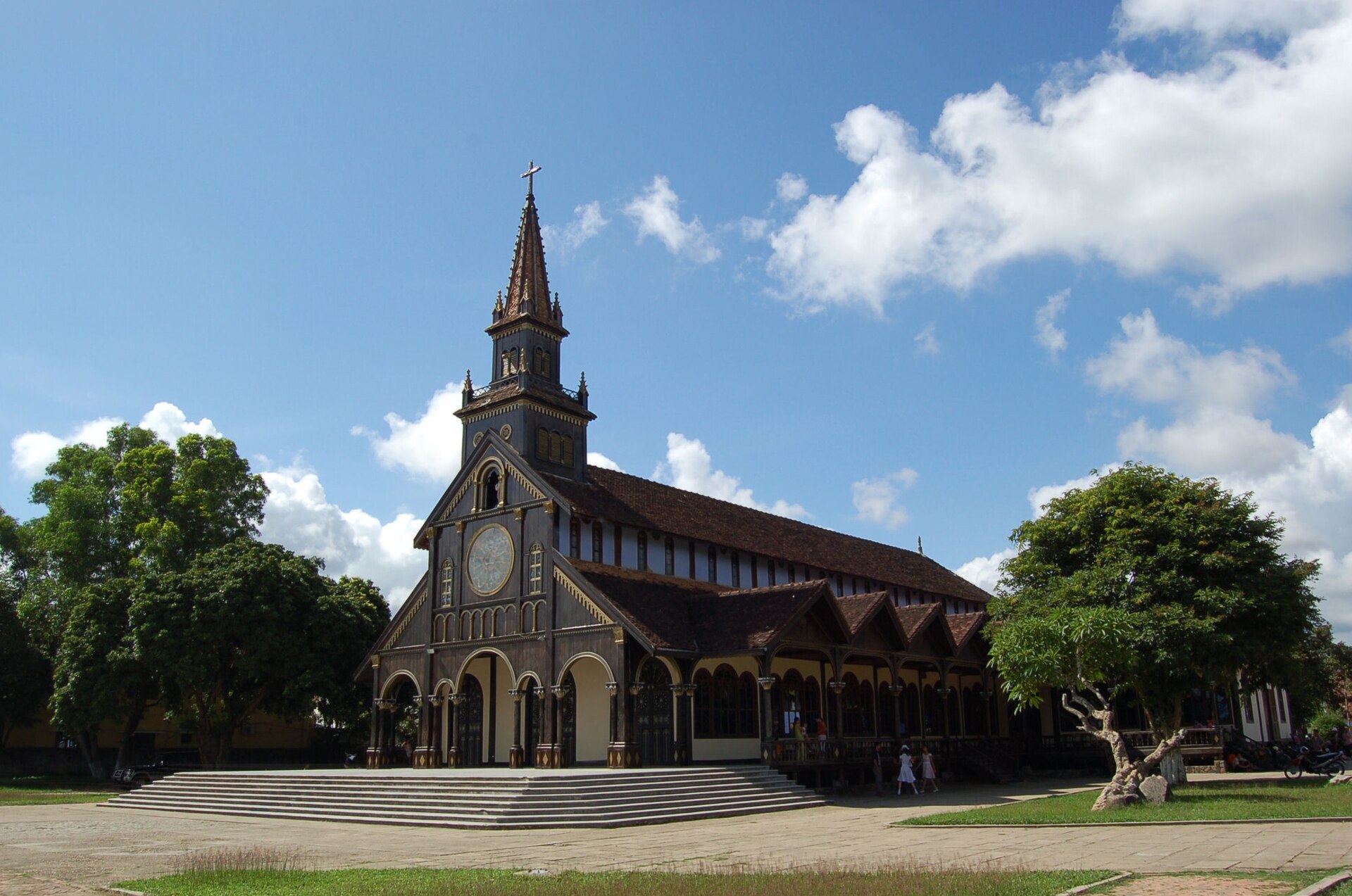
The Catholic Church came to the highlands with the Kon Tum mission (see The Kon Tum mission), and today many tens of thousands of Bahnar, Jarai, Sedang and other highlanders are Catholic. After 1975 the church lost most of its priests and has worked since under close control. It has been treated more gently than the house churches, but not left alone.

The two highland dioceses
| Kon Tum | Ban Mê Thuột | |
|---|---|---|
| Founded as a diocese | 1960 | 1967 |
| Catholics, 2023 | 394,274 (18.4%) | 468,836 (14.3%) |
| Priests, 2023 | 224 | 233 |
| Parishes, 2023 | 143 | 118 |
Figures are from the Vatican’s own statistics as compiled by Catholic-Hierarchy. They count all Catholics, Vietnamese as well as highland. In the Redemptorists’ Jarai mission in Kon Tum diocese, AsiaNews reported in 2019, 45,000 of 61,000 Catholics were Jarai and 6,000 Bahnar.
After 1975: a church without priests
The clearest record of what happened after 1975 is in the numbers. In 1969 the diocese of Kon Tum had 76 diocesan priests for about 80,000 Catholics. By 1979 it had 32. By 2001 it had 27 for more than 180,000. In 2002 there were nearly 6,000 Catholics for every priest. The numbers began to recover only after 2002. The French bishop, Paul Seitz, resigned on October 2, 1975; his Vietnamese coadjutor, Alexis Phạm Văn Lộc, appointed that March, led the diocese until 1995.
What has been documented
- 1990 — The bishop of Ban Mê Thuột speaks against the state-controlled Catholic organization; USCIRF reports that he was kept from a gathering of Catholic leaders, and that the diocese has been targeted since, with priests harassed and services interrupted.
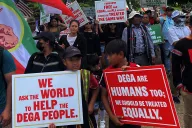
- 2001 — After the February protests, highland Catholics in Kon Tum are called to meetings and warned, HRW reports, not to repeat the mistakes of the “Dega Protestants.”
- 2010 — Bishop Michael Hoàng Đức Oanh of Kon Tum complains in a pastoral letter that local authorities are preventing him from saying Mass; police stop him celebrating Christmas in Kbang district, Gia Lai. The campaign against the Hà Mòn movement begins (see Hà Mòn).
- 2015 — The authorities order the demolition of the Đắk Nú community’s chapel, and parishioners keep watch in shifts to stop it; 22 chapels are threatened. In an open letter Bishop Oanh tells the authorities to “see who are the ones who really are undermining people’s trust in the government.”
- December 2015 — Christmas Mass is blocked for two highland parishes of about 5,000 and more than 3,000 faithful because their priests lacked prior approval.
- 2011–16 — Eleven Montagnard Christians — six Protestants and five members of the Hà Mòn community — are sentenced to a combined 90 years and eight months; AsiaNews, citing International Christian Concern, reported in 2024 that there was “no longer any news” of them.
Human Rights Watch wrote in 2002 that Catholics had “generally been under less pressure” than Protestants in the highlands. That remains broadly true, and it is not the same as freedom. See The Kon Tum mission for the church’s earlier history and The Law on Belief and Religion for the rules it now works under.
Sources
- Catholic-Hierarchy: Diocese of Kon Tum; Diocese of Ban Mê Thuột
- Human Rights Watch, Repression of Montagnards (2002), chapter VII; Human Rights Watch, Montagnard Christians in Vietnam (2011), PDF, p. 17
- USCIRF, State-Controlled Religion and Religious Freedom in Vietnam (September 2024), p. 25
- AsiaNews: October 16, 2015; December 28, 2015; October 23, 2019; July 10, 2024
Compiled September 2026. We have not found an independent account of ordination quotas or seminary restrictions after 1975; if you know of one, please tell us.