











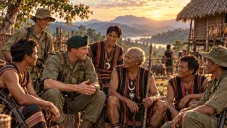

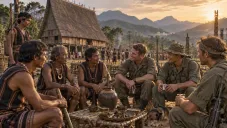





On the morning of September 20, 1964 he was at the radio station in Ban Me Thuot, trying to talk armed highland soldiers back into their camps. By noon he had been taken to the border. For the next four years he was president of FULRO at Camp le Rolland in Mondulkiri, and the record of those years is not mainly a record of fighting: it is a record of meetings, letters and terms, in which his demands got smaller every year and were never accepted.
The revolt he may not have called
The rising of September 20, 1964 is described on FULRO, 1964–1992. What the sources say about his own part in it does not agree, and the differences are worth setting out, because the claim that he led an armed revolt has followed him ever since.
| Source | His part in it |
|---|---|
| CIA (1966) | He may not have known that an armed revolt was planned. He held a meeting at Buon Enao on the evening of September 19. On the morning of the 20th he was at the Ban Me Thuot radio station with the province chief, trying to talk the troops back to their camps. About noon, soldiers from Buon Sar Pa took him away; whether he went willingly or under duress is not known. General Co believed Y Dhon Adrong, not Y Bham, was the real leader. |
| Hickey, RAND (1970) | The revolt was plotted by Y Dhe Adrong with the Cham and Khmer Krom fronts. When it began, Y Bham Enuol joined them. |
| Hinh and Tho, US Army (1980) | At the radio station he denounced the Vietnamese for committing genocide. Afterwards he, his staff and some Rhade soldiers disappeared. |
| CRESS review (1967) | An American embassy officer reported that he was involved, but disagreed with the anti-American wording of the declaration. |
| The army handbook (1967) | He announced the formation of FULRO on August 1, 1964. |
The CIA’s own view was that FULRO was not a new thing at all but a reorganization of BAJARAKA under arms. On the evidence, that is the safest description of what he was leading: the same demand, made by the same men, in the only way left to them.
Camp le Rolland
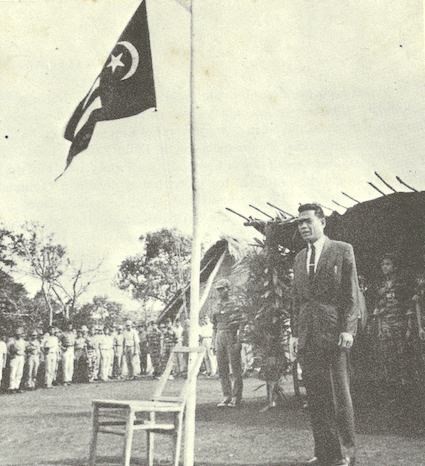
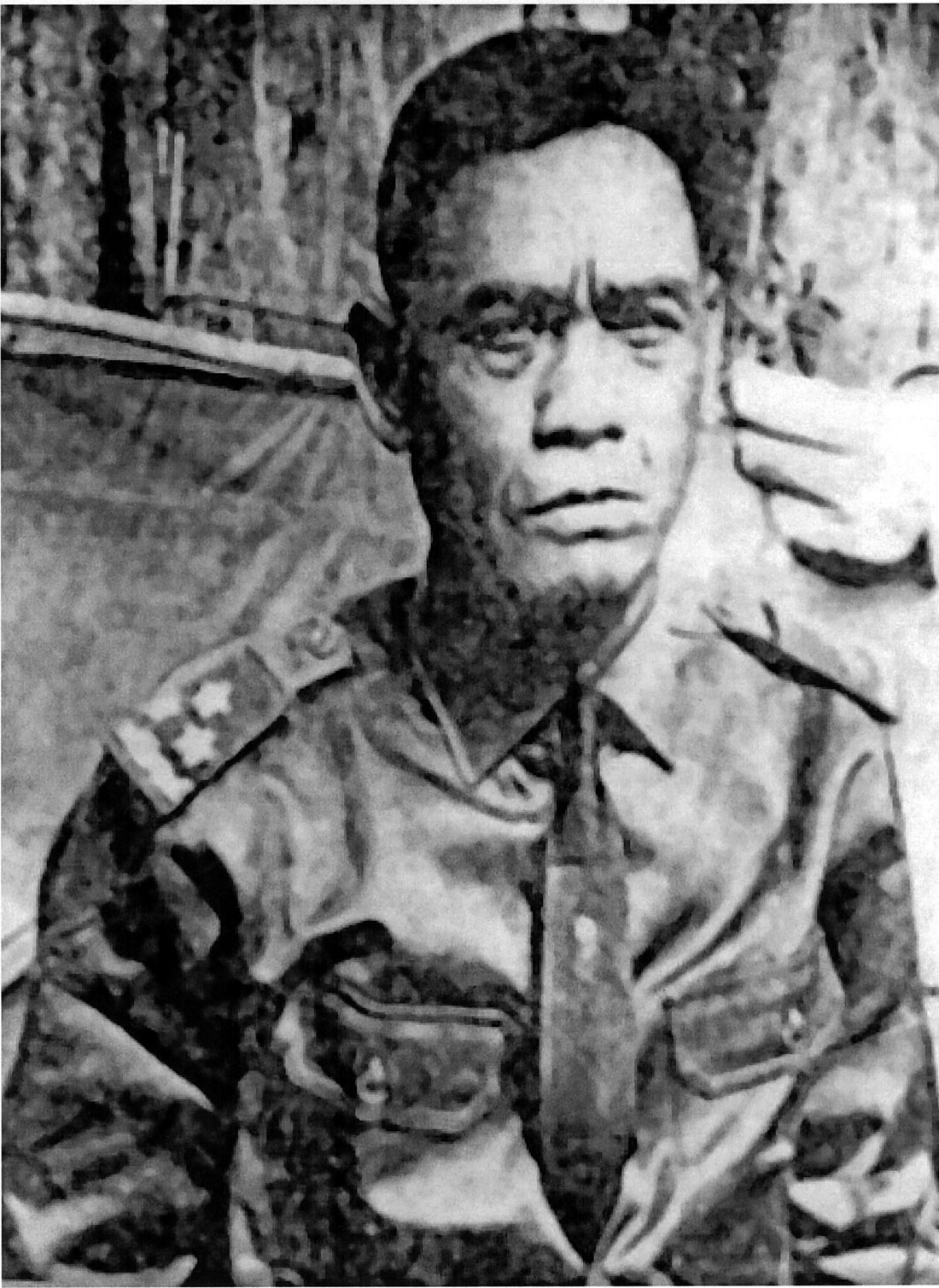
He crossed into Cambodia with about two thousand followers and made his headquarters at the old French post at Camp le Rolland in Mondulkiri. Prince Sihanouk allowed FULRO to operate from Cambodian soil; a courier reported to the Americans that Y Bham had met him. In March 1965 he led the FULRO delegation to the Conference of Indochinese Peoples at Phnom Penh, where, on March 13, he set out the history of our case to an international meeting for the first time.
In a letter of August 9, 1965 he wrote in the name of the “Free Country of DEGA.” That is the earliest use of our own name for ourselves in a document held in an American file, and it is why this library uses the word at all. It is also the year he wrote the short history he called Extraits de l’Histoire des Hauts-Plateaux du Centre Viet Nam, Pays Montagnards du Sud, dated November 1, 1965; it is described on What he actually asked for.
Ten rounds of talks
From the border he negotiated, continuously, with the government he had left. The dates below are from American reporting at the time.
- May 21 and June 5, 1965 — talks at Ban Don.
- July 20–21, 1965 — FULRO asks to fly its own flag beside the flag of South Vietnam, and for support for a force of 50,000 men with advisers.
- July 30, 1965 — a meeting at Ban Me Thuot with General Vinh Loc, General Westmoreland and the American embassy. The Vietnamese generals refuse a special autonomous status; the talks are broken off on August 25.
- September 23, 1965 — he sends eight moderated points; autonomy is no longer among them.
- December 1965 — a second armed rising, which the CIA doubted he had approved or even known of. In January 1966 he held an inquiry that found a FULRO major responsible.
- Mid-1966 — Paul Nur, by then inside the government, offers him the post of director-general for highland affairs. He does not take it.
- November 1966 — a new and larger set of demands: a separate administration, army, police, schools and courts, and a Montagnard seat at international conferences.
- January 1967 — he asks the Americans for exile in Thailand, then fails to appear at a meeting set for January 28.
- May 1967 — he comes to Ban Me Thuot and reaches a preliminary agreement with General Vinh Loc, swearing to cease all acts against the national interest. The questions of a separate FULRO army and of aid received directly from the Americans are put off. The American embassy reports it to Washington.
- August 1968 — he comes secretly to Ban Me Thuot again, and later meets Prime Minister Tran Van Huong in Saigon.
Read in order, the list is a man conceding. In 1965 he asked for a country; by September of that year he had dropped autonomy; in 1967 he asked to be allowed to leave for Thailand; in 1968 he was negotiating the terms of his own return. The government of the Republic of Vietnam did not close with him in any of those years, and the men who eventually signed for FULRO were not him.
The settlement, and the end of his liberty
The agreement was signed in December 1968 by his deputies Y Dhe Adrong and Y Bling — Hickey gives December 19; other accounts of the FULRO settlement give December 11. Under it the highlanders could form their own political party and fly their own flag, and a ministry for highland affairs was created. Y Bham Enuol did not sign it. Just before he was due to, his headquarters was seized.
What happened then, and the six years that followed, are on Phnom Penh: the captivity and the death.
What we do not know
- Whether he knew in advance about either rising, in September 1964 or December 1965.
- The text of the FULRO declaration of September 1964, which he is said to have delivered at the camps.
- What he said at Phnom Penh in March 1965, beyond that he set out the history of our case.
- Whether he was taken from the radio station by his own side or by force.
Sources
- CIA, The Highlanders of South Vietnam: A Review of Political Developments and Forces (June 1966) — the day of the revolt, the letters of late 1964, the talks of 1965 and 1966, and the January 1966 inquiry
- Gerald C. Hickey, Accommodation and Coalition in South Vietnam, RAND P-4213 (1970) — Camp le Rolland, the December 1968 signature, and the seizure
- Nguyen Duy Hinh and Tran Dinh Tho, The South Vietnamese Society, US Army Center of Military History (1980) — the radio station, and the secret visit of August 1968
- Kurt Bloch, A Review of United States Military Counterinsurgency Activities in South Vietnam, CRESS (1967) — the proclamations of August and September 1964
- US Embassy Saigon to the State Department, May 3, 1967, Foreign Relations of the United States, 1964–1968, vol. V, doc. 158 — the preliminary agreement of May 1967
- Department of the Army, Area Handbook for South Vietnam, Pamphlet 550-55 (1967) — the announcement of August 1, 1964, and the Phnom Penh conference
- Human Rights Watch, Repression of Montagnards (2002), the historical chapter — the two thousand followers, and the terms of the 1968 agreement
- William H. Chickering, A War of Their Own: FULRO, the Other National Liberation Front, Vietnam 1955–75 (Casemate, 2025), excerpt, pp. 152–163 — FULRO in the field in 1966, and Y Bham Enuol as its president and commanding general
Compiled September 2026. Dates in the list of talks are as reported at the time by American intelligence, and have not been checked against Vietnamese or Cambodian records.