








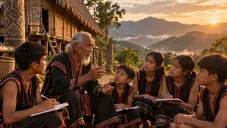

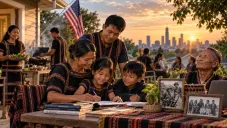











Most Dega children start school in a language they do not speak at home, often taught by teachers who do not speak theirs. Fewer finish secondary school than their Vietnamese neighbors, and very few reach university. The UN Human Rights Committee has expressed concern that minority communities in Vietnam “suffer from discrimination, including with regard to education.”
The language of the classroom
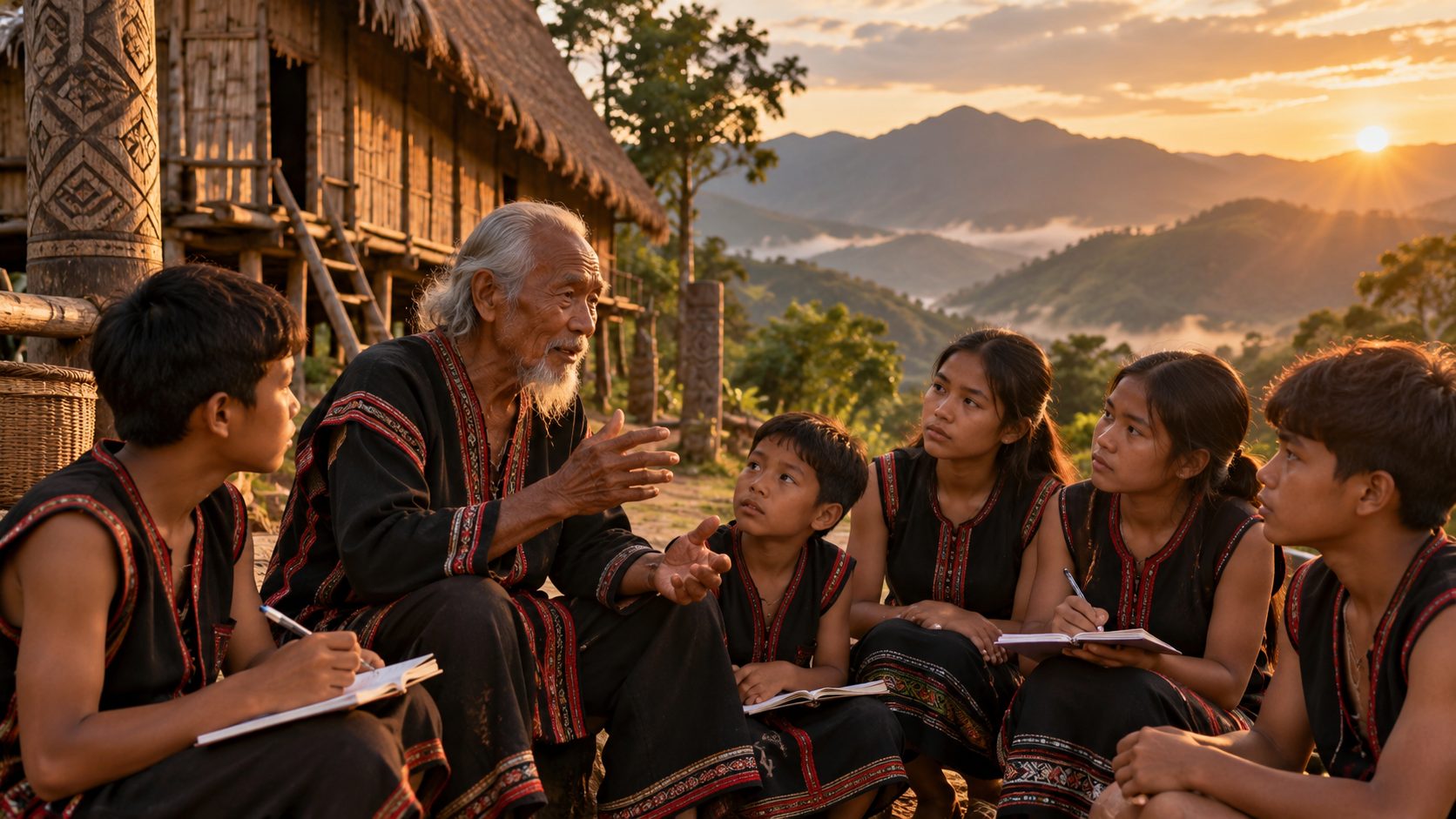
Human Rights Watch reported in 2002 that despite provisions in Vietnam’s constitution for teaching in minority languages, “the vast majority of primary schools in the Central Highlands conduct their classes in Vietnamese.” A World Bank paper of 2009 found that “the vast majority of ethnic minority children speak their own languages at home” and that “many minority children start their first day of primary school unprepared for instruction in Vietnamese.” A 2019 World Bank study reported language barriers between Vietnamese-speaking teachers and minority families, and named the Xơ Đăng (Sedang) among the groups most affected.
UNICEF Viet Nam says mother-tongue-based bilingual education is needed to break down those barriers. In 2019 the UN Human Rights Committee asked Vietnam to protect minorities’ right “to use their own language.”
Who stays in school
| Measure | Figure | Reported by |
|---|---|---|
| Upper secondary net enrollment, rural areas, Central Highlands minorities, 2006 | under 20% (Kinh and Hoa: almost 60%) | Baulch et al., World Bank, 2009 |
| Minority students’ share of all post-secondary students, 2006–07 | 2.5% | Baulch et al., World Bank, 2009 |
| Ethnic minority students reaching upper secondary or higher | one in five | UNICEF Viet Nam (undated) |
| Illiteracy among the Bahnar and Jarai, around 2000 | 70–72% of men, 88% of women | UNDP, cited by Human Rights Watch, 2002 |
The figures are old, and they draw on Vietnamese government surveys analyzed by the World Bank and UN agencies; we give them because we have found no independent count. The same 2009 paper found that in the Central Highlands drop-outs peaked between grades six and seven, “especially for girls.”
Poverty and the cost of school
The World Bank reported in 2023 that 79 percent of Vietnam’s remaining poor in 2020 were ethnic minorities, who make up 15 percent of the population, and that the Central Highlands, with 6 percent of the population, held 21 percent of the poor. Kinh families, it found, spend “over seven times more” than minority families on extra classes in the primary and lower secondary grades. Human Rights Watch reported in 2002 that although minority pupils were in theory exempt from school fees, fees were charged in practice, and that special boarding schools had been set up for minority students.
Faith in the classroom
Human Rights Watch recorded an Ede girl told she was no longer welcome at school after she attended the February 2001 demonstration in Buôn Ma Thuột, and a commune decision that a Jarai trainee teacher could be hired only if she renounced Protestantism in writing (see The church they closed).
What we have not found
We have not found independent figures for the minority boarding schools, for university places reserved for minority students, or for the results of the bilingual education pilots. If you have taught in, or studied at, a highland school, we would like to hear what it was like. See also Language resources.
See also: Growing up Dega, The Franco-Rhade school and the Collège Sabatier.
Sources
- UN Human Rights Committee, concluding observations on Viet Nam, CCPR/C/VNM/CO/3 (2019), paras 55–56
- Human Rights Watch, Repression of Montagnards (2002), chapter VIII
- Bob Baulch et al., Ethnic Minority Poverty in Vietnam (World Bank discussion paper, 2009)
- World Bank, Drivers of Socio-Economic Development Among Ethnic Minority Groups in Vietnam (2019)
- World Bank, From the Last Mile to the Next Mile: 2022 Vietnam Poverty and Equity Assessment (2023)
- UNICEF Viet Nam, Education
- Truong Huyen Chi, “‘They think we don’t value schooling’: paradoxes of education in the multi-ethnic Central Highlands of Vietnam,” in J. London (ed.), Education in Vietnam (ISEAS, 2011) — further reading
Compiled September 2026.