
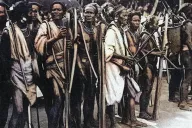

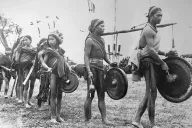
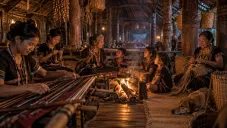
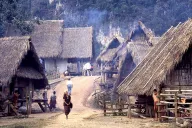

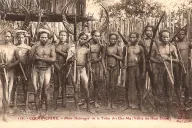

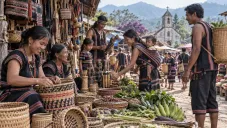



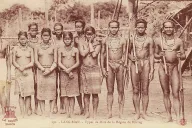

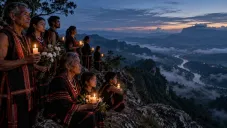
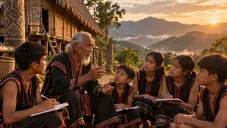



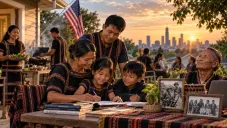
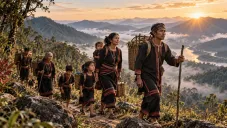
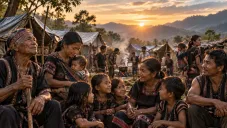
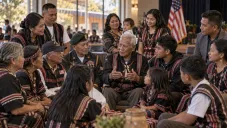



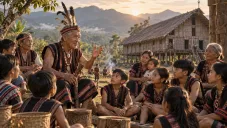
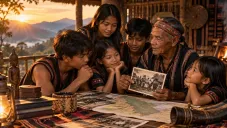




A Dega child was usually born beside the family hearth, named by the ancestors, given a false name to hide it from the spirits, and raised with a freedom that outsiders often remarked on. This page sets out what the older written sources record about growing up in the highlands, people by people, and what changed for the children who grew up in exile.
Reading these sources
Almost everything written down about our childhood customs was written by outsiders: the US Army handbook of 1966, the anthropologist Gerald Hickey, and missionaries before them. Each people had its own customs, and many had already changed by the 1960s. We give each custom with the people it was recorded for, in the past tense where the source uses it. Elders who remember it differently are the better authority, and we would like to hear from them.
Birth
Among the Bahnar, the 1966 handbook records, a woman gave birth “in the house near the family hearth, where a fire is kept burning,” helped by a midwife. The Mnong called childbirth “remaining near the fire.” Among the Rhade, after the midwife delivered the baby the mother was placed near the hearth and her body rubbed with ginger; custom allowed her to stay in bed six or seven days, though most women were up after three or four. Rhade parents, the handbook notes, “always wish to have a daughter, especially if it is the first child” — in a society where the house, the jars and the harvest passed through women.
Birth brought the soul into the child. The Rhade believed that a second soul, the yun, entered the newborn “through a bluish mark” that faded by the age of two or three, and that a dead relative could return in a new baby; families tried to work out which ancestor had come back. Among the Jarai and the Halang, someone blew into the newborn’s ear, which the Jarai believed sent the soul into the body. Under Rhade customary law it was a crime not to report a birth to the village chief.
Names
The Rhade naming ceremony, bi hoa bue, took place the day after the birth. The handbook describes the midwife putting a drop of dew on the baby’s tongue and asking, “Your name, is it …?” trying names of the family’s dead maternal aunts and uncles. If the child smiled or was quiet, that was its name; if it cried, the ancestors were not pleased and another name was tried.
A child was not called by that name at first. Rhade, Jarai and Bahnar children were given ugly names — “excrement,” “rotten,” “death” among the Rhade — so that evil spirits would pass them by, and among the Rhade the real name was used from about the age of five. Raglai parents kept the name secret for about six years. Among the Bahnar, a child who fell seriously ill could be adopted into another branch of the family in an alliance called topok, and take a new name with it.
A Rhade or Jarai child took the clan name of the mother’s family, and so belonged to her clan. Among the Jarai, the handbook says, “names of all girls begin with an ‘H.’” Raleigh Bailey’s guide for American service providers explains the prefixes that still puzzle officials: in some tribes men’s names are preceded by a capital Y, and some women’s by H or K. See Names and words.
Childhood
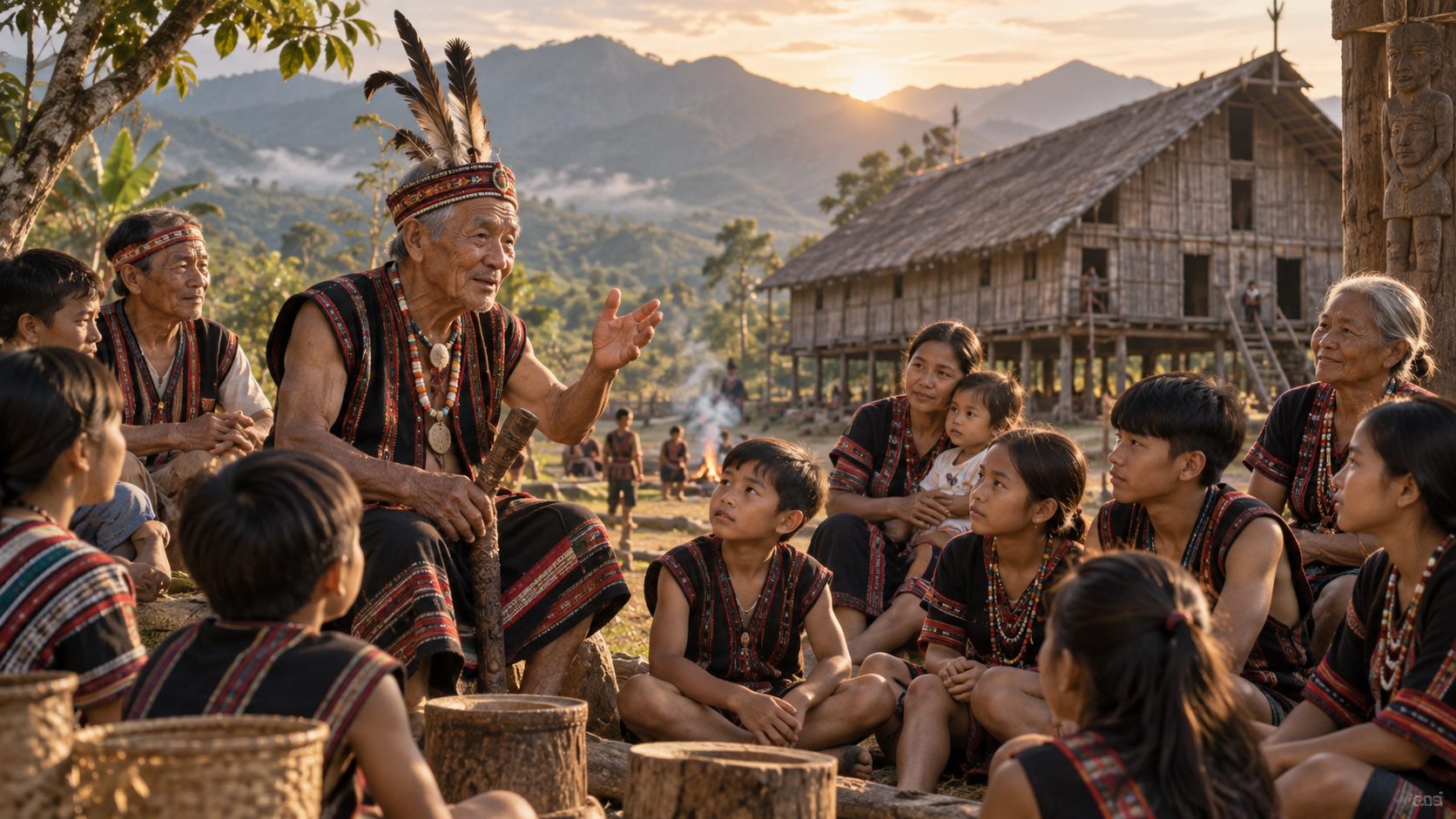
Visitors noticed how freely our children were raised. The handbook says of the Rhade that for the first five years children “are not disciplined” because parents thought that paying them too much attention would attract evil spirits, and that adults “never force a child to do anything against his will” — a respect the handbook links to the belief that ancestors return in newborn children. Of the Katu it says children were disciplined “only by voice, never by hand or beating”; of the Raglai, that a crying child was picked up at once.
Children worked from early on. Bahnar children of five or six looked after the poultry, and a few years later the buffaloes. Rhade girls played with small spinning wheels and looms and so learned to weave; boys learned to make snares, nets and winnowing baskets. Rhade children walked on stilts, flew kites, spun tops and swam.
The communal house
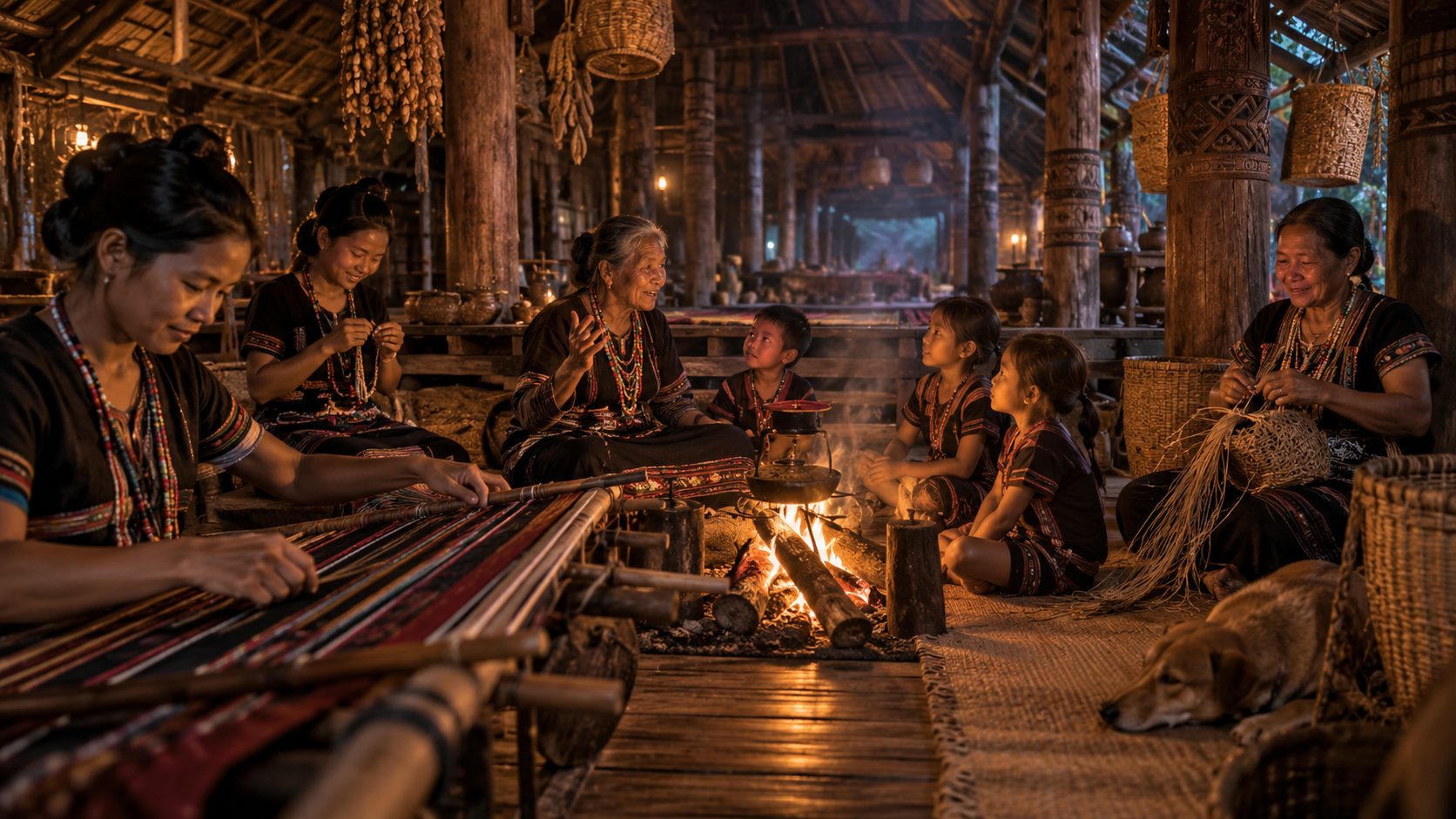
Among the Bahnar, the rong gave “a sleeping place for boys from puberty until marriage,” and was also known as the bachelors’ house; the Jarai, Rengao, Sedang and Katu kept similar houses. Bachelors made tools, traps, nets and baskets there, and among the Sedang, Hickey wrote, it was also the defense headquarters in time of war. The Rhade were different: their life centered on the mother’s longhouse, and we have found no source for a Rhade bachelors’ house. See Dega culture.
Coming of age
For many of our peoples the end of childhood was marked on the teeth. Bahnar boys and girls of fourteen or fifteen had their upper teeth filed with a basalt stone; Jarai boys of about twelve had theirs filed and lacquered; among the Sedang and Mnong the teeth were filed and stained black. Among the Rhade, the handbook records a former initiation in which the upper front teeth were removed and the young person received a bracelet engraved with a secret mark. By the 1960s all of these were described as dying out.
Marriage: who asks whom
Among the Rhade and the Jarai, the woman’s family asks. “The girl asks the boy’s hand in marriage, for which she pays a dowry,” Hickey wrote of the Rhade, “and after marriage the couple resides in the bride’s longhouse.” Among the Jarai, the girl’s mother gave a bracelet to a go-between; if the girl did not touch it, she consented, and the go-between carried it to the boy’s family, where his mother placed it on his wrist as a sign of the engagement. The Koho and Mnong also left the initiative to the woman. Among the Bahnar either family could propose, and among the Sedang and Jeh it was the man’s family. See Dega women.
Growing up in exile
The children who came to North Carolina grew up between two worlds. Bailey wrote in 2002 that most arrived “with little formal education and little if any English,” and that tension between the generations grew “when the children learn English more quickly than their parents do and become the culture brokers and interpreters for their families.” Parents could not help with homework, did not understand American rules on discipline, and did not approve of dating. Elders, the traditional source of guidance, were preoccupied with families still in the highlands. Bailey’s conclusion was hopeful: “The next generation of the Montagnards, the youth now growing up in the United States, will be the ones to lead the community to a new level of acculturation.” See North Carolina and Schools, language and the university gap.
What is missing
The 1966 handbook also records, as customs of the past, harsh responses to twins and to children who could not be nursed. We do not repeat them without the account of our own elders. We have not found a source on how children are named, taught or brought of age in Dega families today, in the highlands or in exile. If you can record an elder on how a child was named in your village, see How to record an elder.
See also: The bracelet.
Sources
- Department of the Army, Minority Groups in the Republic of Vietnam, Pamphlet 550-105 (1966) — the Bahnar, Jarai, Rhade, Sedang, Mnong, Koho, Katu, Halang, Raglai and Jeh chapters
- Gerald C. Hickey, The Major Ethnic Groups of the South Vietnamese Highlands, RAND RM-4041 (1964) — text copy
- Raleigh Bailey, Montagnards: Their History and Culture, Culture Profile (Center for Applied Linguistics, 2002)
Compiled September 2026.