



































In 1915 a school opened at Buôn Ma Thuột that taught Rhade children in French and, in time, to read and write their own language. Its pupils became the first generation of Dega leaders. In the early 1950s the French opened a secondary school in the same town, the Collège Sabatier, and it too produced leaders. Under Ngô Đình Diệm, teaching in highland languages was banned.
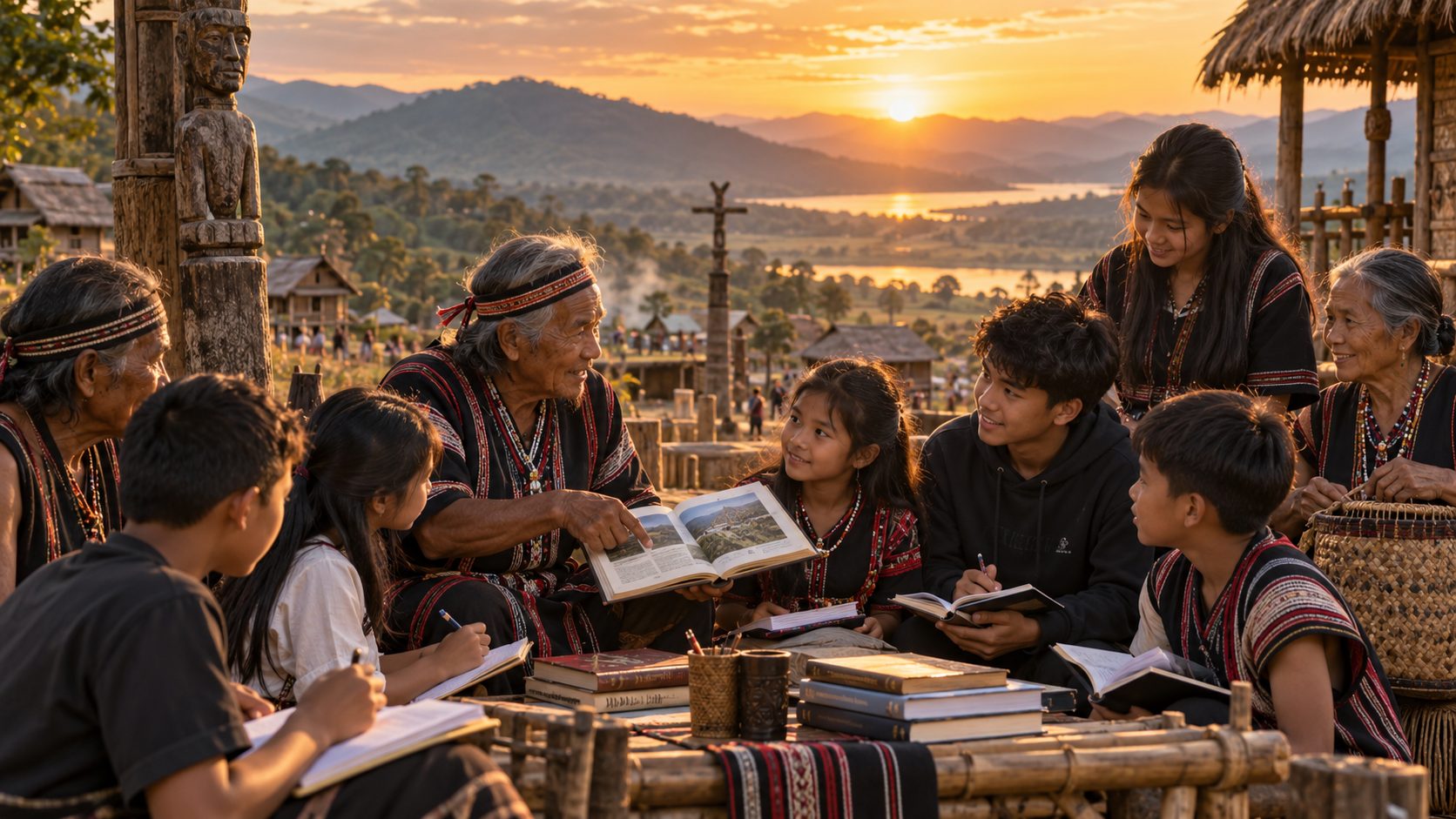
The Franco-Rhade school, 1915
“In 1915 the Franco-Rhade School opened with an enrollment of thirty students, all of them from surrounding villages,” Gerald Hickey wrote. They were taught the French language, history and geography, “with some instruction in Rhade customs.” In 1922, when the first examinations for the primary certificate were held at Buôn Ma Thuột, three of the four candidates passed. The school was part of the policy of Léopold Sabatier, the French Resident of Darlac, whose court, code and closed door are described on Sabatier, the oath of 1926 and the Rhade law code. The anthropologist Frédéric Bourdier’s volume describes it as a school that “trained the children of local elites to read and write Rhádé.”
Writing Rhade
Rhade had to be written before it could be taught. Sabatier, Hickey records, encouraged two educated Rhade to begin devising an alphabet, and Oscar Salemink credits him with providing “a romanized Rhade script.” In 1921 Sabatier published a Rhade word book arranged by subject, “for the use of the pupils of the Franco-Rhade school of Darlac.” The US Army’s handbook of 1966 still credited him with “developing the written form of the Rhade language and codifying the traditional Rhade laws.” See Names and words.
Antomarchi and the school system
Sabatier did not build the schools alone. Hickey wrote that Sabatier, “assisted by the able administrator Antomarchi,” founded a school system for highlanders; the French writer Gabrielle Bertrand called Dominique Antomarchi the “founder of the Groupe Scholaire Franco-Rhade de Ban-Me-Thuot,” and Hickey notes that he later became a well-remembered school director. A survey of public education in Indochina, printed in La Documentation catholique in 1934, described a complete Franco-Rhade school system “with its own methods, staff and separate exams” (our translation). It reported that in 1930 two pupils passed the elementary certificate and seven the primary certificate, and in September 1930 a class to train Rhade teachers was opened at the Collège Quốc Học in Huế.
The Collège Sabatier
A generation later, during the war of 1946–54, the French opened a second school in Buôn Ma Thuột and named it after Sabatier. “During the Indochina War, in an attempt to win greater support among highlanders, the French established the Collège Sabatier in Ban Me Thuot,” Hickey wrote, and scholarships were given for highland pupils to go on to the Lycée Yersin in Đà Lạt. It was a lower secondary school. The historian Christopher Goscha describes hundreds of young men from across the highlands meeting “in the classrooms of the newly opened Collège Sabatier,” and Hickey traced the friendships and marriages among highland leading families to the Collège Sabatier and the Lycée Yersin. In July 1954 the school was still listed in the French Journal officiel for a payment of 100,000 francs.
Who studied there
| Name | School | Source |
|---|---|---|
| Y Bhăm Êñuôl | The Franco-Rhade school, then the Christian and Missionary Alliance Bible school and the national agriculture school | Human Rights Watch, 2002 |
| Y Thih Eban | The Franco-Jarai school in Pleiku, then the Collège Sabatier | Human Rights Watch, 2002, citing Hickey |
| Nay Luett | The Franco-Bahnar school in Kon Tum and the Collège Sabatier, then the Lycée Yersin | Hickey, 2002 |
Goscha wrote that the school “produced highland nationalists, equipped with their own Romanized languages.” All three were among the leaders arrested after the BAJARAKA movement of 1958.
Under Diệm
After 1955 the government of the Republic of Vietnam set out to assimilate the highlands. “Instruction in highland languages was banned under the Diem regime,” Hickey wrote in 1967; highland place names were replaced with Vietnamese ones, and highland soldiers had to take Vietnamese names. Diệm closed the highland students’ section of the National Institute of Administration, and from 1958 to 1964 no highlanders were admitted to it. Only after the rising of September 1964 and the Pleiku conference of October that year did the government agree to allow reading and writing in highland languages to be taught in primary schools again. A Highland Normal School had opened at Buôn Ma Thuột in 1957, but under a government that no longer taught in our languages. See Schools, language and the university gap.
What is missing
We have not found what became of the Collège Sabatier after 1954, whether it was closed, renamed or taken over, nor a list of its pupils. Gerald Hickey’s Free in the Forest (1982) probably holds more, and we have not yet been able to consult it. If you or your parents studied at either school, we would like to record it.
See also: Writing our languages.
Sources
- Gerald C. Hickey, Kingdom in the Morning Mist: Mayréna in the Highlands of Vietnam (University of Pennsylvania Press, 1988)
- Gerald C. Hickey, Window on a War: An Anthropologist in the Vietnam Conflict (Texas Tech University Press, 2002)
- Gerald C. Hickey, The Major Ethnic Groups of the South Vietnamese Highlands, RAND RM-4041 (1964) — text copy
- Gerald C. Hickey, The Highland People of South Vietnam: Social and Economic Development, RAND RM-5281 (1967)
- Frédéric Bourdier (ed.), Development and Dominion: Indigenous Peoples of Cambodia, Vietnam and Laos (White Lotus, 2011)
- Oscar Salemink, “Mois and Maquis: The Invention and Appropriation of Vietnam’s Montagnards from Sabatier to the CIA,” in G. W. Stocking (ed.), Colonial Situations (University of Wisconsin Press, 1991)
- Christopher Goscha, Vietnam: A New History (Basic Books, 2016)
- Gabrielle Bertrand, The Jungle People (English translation, 1959)
- La Documentation catholique, November 3, 1934 — survey of public education in Indochina
- Journal officiel de la République française, July 13, 1954
- Department of the Army, Minority Groups in the Republic of Vietnam, Pamphlet 550-105 (1966)
- Human Rights Watch, Repression of Montagnards (2002), chapter III
Compiled September 2026. Hickey dated the founding of the Darlac school system to the 1920s in 1967, but the opening of the Franco-Rhade school to 1915 in 1988; we follow the later account.