

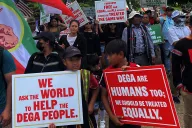













































Since September 2023 Thailand has had its own procedure for deciding who cannot be sent home, the National Screening Mechanism. On paper it is the first Thai status a refugee can hold. In practice a person must be arrested before applying, and in its first thirty months seven people received it. This page explains what the mechanism is and why a UNHCR card still does not keep a Dega refugee in Bangkok out of detention.

The starting point
Thailand is not a party to the 1951 Refugee Convention. UNHCR registers asylum seekers in Bangkok and issues refugee cards, but the card gives no status under Thai law: to an immigration officer its holder is someone present without permission. What Thailand is bound by is the rule against returning anyone to torture — through the Convention against Torture, ratified in 2007, and section 13 of its own 2022 Act on the Prevention and Suppression of Torture and Enforced Disappearance. How that rule was applied to one Dega refugee is on Y Quynh Bđăp.
What the mechanism is
Asylum Access Thailand, which works inside the process, called the mechanism a significant step: it is the first time the Thai state has itself given legal status to asylum seekers. Its 2026 submission to the UN’s review of Thailand describes what the step has come to.
- Arrest first. To apply, a person must already have been arrested and hold “awaiting deportation” status. “The system designed to prevent arbitrary detention requires arbitrary detention as its entry point.”
- Almost no one gets it. Seven Protected Persons in thirty months, out of more than 5,500 urban refugees.
- Little comes with it. No right to work, no public health insurance, no clear path to a stable status.
- Few have heard of it. Seventy percent of the refugees surveyed did not know it existed.
- Whole nationalities are shut out. Human Rights Watch reports that the authorities refused to consider Lao, Hmong, Uyghurs, Rohingya and North Koreans.
Detention
Thai law sets no maximum period of immigration detention. Asylum Access reports the Suan Phlu immigration detention center in Bangkok running at more than 155 percent of capacity, with over 1,200 detainees, and no successful bail application since early 2026. Most of the Dega arrested in the Nonthaburi raids of February and October 2025 were taken to Suan Phlu (see Asylum today). Human Rights Watch reported in November 2025 that Vietnamese officials had visited the center and that detainees had met Vietnamese officials in jails and at immigration check-ins.
No way onward
For most Dega in Bangkok the hope was never Thai status but resettlement, usually to the United States. On January 20, 2025, an executive order suspended US refugee admissions. Radio Free Asia reported that it left Vietnamese refugees in Thailand with no route out. On July 14, 2026, the Thai Cabinet approved in principle draft deportation regulations; Asylum Access asked for explicit exemptions for Protected Persons and UNHCR-recognized refugees.
If you are in Thailand
Nothing on this page is legal advice. Keep your UNHCR documents and a copy of them in a separate safe place. Know the name and number of a lawyer or organization before you need them; Asylum Access Thailand and UNHCR Thailand’s help site are starting points. Do not send us identifying details about yourself through open channels; see reporting safely.
Sources
- Asylum Access Thailand and partners, submission for Thailand’s Universal Periodic Review (April 2026)
- Asylum Access Thailand, statement on the draft deportation regulations, July 21, 2026; Asylum Access Thailand
- Human Rights Watch, World Report, Thailand chapters: 2024, 2025, 2026
- Human Rights Watch, “Thailand: Vietnamese refugees at risk from Hanoi,” November 13, 2025
- Radio Free Asia, February 7, 2025, on the suspension of US refugee admissions
- International Commission of Jurists, brief on non-refoulement in the Y Quynh Bđăp case (2024)
Compiled September 2026. We do not have a reliable count of Dega in Thailand and do not print one.