
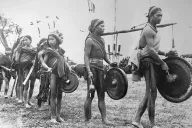
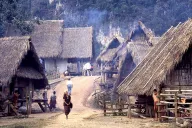
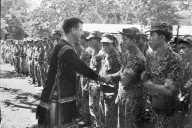
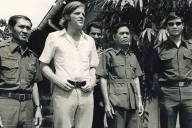

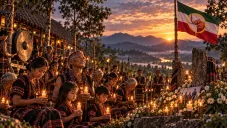
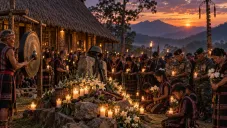
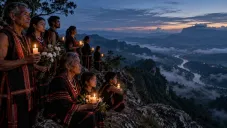

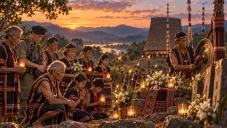
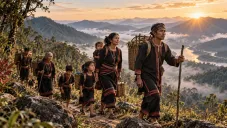
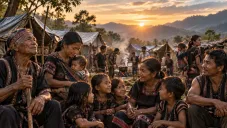
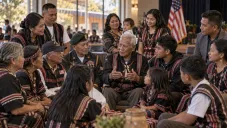
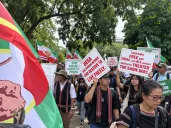
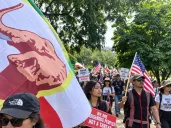
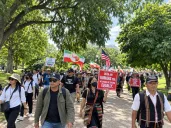




In the summer of 2002 close to nine hundred Dega who had fled into Cambodia after the February 2001 protests were flown to North Carolina. It was the largest single movement of our people to the United States. It happened because a plan to send them back to Vietnam collapsed in the open, in front of UN staff, in a forest camp in Mondulkiri.
Why they were in Cambodia
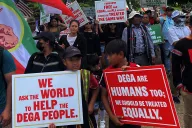
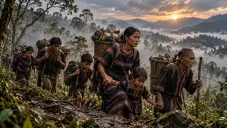
In February 2001 several thousand highlanders demonstrated in the provincial towns for their land and their church (see The 2001 protests). Within days of the crackdown people from Đắk Lắk and Gia Lai began crossing into the forests of Ratanakiri and Mondulkiri. The first to be flown out were 38 — 24 Rhade and 14 Jarai — resettled in the United States in April 2001 after the Cambodian government, having first held them, allowed UNHCR to interview them.
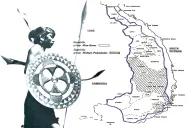
On May 17, 2001, UNHCR obtained Cambodian permission for two sites, one in each province. By the end of May they held close to 400 people. Before and after, Cambodian authorities sent people back: Human Rights Watch counted more than a hundred forcibly returned between March and May 2001, and 167 forced back from Mondulkiri on December 28. By March 2002 more than a thousand highlanders were in Cambodia. The wider story of the camps, 2001–2005, is on The Cambodian camps.
The agreement that failed
- January 21, 2002 — Cambodia, Vietnam and UNHCR reach a tripartite agreement on repatriation. Human Rights Watch notes that it made no mention that returns had to be voluntary.
- February 21, 2002 — Cambodia and Vietnam agree to carry out the returns themselves, with or without UNHCR, and to finish by April 30. UNHCR answers that a deadline “clearly undermines the voluntary nature of return.”
- February 22, 2002 — Cambodia’s co-minister of the interior, Hok Lundy, visits the Mondulkiri site with fifty police and a fire engine. When the refugees shout that they want to stay, a police officer beats five of them with an electric truncheon.
- March 2, 2002 — 61 people are taken from the Ratanakiri site and returned to Vietnam without UNHCR.
- March 21, 2002 — More than 400 people arrive at the Mondulkiri site in twelve tour buses from Vietnam. UNHCR estimated that up to a hundred were officials. Human Rights Watch reports that they threatened and manhandled refugees and UN staff.
- March 22, 2002 — UNHCR withdraws from the tripartite agreement.
- March 31, 2002 — Hun Sen announces that the two sites will close and that no newcomers will be accepted. He agrees that the 905 people under UN protection may go to the United States; the rest must go back. “They cannot choose to live in Cambodia forever,” the Cambodia Daily reported him saying.
- April 15, 2002 — About 550 people are trucked from Mondulkiri to Phnom Penh in eighteen trucks. Witnesses told the Cambodia Daily that Cambodian police and Vietnamese officials set fire to the camp soon after the last truck left; the Interior Ministry denied it.
Phnom Penh to North Carolina
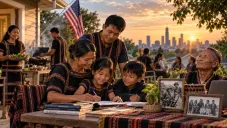
The first fifty left Phnom Penh for the United States on Monday, June 3, 2002. By early July, the Cambodia Daily reported, 558 of the 905 had gone, with the International Organization for Migration arranging the flights. Their cultural orientation was a three-day course, and its teacher began with the basics: “This is a couch. This is a bathtub. This is an escalator. This is a lease.” Smaller groups followed through the autumn while American immigration officials checked cases, and the last departures ran into 2003.
Raleigh Bailey, writing for the Center for Applied Linguistics that year, put it in one sentence: in the summer of 2002 “close to 900 Montagnard villagers were resettled as refugees” in Raleigh, Greensboro and Charlotte and at a new site, New Bern. He noted that they had had little orientation, that most were men, and that many had left wives and children behind in the highlands.
What was different about this group
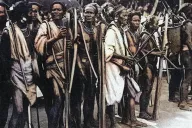
The men of 1986 and 1992 were soldiers, many of them known to American veterans (see Mondulkiri, 1992). The people of 2002 were villagers: farmers and church members who had marched, or had been accused of marching, or had simply been afraid. They came with no English and no military record, and they left families in villages where the police knew who had gone. Much of what the North Carolina community has done since — family reunification, remittances, the fear of speaking publicly — begins with that separation.
After 2002
People kept crossing, especially after Easter 2004 (see Easter week, 2004), but there were no more border camps. In January 2005 UNHCR signed a new memorandum with Cambodia and Vietnam; on July 20, 2005, Cambodia forcibly returned 94 people whose claims had been rejected. By mid-2006, Human Rights Watch counted about 1,300 highlanders resettled abroad from Cambodia since 2001. In December 2010 Cambodia extended the UNHCR center for Montagnards in Phnom Penh to mid-February 2011; it then held 76 people, 62 of them recognized refugees.
See also: Beyond North Carolina.
Sources
- Human Rights Watch, Repression of Montagnards (2002), chapter XIII, “Refugee flight to Cambodia”
- Amnesty International, Viet Nam: No sanctuary — the plight of the Montagnard minority, ASA 41/011/2002; and Viet Nam: Renewed concern for the Montagnard minority, ASA 41/005/2004
- Human Rights Watch, “Cambodia: Protect Montagnard refugees fleeing Vietnam,” September 25, 2002
- The Cambodia Daily: April 1, 2002; April 22, 2002; June 4, 2002; July 4, 2002; September 10, 2002; December 18, 2010
- Raleigh Bailey, Montagnards: Their History and Culture, Center for Applied Linguistics (2002)
- Human Rights Watch, No Sanctuary (2006): summary and chapter 4
Compiled September 2026. We would like to record the memories of people who were in the Mondulkiri and Ratanakiri camps; see How to record an elder.