



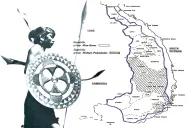











































For thirteen years a French administrator named Léopold Sabatier governed Darlac on the principle that the land belonged to the Rhade and that outsiders should be kept off it. He set up a court that judged by Rhade law, a school that taught in Rhade, and on January 1, 1926, an oath-taking assembly of the chiefs. The same year he was removed, and the plateau was opened to rubber.

Who he was
Léopold Sabatier took charge of Darlac province around 1913–14 and ran it until 1926. He learned Rhade, worked on a way of writing it, and came to hold views that were unusual for a colonial official of his time: that the highlands were not empty, that the Rhade had law and property and government of their own, and that the best thing the colonial state could do was protect them from the people who wanted their land.
What he built
- A Franco-Rhade school at Buon Ma Thuot, teaching in both languages — the school that educated Y Bhăm Êñuôl’s generation (see Y Bhăm Êñuôl)
- A customary law court, from 1923, in which Rhade judges decided cases by Rhade law
- Medical posts, and a highland guard recruited from the Rhade themselves
- A closed-door policy: Vietnamese and Chinese traders, planters and even missionaries were kept out of Darlac, and the land used for shifting cultivation was protected from concession
The oath of January 1, 1926
On New Year’s Day 1926 Sabatier assembled the chiefs of Darlac at Buon Ma Thuot for a palabre du serment — an oath-taking assembly. His own record of it was published by the Imprimerie d’Extrême-Orient in 1930 as Palabre du serment au Darlac: assemblée des chefs de tribus, 1er janvier 1926. In Dega tradition the oath is remembered as a mutual undertaking: the chiefs’ loyalty in exchange for France’s protection of their land. That is the understanding the highland leaders of 1946 and 1958 would appeal to, and it is why the date still matters.
The code
Sabatier collected Rhade customary law in the form in which it was declaimed by the judges — rhythmic, parallel sayings recited from memory. The collection was published after his time, in Hanoi in 1940 by the Imprimerie d’Extrême-Orient, as the Recueil des coutumes rhadées du Darlac (in Rhade, Hdruôm hră klei duê klei bhiăn), with a translation and notes by D. Antomarchi. It sets out, article by article, the law of marriage, inheritance through the mother’s line, land, debt, injury and the settlement of disputes. It remains the most complete written statement of any Dega people’s law.
Sabatier also wrote down the Rhade epic of Dam San, published in Paris in the late 1920s as La Chanson de Damsan. See Gongs and epics.
Why he was removed
The closed door made enemies. Planters and commercial interests in Saigon and Paris wanted the red basalt soils of the plateau for rubber and coffee; missionaries wanted access; and Sabatier quarreled with all of them. In 1926 he was removed. Within a few years rubber concessions had poured onto the plateau — more than a hundred were granted, though the Depression killed most of them — and the pattern that would define the next century was set: the land most valuable to outsiders was the land the Rhade farmed.
A colonial official, not a saint
Sabatier governed us for France, not for ourselves, and his protection was paternal: the Rhade were to be kept as he imagined they had always been. Oscar Salemink, who has written the most careful account, is clear about that. But the court, the school and the code were real, and every later Dega claim that our law and our land were recognized before 1954 points back to Darlac under Sabatier.
See also: Customary law and the village court, The Franco-Rhade school and the Collège Sabatier, Roads, taxes and forced labor.
Further reading
- Léopold Sabatier, Palabre du serment au Darlac: assemblée des chefs de tribus, 1er janvier 1926 (Imprimerie d’Extrême-Orient, 1930) — catalog record
- Léopold Sabatier and D. Antomarchi, Recueil des coutumes rhadées du Darlac (Imprimerie d’Extrême-Orient, Hanoi, 1940)
- Oscar Salemink, The Ethnography of Vietnam’s Central Highlanders (University of Hawai‘i Press, 2003) — the fullest account of Sabatier’s policy and its defeat
- Nakamura, “A Man of the Central Highlands,” JATI: Journal of Southeast Asian Studies 19 (2014)
- Anne de Hauteclocque-Howe, Les Rhadés: une société de droit maternel (Éditions du CNRS, 1987) — publisher; the major study of Rhade kinship and customary law
- Chris Lang, “The legacy of savage development,” Watershed (1995) — Sabatier’s removal and the rubber concessions
- Léopold Sabatier — summary with references
Compiled September 2026. Sources differ on when Sabatier's Darlac posting began (1913, 1914 or 1923). We would like a copy of the 1926 Palabre for our own archive.