

























In 1976 about 1.2 million people lived in the four provinces of the Central Highlands, half of them indigenous. By 2001 there were more than four million, and we were about a quarter. No war, epidemic or famine did that. It was done by migration: planned by the state in New Economic Zones, and then, when coffee made the highlands rich, by hundreds of thousands who came on their own.

The numbers
| When | Where | Figure | Source |
|---|---|---|---|
| early 1900s | Central Highlands | about 240,000 people, the great majority indigenous | HRW (2002) |
| 1921 | Darlac | twenty ethnic Vietnamese residents | HRW (2002) |
| 1943 | Darlac | 80,000 people, of whom 4,000 Kinh | HRW (2002) |
| 1940 → 1989 | Central Highlands | Kinh share of the population rises from 5% to 66% | HRW (2002) |
| 1975 → 1997 | Đắk Lắk | indigenous share falls from 48% to about 20% | HRW (2002) |
| 1976 → 2001 | four highland provinces | 1.2 million → over 4 million; indigenous 600,000 → about 1 million | Salemink (2003) |
| 1976–96 | Đắk Lắk | 311,764 planned migrants and about 350,000 spontaneous migrants | HRW (2002) |
Other figures circulate — “three million” settlers, or “six million” — and they measure different periods and areas, or cannot be traced to a reliable source. We give only figures we can trace. See How many Dega there are.
New Economic Zones
The model came from the North, which had used “New Economic Zones” to move lowlanders into its own mountains during its first five-year plan. After 1975 the new state applied it nationally: at least three-quarters of a million southerners were sent to New Economic Zones, and over a million northerners moved south, according to the geographer Jacqueline Desbarats, as her figures are commonly summarized. In the early 1980s, Human Rights Watch records, the government initiated transmigration programs to the highlands. Many settlers did not stay — as many as half of New Economic Zone migrants left or went home soon after arriving — but those who stayed took land.
State farms and forest enterprises
After 1975 all land belonged to the state. Farming was collectivized and the forests and plantations went to state enterprises. In Đắk Lắk, sixty-four state farms and forty-two state forest enterprises came to control 86 percent of the land while holding about a fifth of the people, Human Rights Watch found. The fallow land of the rice cycle was treated as empty and reallocated (see The rice year and Land law and customary land).
Coffee
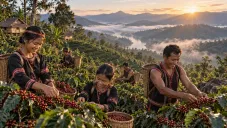
In the 1990s coffee turned planned migration into a rush. Vietnam became the world’s largest exporter of robusta, and Đắk Lắk grew nearly 60 percent of it. Families came from the lowlands and from the northern mountains — Tai, Nùng and Dao among them, in Human Rights Watch’s account — to plant it. Highland villages sold or rented land they could not defend under a law they had not been taught, or simply lost it. Then prices collapsed: from 40,000 đồng a kilo in 1995 to 4,250 in January 2002, a year after the highlands rose in protest. See Land taken for coffee and The 2001 protests.
What it means
Human Rights Watch calculated that migration quadrupled the density of settlers in parts of the highlands, and that the population density had passed the level at which rotating cultivation can work. The indigenous peoples became a minority in most highland provinces. That is the demographic fact behind almost everything else in this library: the loss of land, the pressure on language and church, and the state’s confidence that it can do as it likes in a region where the people it does it to are a quarter of the population.
Sources
- Human Rights Watch, Repression of Montagnards: Conflicts over Land and Religion in Vietnam’s Central Highlands (2002)
- Oscar Salemink, The Ethnography of Vietnam’s Central Highlanders (2003), and “Enclosing the Highlands” (conference paper, 2003)
- Andrew Hardy, Red Hills: Migrants and the State in the Highlands of Vietnam (NIAS Press, 2003)
- Jacqueline Desbarats, “Population Redistribution in the Socialist Republic of Vietnam,” Population and Development Review 13:1 (1987)
- Minority Rights Group, “Highlanders”
- Phuong Nguyen-Hoang and John McPeak, “Leaving or Staying: Inter-Provincial Migration in Vietnam” (2011)
- Gerard Clarke, “From ethnocide to ethnodevelopment?” Third World Quarterly 22:3 (2001)
Compiled September 2026.