







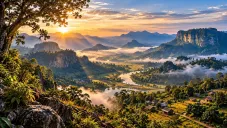

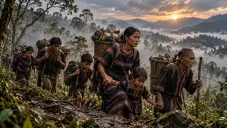
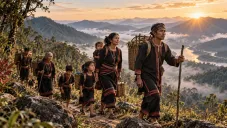
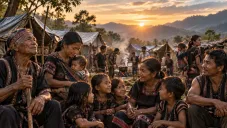







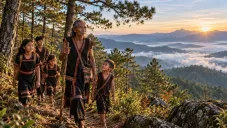

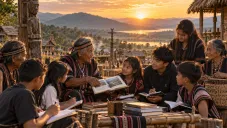

For most of our history the year was measured by rice. A village chose a piece of forest, cleared it, burned it, planted it when the rains came, harvested it, and after a year or two let it grow back while it moved on to the next. Outsiders called this “slash and burn” or “nomadic farming” and set out to end it. This page describes the rice year and what has happened to it.
The cycle
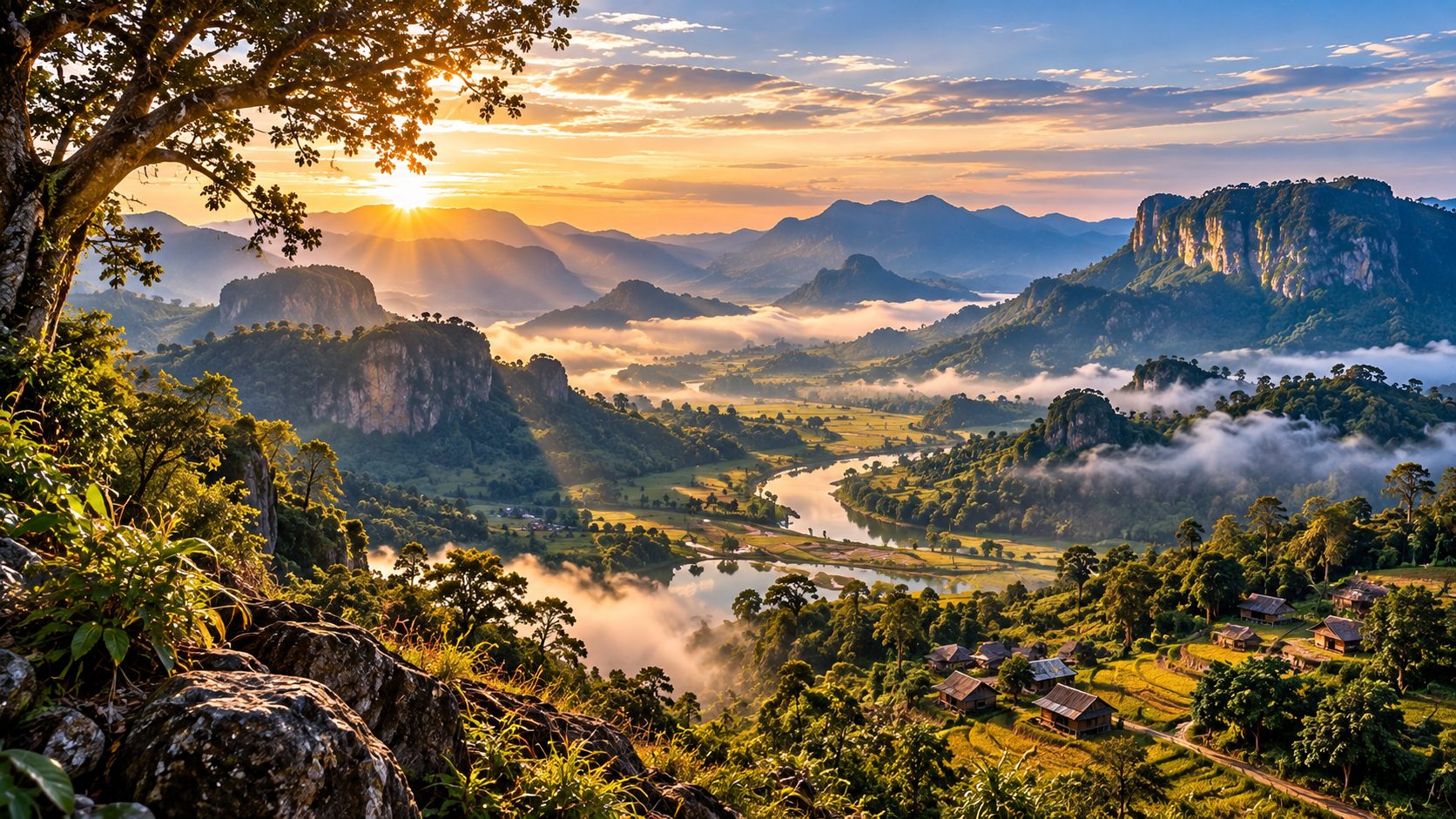
The details differ from people to people and valley to valley, but the shape of the year is shared:
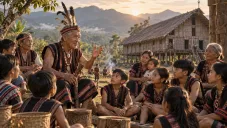
- Choosing — Early in the dry season the elders choose which forest to open, within land the village regards as its own. Omens and dreams are consulted.
- Clearing — The undergrowth is cut and the trees felled or lopped, and the cut wood is left to dry.
- Burning — Just before the rains the plot is burned. The ash is the fertilizer.
- Sowing — When the first rains soften the ground, men make holes with digging sticks and women follow, dropping the seed. Corn, squash, beans and other crops are sown among the rice.
- Weeding and guarding — Through the wet season the field is weeded and watched against birds and animals, often from a field hut.
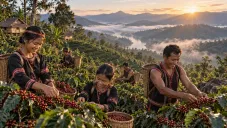
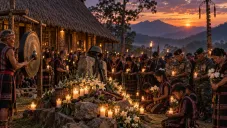
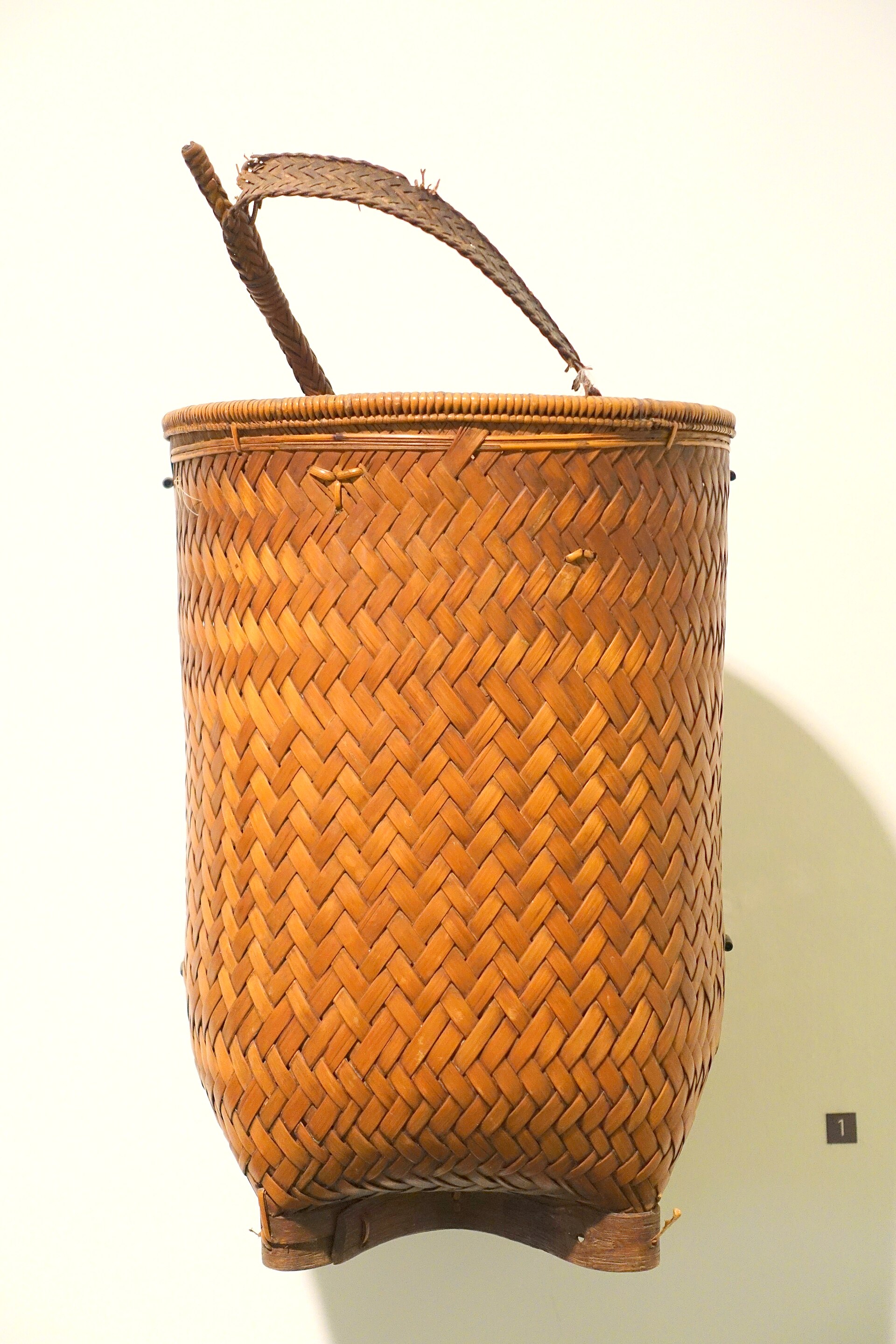
- Harvest — At the end of the rains the rice is cut and carried home in baskets, and the soul of the rice is brought back with it. The harvest festivals follow.
- Rest — After one or two harvests the field is left. Forest returns, and in time — ten years, fifteen, more — the village may come back to it.

“We have eaten the forest”
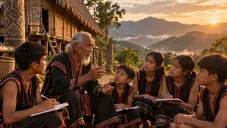
The fullest account of a single rice year is by the French ethnographer Georges Condominas, who lived in the Mnong Gar village of Sar Luk, in what is now Đắk Lắk, from 1948 to 1950. His book takes its title from the words the Mnong Gar used for a year’s farming: Nous avons mangé la forêt de la Pierre-Génie Gôo (1957), in English We Have Eaten the Forest (1977). Month by month it records the clearing, the burning, the sowing and the rites, and the lives of the people who did them.
The missionary and ethnologist Jacques Dournes, who lived for decades among the Sre (Koho) and the Jarai, recorded the same world from inside: the village and its fields, the forest, and the rites, myths and music that went with them. His archive is at the Institut de recherche France-Asie in Paris; Andrew Hardy’s The Barefoot Anthropologist is a guide to his life and work.
Why it was not “nomadic”
Rotating fields is not wandering. A village’s fields moved inside a territory the village knew and defended, and the village itself usually stayed where it was for many years. The forest regrowing on old fields was not abandoned land; it was land resting. Condominas later built a general theory of l’espace social, social space, in which territory is defined by relationships and use as much as by boundaries. To a surveyor, though, a resting field looks empty.
A hundred years of trying to stop it
French forestry law already treated swidden as a threat to the forest. After independence, as the historian Pamela McElwee has shown, Vietnamese ministries took up the same view. The policy that followed has a name: định canh định cư, “fixed cultivation, fixed settlement.” Villages were moved down to valleys, to grow wet rice or cash crops on assigned plots.
- In March 2007, according to Minority Rights Group, a prime-ministerial decision aimed to end swidden farming among minorities by 2010.
- A 2006 study of a village in north-central Vietnam, cited by Minority Rights Group, found that restricting swidden lowered rice yields and food security in the households affected.
McElwee has traced this policy from the colonial period to the present, and shows how little it changed across regimes. Meanwhile, the resting land was reallocated — to state farms, to settlers, and to coffee and rubber (see Land taken for coffee and Rubber).
What remains
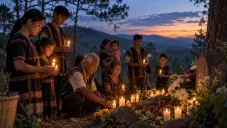
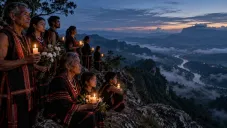
Some villages still farm upland rice, on smaller plots and shorter rotations. The festivals and the rites of the rice soul are kept in many places, and in the diaspora. See Dega culture and Gongs and epics.
See also: The Mnong, Food and the highland kitchen.
Sources
- Georges Condominas, We Have Eaten the Forest (1977; French original 1957) — Internet Archive
- Andrew Hardy, The Barefoot Anthropologist: The Highlands of Champa and Vietnam in the Words of Jacques Dournes (Silkworm Books)
- Institut de recherche France-Asie, Jacques Dournes archive
- Pamela McElwee, “Shifting policies for shifting cultivation: A history of anti-swidden interventions in Vietnam,” Journal of Southeast Asian Studies 53 (2022)
- Minority Rights Group, “Highlanders” (Vietnam)
Compiled September 2026. The calendar above is a general outline. If you can describe the rice year as your own village kept it, with its names for the months and the rites, we would like to add it.