





































In Vietnam no one owns land: it belongs to “the entire people,” and the state manages it. What families hold are rights to use it, recorded in certificates called red books. For highland villages, whose land was held by clans and lineages, rested in fallow for years and was defined by custom rather than surveys, this system has been the legal mechanism of dispossession. This page explains how it works.
How our land was held
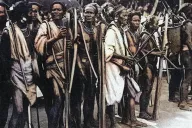
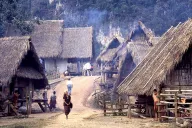
Before the modern state, highland land belonged to villages and, among the Rhade and Jarai, to clans through their women; the Rhade po lan, senior women, held clan land by inheritance and walked its boundaries (see The Rhade). Fields rotated through the forest and came back after long fallow (see The rice year). Human Rights Watch summarized it in 2002: rotational farming, customary rights over fallow land, village boundaries set by elders, and inheritance through the female line.
How the state holds it
- Ownership. Under the 2013 Constitution, land is public property owned by all the people and managed by the state. The 2024 Land Law repeats it: the state acts as the owner’s representative.
- Use rights. Households and organizations receive rights to use land for fixed terms — indefinitely for residential land, 50 years for farm and forest land — recorded in land-use right certificates, the “red books.” The rights can be exchanged, sold, leased, mortgaged and inherited.
- After 1975. All land became the state’s. Farming was collectivized, and forests and plantations passed to state farms and forest enterprises, which in Đắk Lắk came to control 86 percent of the land (see The great migration).
The land laws
- 1988 — Collective farming largely ends; land is leased to households.
- 1993 — The Land Law makes the household the unit of farming and grants the five rights to exchange, transfer, lease, mortgage and inherit use rights. Red books are issued — for permanent fields. Fallow swidden land counts as unused.
- 2003 — For the first time the law allows land to be allocated to “communities.” In practice it has rarely happened.
- 2013 — A new Land Law includes a policy on ethnic minority land “in accordance with the customs, traditions and cultural identity” of each region.
- 2024 — The Land Law of January 18, 2024, replaces the state’s broad discretion to recover land for “socio-economic development” with a fixed list of cases (31, by one law firm’s count), moves to market-based prices, and requires provinces to ensure land for minority communities’ activities and to support landless minority households. According to an English translation of the law, a “residential community” — a village sharing customs or clan ties — may be allocated land, but may not transfer it.
What the law does not recognize
“Vietnam’s legal system has not recognized customary laws since 1975,” the US land-rights program LandLinks notes. Custom is allowed only where it agrees with the law. Vietnam, as Minority Rights Group puts it, “does not acknowledge customary indigenous land ties”; nor does it recognize indigenous peoples at all. Human Rights Watch found in 2002 that land law “does not accommodate the customary communal ownership” of the highlands and covered only permanent agriculture, so fallow land was treated as unused and redistributed.
The results
- As of 2015 only about 2 percent of forest land had been allocated to communities; state enterprises, management boards and communes held most of it.
- By around 2010 ethnic minorities held certificates to only 1 percent of Vietnam’s forest land, and only 4 percent of minority people in the Central Highlands reported access to forest use.
- More than 300,000 households in the mountain regions still lacked farming or residential land, according to a National Assembly committee report cited by researchers in 2019.
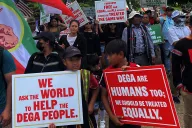
- Return of ancestral land was one of the two central demands of the protests of 2001 and 2004 (see The 2001 protests and Easter week 2004).
What the United Nations has said
In 2019 the UN Human Rights Committee said it was concerned that Vietnam does not recognize its indigenous peoples and that they are not consulted on “the seizure and allocation of land, including traditional and ancestral lands, for development projects,” and called for consultation with a view to their free, prior and informed consent. In 2023 members of the Committee on the Elimination of Racial Discrimination raised the confiscation of ancestral lands. See What Vietnam signed and Indigenous rights at the UN.
See also: Customary law and the village court, Forests, logging and the sacred groves.
Sources
- USAID LandLinks, Vietnam country profile (archived copy; the USAID site is offline)
- Open Development Vietnam, “Land” and “Communal land”
- Phuc To, Sango Mahanty and Andrew Wells-Dang, “From ‘Land to the Tiller’ to the ‘New Landlords’?” Land 8:8 (2019)
- EY, legal update on the Law on Land No. 31/2024/QH15; CNC Counsel, “Vietnam 2024 new land law: 8 key notes”; LuatVietnam, English translation of the 2024 Land Law (a private Vietnamese legal publisher); IWGIA, The Indigenous World 2024: Vietnam
- Human Rights Watch, Repression of Montagnards (2002)
- UN Human Rights Committee, CCPR/C/VNM/CO/3 (2019), paras 55–56
- Minority Rights Group, “Highlanders”
Compiled September 2026. This page describes the law in general terms and is not legal advice.