



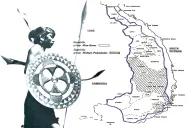

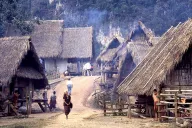



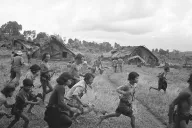







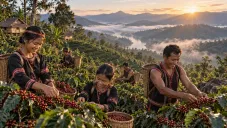

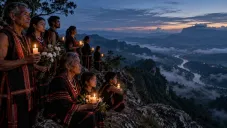


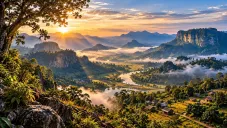

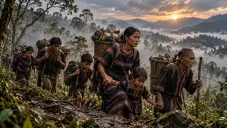

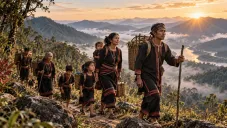
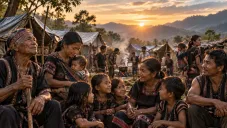















The Sesan and the Srepok carry water from our highlands into Cambodia, where the same peoples live on both banks. In 2017 the gates closed on Lower Sesan 2, a dam just below the rivers’ meeting in Stung Treng. It flooded some 30,000 hectares and displaced nearly 5,000 people, mostly Indigenous peoples and other ethnic minorities — among them Bunong, Brao, Lao and Jarai — and in 2021 some of those who refused to leave were still living at the edge of the water.
Upstream first
Lower Sesan 2 was not the first dam on these rivers. From the late 1990s, releases from Vietnam’s Yali Falls dam on the Sesan sent floods downstream into Ratanakiri; the story, and the resettlement on the Vietnamese side, is on The dams. Mekong Watch wrote that the floods threatened the livelihood of some 20,000 people. The villages organized in the Sesan Protection Network, later the Sesan, Srepok and Sekong network. In 2005 the network reported four deaths after high water from Yali — three from water-borne illness, one woman in a boat accident; a provincial official denied the dam was to blame.
Who was moved
Human Rights Watch conducted more than sixty interviews between April 2019 and July 2020. It found that the dam displaced nearly 5,000 people, “mostly Indigenous peoples and other ethnic minorities” — among them Bunong, Brao, Kuoy, Lao, Jarai, Kreung, Kavet, Tampuan and Kachok — and that tens of thousands more upstream and downstream lost fisheries and farmland. The company’s compensation plan, International Rivers noted, listed only six affected villages; other studies found more than 250.
- Kbal Romeas was a Bunong village. Sarah Milne, Sango Mahanty and Thomas Cristofoletti reported in 2021 that 52 Bunong families had refused the resettlement package and stayed on their customary land, and that a third of the houses in the Kbal Romeas resettlement village were empty.
- Srekor was two Lao villages, submerged in 2017. Seventy-two Lao families rebuilt on their own land at the edge of the reservoir.
What they were given
The package, HRW reported, was a plot of about five hectares at a resettlement site and a house, or 6,000 US dollars. Fishing losses were paid once, covering one year; farming losses were not paid. More than 180 families refused. Villagers told HRW they used to catch up to forty kilos of fish a night; now they sometimes struggle to get ten. A 2012 study in PNAS estimated that the dam would cut fish stocks across the Mekong basin by 9.3 percent.
The spirits and the dead
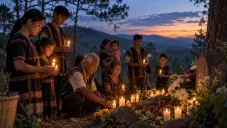
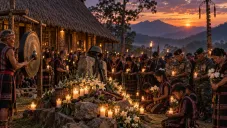
For the people of these villages the loss was not only land. The geographers Ian Baird and Akarath Soukhaphon have written about the spirit mediums of the Lower Sesan 2 villages and the sacred places the reservoir covered. The same pattern — spirit forests and burial grounds lost to projects designed elsewhere — runs through Forests, logging and the sacred groves and Rubber.
Why this is in our library
The Bunong of Kbal Romeas are the Mnong of Đắk Nông; the Jarai of the Sesan are the Jarai of Gia Lai (see Kin across the border and The Mnong). A border drawn by France divides a single people, but not a single river.
Sources
- Human Rights Watch, Underwater: Human Rights Impacts of a China Belt and Road Project in Cambodia (August 2021)
- International Rivers, Watered Down (November 2019)
- Sarah Milne, Sango Mahanty and Thomas Cristofoletti, “Ruptured Worlds: A Photo Essay on the Lower Sesan 2 Dam,” Global China Pulse (2021)
- Ian G. Baird and Akarath Soukhaphon, “The Belt and Road Initiative and spirit mediums: the Lower Sesan 2 dam and sacred space in northeastern Cambodia,” Modern Asian Studies 58:5 (2024), 1342–1363
- Mekong Watch, Cambodia; Lower Sesan 2
- The Cambodia Daily: September 2, 2005; July 17, 2017
- Ziv et al., “Trading-off fish biodiversity, food security, and hydropower in the Mekong River Basin,” PNAS 109:15 (2012)
Compiled September 2026. Figures for the people displaced range from about 2,000 in early estimates to more than 5,000; we follow Human Rights Watch.