


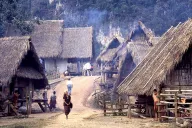
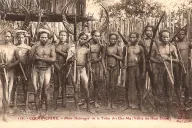

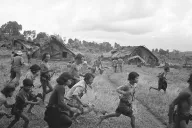




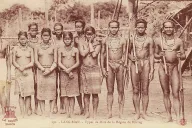
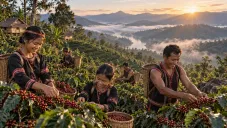
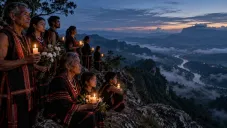


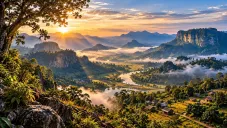

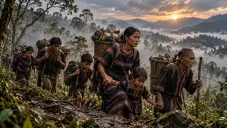
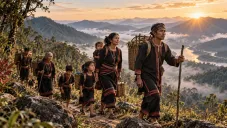
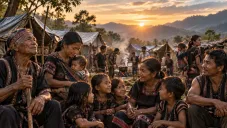



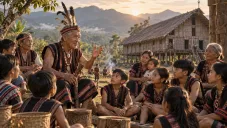






The highlands were forest country, and the forest was ours: farmland in rotation, hunting ground, the place of the spirits and the dead. After 1975 the forest became state property, managed by state forest enterprises and cleared for settlers and coffee. What remains is being handed back in small pieces of poor land, while logs cut across the border in Cambodia come the other way.

From village forest to state forest
After reunification the state took the forest. In Đắk Lắk, Human Rights Watch reported in 2002, citing a 1996 study, sixty-four state farms and forty-two state forest enterprises controlled 86 percent of the province’s land, “including virtually all of the high quality land.” A village petition HRW published describes what that meant: from 1986 the government took the village’s land, much of it for a state tree nursery run by the provincial forestry service; in 1995 “the forestry unit employed armed units to further confiscate village land”; and the forestry service then sold the land to newcomers to plant coffee and sugar cane. A Mnong villager from Đắk Mil told HRW: “In my village from 1994-2000 the Vietnamese took our land-even plowing over our cemetery to build their houses.”
How much was lost
A 1996 survey cited by HRW estimated that new migrants had cleared as much as 100,000 hectares of forest in Đắk Lắk alone over twenty years. A 2026 report by Coffee Watch, reported by Mongabay, puts forest cover in the Central Highlands at 42.8 percent in 1990 and 19 percent by 2020, with the worst losses between 1995 and 2010, the years of the coffee boom (see Land taken for coffee and The great migration). Official figures are higher, partly because definitions of forest differ; they are the state’s, and we do not use them.
Handing it back
The state has since begun allocating forest land to households. Studying a pilot of forest land allocation in the Central Highlands, the researchers Thomas Sikor and Trần Ngọc Thanh found that it “failed to diminish the gap between state and customary regulations, created conflicts among local actors, and contributed to forest loss.” The International Work Group for Indigenous Affairs reports that by 2015 only 26 percent of forest land had been allocated to households, and only 2 percent of that to communities — and that some communities complained the forest they received was of low quality, “with no plant cover.” In our view, villages that had managed their forest as a whole for generations have received it back, if at all, in scraps.
Schemes that pay villagers to protect forest have been studied more favorably: a 2021 study of 404 households in the Central Highlands found that payments for forest environmental services had positive effects on income and on attitudes toward conservation. The forest they protect remains the state’s.
The spirit forests
Our elders say every village kept forest it did not farm: the grove of the spirits, the burial forest, the water source. We have found no independent study of what has happened to them on the Vietnamese side. Our best documentation of this comes from across the border. Global Witness reported in 2013 that the Vietnamese company Hoàng Anh Gia Lai held rights to 47,370 hectares of concessions in Cambodia, an area equal to 5 percent of Ratanakiri; in Ratanakiri, village chiefs and elders described how the companies had destroyed spirit forest sites and burial grounds (see Rubber and Kin across the border).
Logs across the border
- 2016–17. The Environmental Investigation Agency documented logs cut in Ratanakiri, including in Virachey National Park, crossing into Gia Lai under a 300,000 cubic meter import quota issued by the province for five border crossings. From Virachey alone about a hundred log carriers a day crossed, some 110,000 cubic meters in 55 days; the roughly 300,000 cubic meters smuggled was worth at least 75 million US dollars.
- 2019. Forest Trends reported that about 500,000 cubic meters of Cambodian timber still crossed into Vietnam each year despite Cambodia’s export ban.
What we have not found
We have not found an independent study of the sacred and burial forests on the Vietnamese side, or of arrests of villagers over forest land since 2004. These are exactly the things a village can record for itself; see How to record an elder.
See also: Hunting, the crossbow and the forest, Lower Sesan 2.
Sources
- Human Rights Watch, Repression of Montagnards (2002), chapter V and chapter VI
- Thomas Sikor and Trần Ngọc Thanh, “Exclusive versus inclusive devolution in forest management: insights from forest land allocation in Vietnam’s Central Highlands,” Land Use Policy 24 (2007)
- IWGIA, Vietnam
- Mongabay, on the Coffee Watch report, July 2026
- Pham et al., Forest Policy and Economics 132 (2021)
- Global Witness, Rubber Barons (2013)
- Environmental Investigation Agency, Repeat Offender (2017)
- Forest Trends, October 2019
Compiled September 2026.