




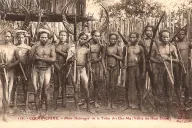


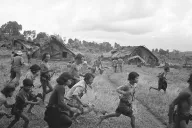






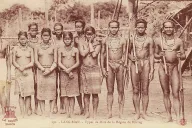




























French rule came to our villages as a tax to pay in cash and days of unpaid work on roads. The roads carried soldiers, officials and, later, the plantations onto our land. More than once, the work itself set off a revolt.
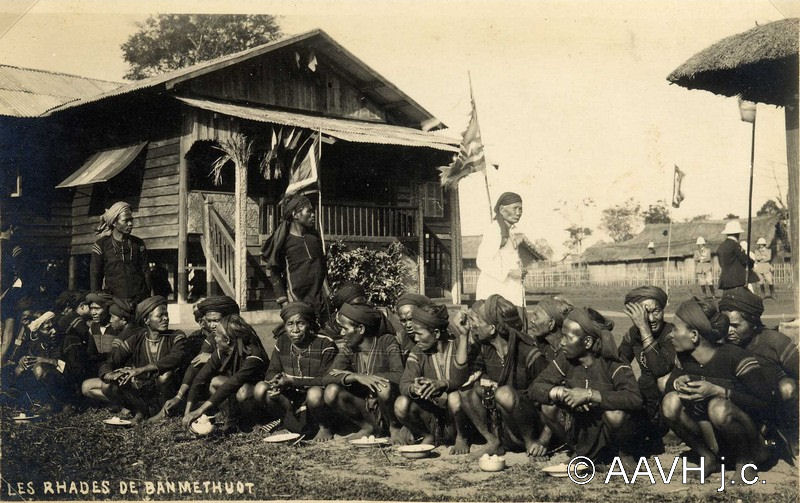

A tax in money
The best-documented case is on the Cambodian side of the southern plateau, among the Mnong and Stieng, studied in detail by the historian Mathieu Guérin. In January 1899 the old tribute to the Cambodian king was abolished and replaced by a head tax: 2.5 piasters for each able man aged 21 to 50, and 0.8 for old men. In 1901 the tax was presented as ancient custom; Guérin’s verdict is that it was a matter of legitimizing “un nouvel impôt en le drapant de l’apparence de la coutume” — a new tax dressed up as custom. Its yield from the highland villages was expected to grow about fivefold. For people who traded in goods and hardly used money, the cash had to be found somewhere.
The tax was collected even in hunger. In the famine of 1913 at Stung Treng, Guérin records, dozens of highlanders starved to death or left to hire themselves out in Laos, and “les opérations de recouvrement ne sont pas suspendues” — collection did not stop.
Days of unpaid work
From 1902 the Mnong also owed corvée, the labor tax: “dix jours de travail par an,” ten days a year, mostly maintaining roads along the Mekong. For the men of Bu Gler that meant eight to ten days’ walk there and back to do ten days’ work. By the 1930s it was fifteen days a year, on tracks and forts, under the guard of colonial troops. A man with money could buy his way out, for between two and four and a half piasters; the burden fell hardest on those without cash, which in practice meant the highlanders. Of the men requisitioned at Bu Gler, Guérin writes: “Il s’agit donc d’un travail forcé, exécuté au titre de la corvée” — this was forced labor, carried out in the name of corvée.
Darlac under Sabatier
In Rhade country the same system built the roads of Darlac. The anthropologist Oscar Salemink writes that Léopold Sabatier used the poll tax to fund “the construction of a network of roads built by corvée labor of Montagnards and forced labor of convicts.” Some Rhade, among them Sabatier’s ally the elephant chief Ma Krong, complained of the amount of corvée he demanded. And those roads “opened up the fertile but hitherto hardly accessible Darlac Plateau to rubber plantations which Sabatier feared would destroy Rhade society.” See Sabatier, the oath of 1926 and the Rhade law code and Rubber.
The revolt that began on a work site
“Le 22 juillet 1914 à midi, la centaine de prestataires du chantier de Bu Gler se soulève”: at noon on July 22, 1914, the hundred or so corvée laborers building a militia post at Bu Gler rose up. It was the start of the Mnong revolt associated with N’Trang Lơng. That September the French exempted the Mnong who had stayed loyal from corvée, to take the edge off the rising, which shows that they too understood what had caused it. See N’Trang Lơng.
Route Coloniale 14
The great north–south road through the highlands, Route Coloniale 14, was built to carry the state onto the plateau. In 1929 an official named Gatille restarted work on it from Snoul, in Cambodia. On May 26, 1931, he was killed in an ambush by Mnong of Bu Than as the track reached the foot of the plateau. His killers, arrested that November, said they had hoped the white man’s death would make the French withdraw and stop the work. Instead a punitive column attacked their villages, bombers were used in the area for the first time, and the road went on under heavy guard. The section joining the Cambodian and Annam roads was finished in March 1934. The missionary Gordon Smith, writing a few years later, said the new Route 14 would “facilitate the speedy penetration of the tribes’ territory.”
Road work as punishment
At the end of 1937 a movement began among the Jarai of Darlac around a man named Sam Bram, who announced a coming catastrophe from which only those who performed his rites would be saved. People across the plateau followed him, and the French arrested him for fraud. Smith saw what followed in Darlac: “Each man who had paid the two cents tribute had to spend ten days working on the road or in jail,” and each village chief who had obeyed Sam Bram was fined twenty piasters.
The plantations
The rubber estates of the plateau were worked mostly by contract laborers brought from northern Vietnam, whose conditions Guérin describes as dehumanizing. But highlanders were not spared. Salemink concludes that the French “could not win Montagnard affection in the face of taxes, corvée labor, and forced labor under horrible conditions on the plantations.”
What is missing
The detailed figures here come from the Cambodian side of the plateau. We have not yet found the number of corvée days, the tax rate or the dates of the first tax in Kon Tum, Pleiku, Darlac or Haut-Donnaï, nor the history of the Kon Tum–Pleiku–Buôn Ma Thuột road. Salemink’s study of the Sam Bram movement, “The Return of the Python God” (1994), and Gerald Hickey’s Sons of the Mountains (1982) hold more, and we have not yet been able to read them.
Sources
- Mathieu Guérin, Des casques blancs sur le Plateau des Herbes: la pacification des aborigènes des hautes terres du Sud-Indochinois, 1859–1940, doctoral thesis, Université Paris-Diderot (2003) — quoted in French; translations ours
- Oscar Salemink, “Mois and Maquis: The Invention and Appropriation of Vietnam’s Montagnards from Sabatier to the CIA,” in G. W. Stocking (ed.), Colonial Situations (University of Wisconsin Press, 1991)
- Gordon H. Smith, The Blood Hunters (Chicago, 1942)
- Gerald C. Hickey, The Major Ethnic Groups of the South Vietnamese Highlands, RAND RM-4041 (1964) — text copy
Compiled September 2026.