
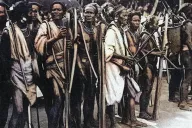


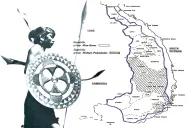
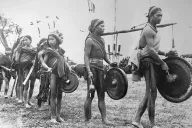

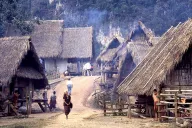

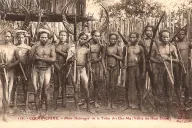
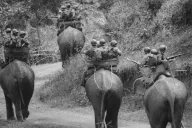

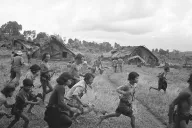


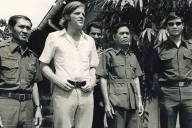



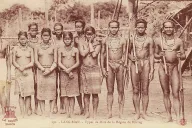




























For more than twenty years, from 1912 to 1935, the Mnong of the upper Chhlong river held the French out of their country. Their leader was N’Trang Lơng, a Mnong koragn — a man of knowledge and a mediator, not a hereditary chief. His people killed the explorer Henri Maître, destroyed French posts, stopped a colonial road, and governed themselves until aircraft and roads broke them. It was one of the longest armed resistances in the history of the highlands.
Names
He appears in the sources as N’Trang Lơng (Vietnamese), N’Trang Lung (Salemink) and Pa Trang Loeng or Loeung (Guérin, and Cambodian usage). His people are the Mnong — in Cambodia, the Bunong — and the revolt also drew in their Stieng neighbors. Sources disagree about his home village.
Why they rose
The resistance began in the tri-border country where Cambodia, Cochinchina and Annam met, among the Mnong Biat confederation of Bu La and Bu Gler on what is now the Mondulkiri plateau. From about 1909, Mathieu Guérin shows, French and Khmer pressure grew fast: Khmer settlers moved in, new posts brought administrators on constant visits, the old tribute every three years became a burden of many taxes, and Lao and Chinese moneylenders impoverished the villages. A very bad harvest came on top. In 1912 — Salemink says 1913 — Pa Trang Loeng brought most of the villages together in revolt. One account, drawing on Guérin, says it began when militiamen requisitioning elephants seized his wife and daughter and a column under Maître burned his village.
The death of Henri Maître, 1914
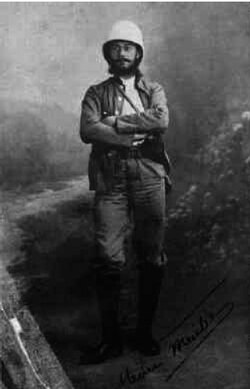
Henri Maître, born in 1883, was the explorer whose books on the highlands Salemink calls unsurpassed in their detail; Guérin, reading the archives, shows him as far more authoritarian and brutal than the colonial legend allowed. In late July or early August 1914, at Mera, Maître and his militiamen were killed by a Mnong force Salemink puts at 400 men, led by N’Trang Lơng. One account, following Guérin, says the Mnong came to a peace ceremony, persuaded the militiamen to smear their guns with rice beer and the blood of the sacrificed pig, and then fell on them. The post at Mera was destroyed. Another French officer, Truffot, was killed in 1915.
Twenty years free
French columns, and from 1915 fortified camps built around rebel villages, failed. Until the early 1930s, as Emmanuel Poisson summarizes Guérin’s findings, French and Khmer officials “took care not to intervene in the enclave.” The villages ruled themselves and their customary courts sat again. The revolt also blocked the completion of Colonial Route 14 between Saigon and Huế. Guérin has said the Mnong freed themselves from colonial rule “for twenty years.”
The end
- 1931 — Two roads across the “Plateau des Herbes” make fast military action possible. The Haut-Chhlong territory, roughly today’s Mondulkiri, is placed under army rule. The délégué Gatille of Thủ Dầu Một is killed.
- 1933 — The enclave is “in flames again.” A new generation of leaders uses the memory of 1912 and divination by dreams to rally the villages. Auguste Morère, a French post chief, is killed.
- 1933–35 — This time the response is immediate: bombing, raids and the destruction of livestock and food stores drive the rebels into the forest.
- April 1935 — Before an attack on the post named after Gatille, the Mnong sorcerer N’long promises that French bullets will not leave the guns. He is killed in the attack.
- May 1935 — N’Trang Lơng is killed. Guérin’s account has him fall to the French on May 22; Salemink, citing the French commander, says he was handed over by his own men. His death brings a cascade of surrenders.
After the conquest the Mnong of Mondulkiri kept a relative independence, Guérin found, unlike the Stieng of Memot, whose land was taken for rubber (see Rubber). The colonial border had already cut the Mnong in two without consulting them; the western Mnong went to Cambodia and the eastern to Vietnam (see Kin across the border).

How he is remembered
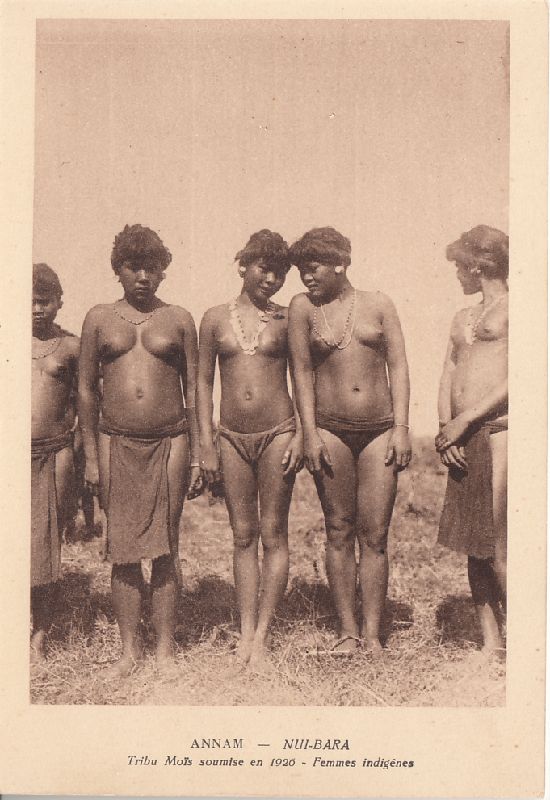
The colonial authorities put up a monument to Maître in 1943. Since 1975 the Vietnamese state has celebrated N’Trang Lơng as a hero of resistance to colonialism. On the Cambodian side, the anthropologist Catherine Scheer has traced how he turned “from murderer to hero,” and a statue now stands there too. We record him as what the sources show: a Mnong leader who defended his people’s country against the French for more than twenty years.
Sam Bram and the Python God, 1937
Two years after N’Trang Lơng’s death, a different movement swept the Jarai country around Cheo Reo. In June 1937 villagers began to say that the Python God had returned to announce a Golden Age, which would follow a cataclysm sparing only those who held the magic water given out by a man named Sam Bram. Villages closed themselves off, sacrificed buffaloes and sought out one-sou coins. The belief spread to Kon Tum and beyond. The French arrested Sam Bram’s followers and imitators, withdrew the one-sou coin, and in September 1938 a court in Darlac sentenced him to ten years for “sorcery with the aim of swindle.” His fate is disputed. Salemink, who has written the fullest study, argues that the French wrongly took scattered millenarian activity for an organized rising; Jarai elders told him in 1991 that it had been a religious cult with no political aims.
See also: The Mnong, The Stieng, Roads, taxes and forced labor.
Sources
- Mathieu Guérin, Paysans de la forêt à l’époque coloniale (2008), as reviewed by Emmanuel Poisson and Nicolas Krautberger; and his thesis Des casques blancs sur le Plateau des Herbes (2003)
- Guérin et al., Des montagnards aux minorités ethniques (IRASEC, 2003)
- Oscar Salemink, The Ethnography of Vietnam’s Central Highlanders (2003), and “The Return of the Python God,” History and Anthropology 8 (1994)
- Guérin interviewed in Le Petit Journal, Cambodia
- Catherine Scheer, “From murderer to hero. Memory politics in the highlands of Cambodia,” lecture, 2024
- Claude Morère (ed.), Le Dialogue interrompu
- J.-M. Filippi, review of Guérin — the date of May 22, 1935; J.-M. Grau, biography of Henri Maître — the account of the 1912 trigger and of Maître’s death
Compiled September 2026. The dates of the revolt’s beginning, of Maître’s death and of N’Trang Lơng’s death differ between sources; we give the range.