



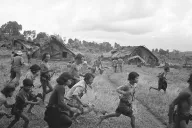





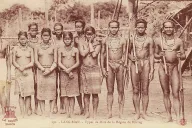


















From at least the eighteenth century until the French arrived, the highlands were a hunting ground for people. Highlanders were seized in raids, carried down to the markets of the Mekong and sold in Cambodia, Siam, Laos and the Vietnamese south. The trade shaped where villages stood and how they were built, it gave the lowland peoples their words for us, and it became one of the arguments the French used to justify taking the highlands for themselves.

Who took whom
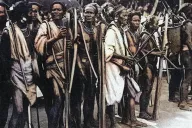
From the eighteenth century, the historian John Murdoch wrote, Siamese, Lao and Khmer raiders took slaves among the peoples east of the Mekong. Some highland peoples raided their weaker neighbors for the same markets: Murdoch names the Sedang, the Ta Oi and the Jarai, and the Sedang above all. Ian Baird records that the Brao were frequent victims of raids organized by the Lao, the Siamese and other highland groups, and that some Brao in turn sold captives on to the Jarai and Sedang.
The demand came from the lowland states. Oscar Salemink describes a trade “stimulated from Siam, Laos and Cambodia” that produced “an unstable situation of raiding, inter-village warfare and hunting for humans to be sold as slaves”; the historian Li Tana has shown that the Vietnamese south was as important a market as Phnom Penh and Bangkok. The Cambodian court saw the north-eastern highlands, in Mathieu Guérin’s phrase, as a “reserve of slaves”; villages that paid tribute to the Khmer king were given protection from the slave hunters in return.
The markets
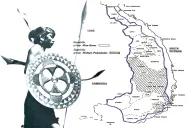
Captives went down the rivers to Stung Treng and to Bassac (Champassak), the outlet for the eastern Mekong’s trade in cardamom, wax, resin, skins, horns and people, and from there on to Ubon, Khorat, Bangkok and Phnom Penh. We have found no reliable count of how many were taken, and no price series from the nineteenth century. One late figure survives: in Stieng country in the 1920s, a French post chief recorded that a man was worth four or five buffaloes, and a young woman up to eight.
What it did to the highlands
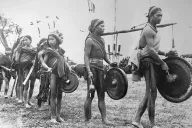
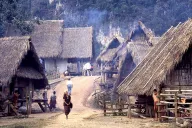
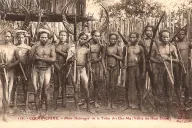
- Villages were fortified. Guérin found that fighting between highland villages over kidnappings for sale continued in places until the mid-twentieth century, one reason villages were fenced and defended.
- Big men and debt. Salemink records highland “big men” who owned many slaves, either captured or from indebted households. Debt-dependants were absorbed into the household and were almost indistinguishable from other members; captives were mostly sold on.
- The names. The lowland words for highlanders — mọi in Vietnamese, kha in Lao and Thai, phnong in Khmer — all mean “savage” or “slave.” Salemink links them directly to the trade. See Names and words.
Abolition, and its uses
- 1874 — King Chulalongkorn begins the gradual abolition of slavery in Siam.
- 1877 — Jules Harmand’s mission describes continuous raids and captives sold in the markets of Phnom Penh and Bangkok, shocking French readers. A Cambodian royal proclamation abolishes slavery, on paper.
- 1880 — A report on slavery commissioned by the governor of Cochinchina is published.
- 1884 — Siam forbids the capture and sale of “Kha” slaves in its eastern territories. The convention forced on King Norodom provides that slavery in Cambodia will be definitively abolished.
- Late nineteenth century — The French occupation of Kon Tum cuts a slave route; resentment at the end of the trade is one of the causes of the rising on the Bolovens plateau in 1901–02.
The French presented themselves as abolitionists, and Guérin shows how they stretched the word “slavery” to cover every kind of dependence they found, as part of the “civilizing mission” that justified their rule. The trade in raided captives was banned, but it did not disappear at once.
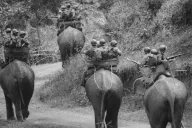
The trade also touched figures we remember differently. The elephant-hunting chief of Bản Đôn who held the Siamese title Khun Jonob served in the Siamese army, and later explorers described him as a slave trader; Oscar Salemink, who names him Ma Krong, reads his appeals for French protection as a way of turning French force against his rivals. See The elephants of Bản Đôn.
What we do not have
No collection of highland memories of the slave raids has been published. Some families will still know the stories. If yours does, we would like to record them; see How to record an elder’s story.
Sources
- John B. Murdoch, “The 1901–1902 ‘Holy Man’s’ Rebellion,” Journal of the Siam Society 62 (1974)
- Oscar Salemink, The Ethnography of Vietnam’s Central Highlanders (2003), and “A View from the Mountains”
- Mathieu Guérin et al., Des montagnards aux minorités ethniques (IRASEC, 2003), chapter 1
- Emmanuel Poisson, review of Mathieu Guérin, Paysans de la forêt à l’époque coloniale, Histoire & Sociétés Rurales 33 (2010)
- Ian G. Baird, “Contested History, Ethnicity and Remembering the Past: The Case of the Ay Sa Rebellion in Southern Laos,” Crossroads 18:2 (2007)
- Milton Osborne, “The French in Cambodia: Years of revolt (1884–1886),” Phnom Penh Post (1998)
- Claude Morère (ed.), Le Dialogue interrompu: Journal d’Auguste Morère — the 1920s buffalo prices
Compiled September 2026.