
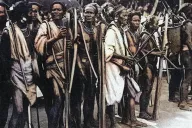


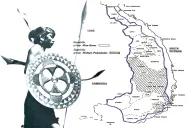
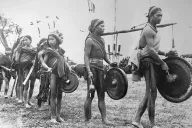

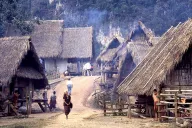

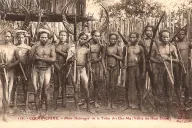
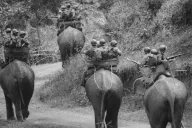
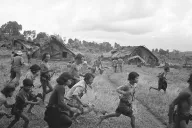






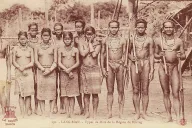




























The Stieng live at the south-western edge of the highlands, where the plateau falls toward the plains north of Saigon, in today’s Bình Phước and across the border in Cambodia. Their red soils were taken for French rubber plantations, and they rose against both French and Vietnamese settlement repeatedly in the nineteenth and twentieth centuries.

Language
Stieng is a South Bahnaric language, related to Mnong and Chrau. Linguists distinguish Bulo Stieng and Budeh Stieng; Hickey named the Budip and Bulach as subgroups. Glottolog lists Bulo Stieng as threatened.
How many
| Figure | Year | Source |
|---|---|---|
| 60,000 | 1951 | estimate cited by Hickey (1964) |
| 17,162 | 1960 | South Vietnamese figure, cited by Hickey (1964) |
| 50,194 | 1985 | Vietnamese census, per the Encyclopedia of World Cultures |
| 66,000 | not stated | Human Rights Watch, Repression of Montagnards (2002) |
Census figures after 1975 are the Vietnamese state’s own counts, which we reproduce only because no independent count exists; see How many Dega there are.
Society
The Encyclopedia of World Cultures describes the Stieng as lacking any tribal-level political organization, with each family the basic social and political unit; Hickey noted that the whole family was held responsible for the wrongs of any member. They farmed upland rice, hunted and fished. Their spirit world, Hickey wrote, was “large and complex,” and witchcraft was feared.
Resistance
- 1859 — The Stieng near Thủ Dầu Một revolt against the French, according to Hickey. The French explorer Henri Mouhot stays among the Stieng that year, as he recorded in his Travels (1864).
- 1910s–30s — French companies plant rubber on the red soils of Stieng country (see Rubber).
- 1933 — Auguste Morère, the French post chief among the Stieng, is killed near Núi Bà Rá.
- 1934–35 — Mnong and Stieng together attack Camp Rolland, a major French post, according to Hickey (see also N’Trang Lơng).
Sources
- Gerald C. Hickey, The Major Ethnic Groups of the South Vietnamese Highlands, RAND RM-4041 (1964) — text copy
- Encyclopedia of World Cultures, “Stieng”
- Th. Gerber, “Coutumier Stieng,” BEFEO 45 (1951)
- Glottolog, Bulo Stieng
- Mathieu Guérin, Paysans de la forêt à l’époque coloniale (2008) — further reading on the Mnong and Stieng of Cambodia
- Claude Morère (ed.), Le Dialogue interrompu: Journal d’Auguste Morère, chef de poste au milieu des rebelles Stieng
Compiled September 2026.