











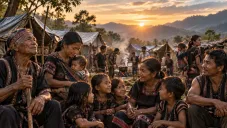









Two things came through the highlands during the American war that had nothing to do with us and fell on us anyway. One was the Ho Chi Minh Trail, the network of roads and paths that carried North Vietnam’s war into the South along our western edge. The other was the herbicide the United States sprayed to strip the forest from the Trail and the crops from the fields that fed its soldiers.

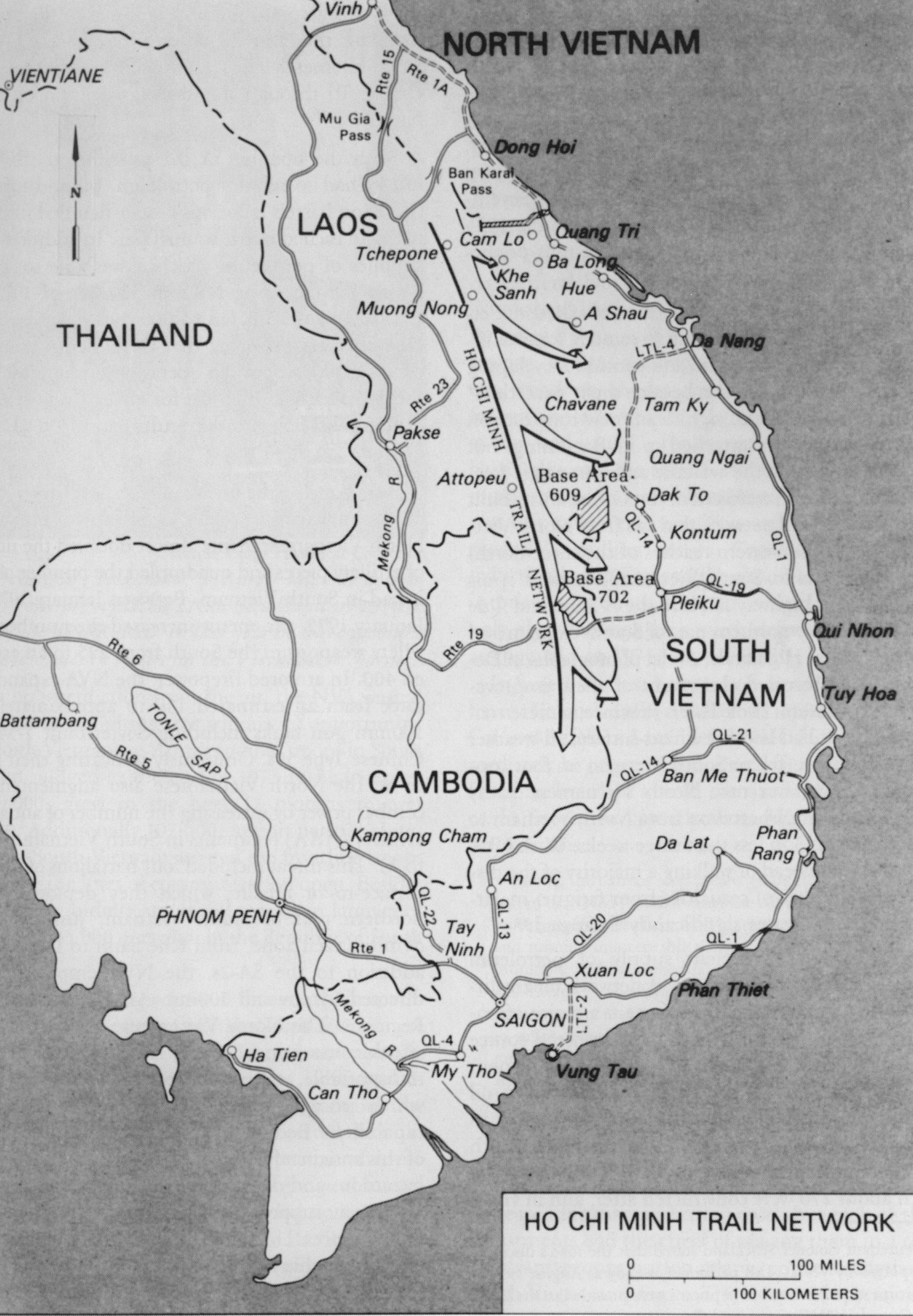
The Trail
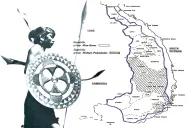
The Ho Chi Minh Trail was not one road but hundreds of kilometers of tracks, truck roads, river crossings and depots running south through Laos and Cambodia, just west of the highlands. Spurs ran east from it into Kon Tum, Pleiku and Đắk Lắk. North Vietnam called the highland war zone the B-3 Front, and the Trail was its supply line: base areas on the Lao and Cambodian side of the border fed men and material across the frontier into the valleys where our villages were.
That geography decided a great deal. It is why the Special Forces built their border camps among the Jarai, Bahnar, Sedang and Rhade in the early 1960s, and why highland soldiers were recruited to watch and patrol the frontier (see The American years). It is why the great battles — Plei Me, the Ia Drang, Dak To, Kon Tum in 1972 — were fought on our land (see Battles on our land). In 1972 North Vietnam tried to take Kon Tum in order to cut the South in two.

Operation Ranch Hand
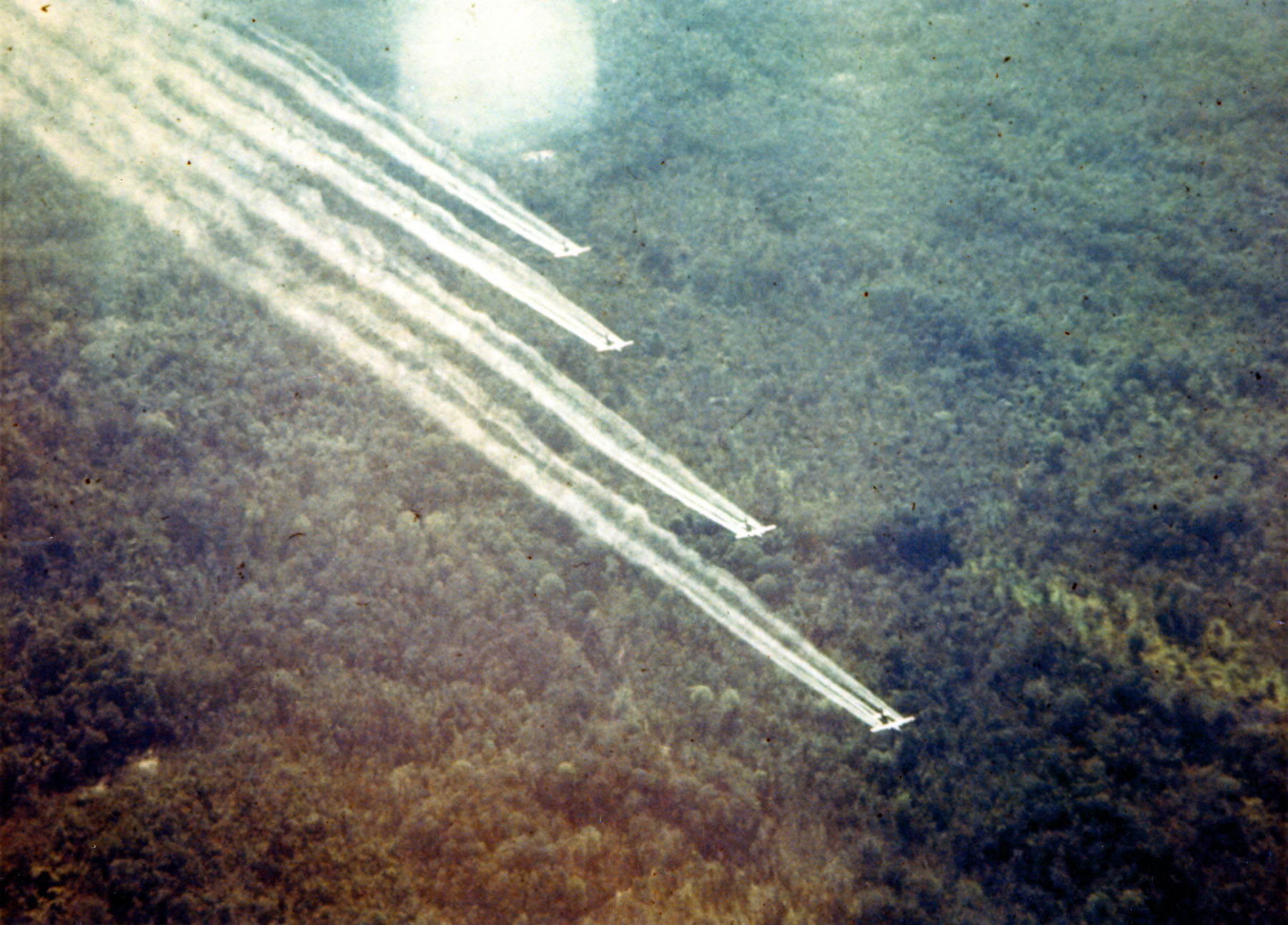
From 1962 to 1971 the United States Air Force sprayed herbicides over South Vietnam and along the Trail in Laos and Cambodia. The program was called Operation Ranch Hand. Its scale, in the figures most often cited:
- nearly 20,000 sorties, most of them flown by twin-engined UC-123 aircraft at around 150 feet;
- about 19 million US gallons of herbicide sprayed;
- about 20 percent of South Vietnam’s forests sprayed at least once — with more than 5 million acres of forest and around 500,000 acres of crops heavily damaged.
About two-thirds of the herbicide used contained 2,4,5-T, which was contaminated with the dioxin TCDD. That is the reason “Agent Orange” is still a medical word and not only a historical one.
In 2003 Jeanne Mager Stellman and colleagues published in Nature a reconstruction of the spraying from the US military’s own mission records, matched against hamlet census data. They raised the estimate of herbicide sprayed by several million liters, and roughly doubled earlier estimates of the dioxin involved. They concluded that millions of people had probably been sprayed directly.
In Laos, spraying along the Trail was approved in December 1965 and went on until 1970: more than two hundred missions, and at least half a million US gallons (about two million liters), according to the Agent Orange Record. That is the forest on the far side of our border, where the Brao and other peoples related to ours live (see Kin across the border).
The crops
Not all of the spraying was meant to strip forest. Part of Ranch Hand was crop destruction: spraying fields to deny food to the other side. In upland areas the fields sprayed were very often highland swiddens (see The rice year).
In 1967 the RAND Corporation, working for the US government, interviewed 206 former Viet Cong and civilians about the crop-destruction program. Its authors, Russell Betts and Frank Denton, concluded that it had not, in any major sense, denied food to the Viet Cong. The crops destroyed were mostly those of ordinary farmers, and the program was producing hostility among the people it fell on. They recommended that, if spraying continued, farmers should at least be told and compensated.
What we do not have
We have not found a published figure for how much herbicide fell on the highland provinces specifically, or how many highland villages were sprayed. The Stellman data set can in principle be broken down by district; that work, as far as we know, has not been published for Kon Tum, Pleiku and Đắk Lắk. Nor do we have any systematic study of the health of highland families in sprayed areas. If you know of one, please tell us.
For families in the diaspora
Highlanders who served with US forces, and their children, may be affected by exposure to herbicides. In the United States the Department of Veterans Affairs is the body that deals with Agent Orange claims by veterans; eligibility for people who were not US service members is limited and depends on the case. Get advice from an accredited organization before making a claim.
Sources
- J. M. Stellman et al., “The extent and patterns of usage of Agent Orange and other herbicides in Vietnam,” Nature 422 (2003), 681–687
- R. H. Betts and F. H. Denton, An Evaluation of Chemical Crop Destruction in Vietnam, RAND RM-5446-1 (1967)
- Agent Orange Record, “Laos,” and CEOBS, “New data on Agent Orange use during the US’s secret war in Laos”
- Wikipedia, “Operation Ranch Hand” and “Ho Chi Minh Trail”
- HistoryNet, “How CIA and Special Forces tested counterinsurgency strategy in Vietnam’s Central Highlands”
Compiled September 2026.