
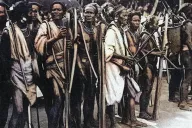


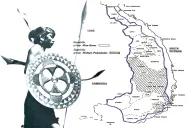
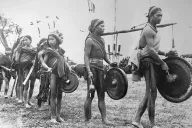

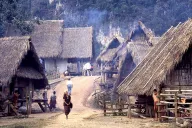

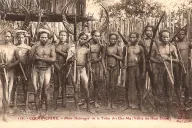


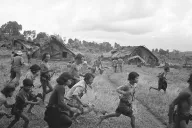






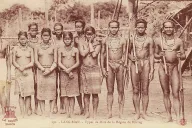




























The Bahnar live around Kon Tum and east of Pleiku, and in the mountains running down toward the coast of Bình Định. They speak a Mon-Khmer language, not a Chamic one; they do not have the matrilineal clans of their Jarai and Rhade neighbors; and their villages are marked by the communal house with its high, sweeping roof. Kon Tum’s Catholic church grew up in their villages.
Language and subgroups
Bahnar is an Austroasiatic language of the Central Bahnaric group, related to Sedang, Jeh, Halang and Mnong rather than to Jarai. It has many local varieties; lists include Tơlô, Gơlar, Alakông, Jơlơng, Bơnâm, Krem and the Kon Tum variety. Rơngao is sometimes counted as a Bahnar dialect and sometimes as a separate language. The French administrator Paul Guilleminet described the Bahnar as divided into seven main subgroups.
How many
| Figure | Year | Source |
|---|---|---|
| about 80,000 | 1952 | estimate cited by Hickey, RAND (1964) |
| 136,859 | 1985 | Encyclopedia of World Cultures |
| 181,000 | late 1990s | UNDP, cited by Human Rights Watch (2002) |
| 286,910 | 2019 | Vietnamese census |
The 2019 figure is the Vietnamese state’s own census count, which we reproduce only because no independent count exists; see How many Dega there are.
The village and the rông
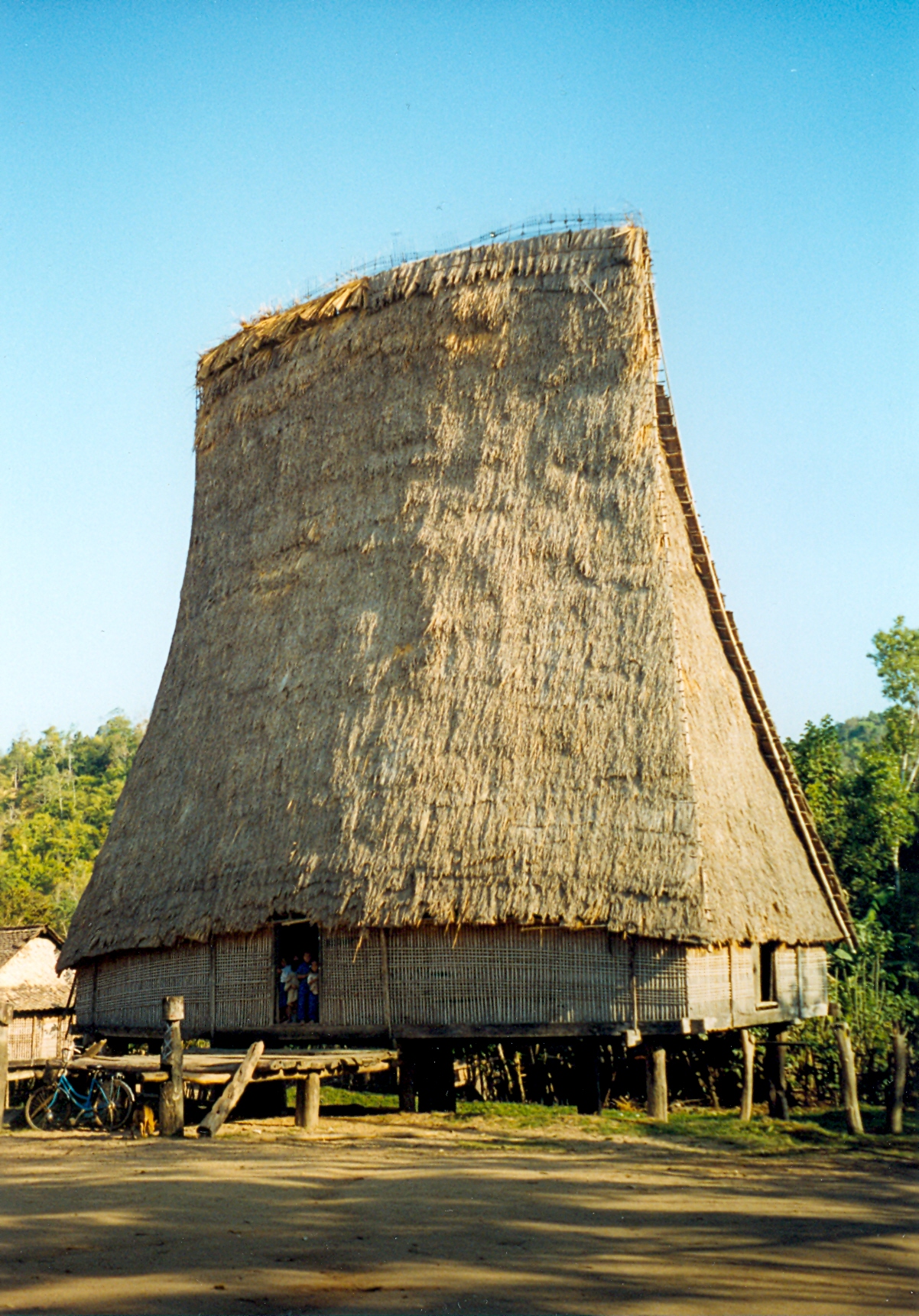
Every Bahnar village had its communal house, the rông: a large building on high piles with an unusually high, sweeping roof. It was the village’s ritual center, the place where boys slept and were taught, where disputes were heard and guests received, and in war its headquarters. Ordinary Bahnar houses, Hickey recorded, were divided into three rooms along an east–west line: the east room for parents and small children, the center for girls, the west for boys.
Several villages together formed a tơring, a territory whose people jointly defended their rights to hunt, fish and farm within it. Village headship usually passed from father to son or to another close kinsman. Old Bahnar society distinguished free people, debtors, outsiders, and war captives or slaves (see The slave raids).
The mission
French missionaries of the Missions Étrangères de Paris settled among the Bahnar around Kon Tum from about 1850. Pierre Dourisboure baptized the first adult Bahnar converts on October 16, 1853, and from about 1865 the mission founded villages that were entirely Christian. Dourisboure’s Les sauvages Ba-hnars (1870s) is an early missionary account of Bahnar life, and his Dictionnaire bahnar-français appeared in 1889. The mission later ran a press that printed Bahnar books for decades. See The Kon Tum mission and, for the adventurer who used the mission to make himself a king, The kingdom of the Sedang.
Bahnar Catholicism absorbed a good deal of the old religion. A 2026 study describes how the church kept the farming rites, named Christ Bă Yang, and wrote Bahnar prayer songs. Oscar Salemink notes that some Bahnar Catholic congregations are an exception among highland Christians in having brought gong music into the liturgy. See Yang.

Law and language on paper
Guilleminet’s Coutumier de la tribu Bahnar, des Sedang et des Jarai de la province de Kontum (EFEO, 1952) records custom as it was applied in the courts of Kon Tum province from 1908 to 1939. With Father Jules Alberty he also compiled the two-volume Dictionnaire bahnar-français (EFEO, 1959), with about 10,000 entries.
People
- Paul Nưr — arrested with the BAJARAKA leaders in 1958; later minister for the development of ethnic minorities.
- Y Yich, a Bahnar pastor imprisoned for twelve years, and others in Our defenders and prisoners.
Sources
- Gerald C. Hickey, The Major Ethnic Groups of the South Vietnamese Highlands, RAND (1964)
- P. Guilleminet, Coutumier de la tribu Bahnar… (EFEO, 1952); P. Guilleminet and J. Alberty, Dictionnaire bahnar-français (EFEO, 1959)
- IRFA, Pierre Dourisboure; P. Dourisboure, Les sauvages Ba-hnars (Gallica)
- Trần H. et al., “Yang, forest animism, and environmental perception among the Bahnar,” PLOS One (2026)
- Oscar Salemink, “Described, Inscribed, Written Off: Heritagisation as (Dis)connection,” ANU Press (2016)
- Glottolog, Bahnar; Encyclopedia of World Cultures, “Bahnar”
Compiled September 2026.