

































The Rhade are the people of the Darlac plateau, the country around Buôn Ma Thuột. They speak a Chamic language, related to Cham and more distantly to Malay; they trace descent through women; and they gave the Dega movement many of its leaders, from Y Bham Enuol onward. This is one of a series of pages on the peoples of the highlands.

Language
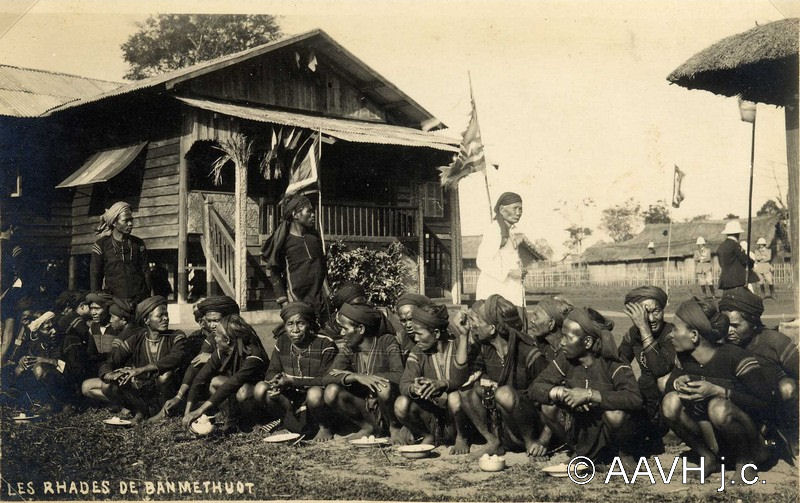
Rade belongs to the Chamic branch of the Austronesian family, the same branch as Jarai, Churu, Raglai and Cham itself — languages carried into the mainland from the islands long ago. Linguists list several dialects, among them Kpă, which became the written standard, M’dhur, Adham, Ktul, Êpan, Blô and Krung. Bih is the most distinct, and is now severely endangered, with only a handful of speakers reported. Rade has a Bible translation, is used on radio, and is written in a Latin alphabet with diacritics; the alphabet was made for the Franco-Rhade school at Buôn Ma Thuột, which opened in 1915, and Protestant missionaries completed a Rhade New Testament by 1956 (see Writing our languages).
How many
| Figure | Year | Source |
|---|---|---|
| about 120,000 | early 1960s | Gerald Hickey, RAND (1964) |
| 194,710 | 1985 | Encyclopedia of World Cultures |
| 258,000 | late 1990s | UNDP, cited by Human Rights Watch (2002) |
| 398,671 | 2019 | Vietnamese census |
The 2019 figure is the Vietnamese state’s own census count, which we reproduce only because no independent count exists; see How many Dega there are.
Clans, houses and the women who own the land
Rhade descent is matrilineal. People belong to their mother’s clan; Hickey counted about twenty clans, and the Encyclopedia of World Cultures describes them as grouped into two larger divisions; marriage within one’s own clan was forbidden. A woman’s name carries the prefix H’ and a man’s Y, as in H’Hen Niê or Y Bham Enuol; the family name that follows is the clan’s.
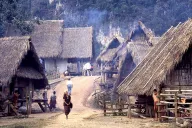
The longhouse is the household of a line of related women, their husbands and their children. When a daughter marries, her husband moves in and the house is extended by another compartment; that is why Rhade houses could grow to great length. The women of the line control the family’s property. The classic ethnography is careful on one point: the formal head of the house was usually a man, often the husband of one of the senior women, chosen by the household. The woman’s role that carried most weight was the po lan, the “proprietor of the land”: a senior woman who held the clan’s land by inheritance and every few years walked its boundaries.
See Dega women for how this was recorded, and misrecorded, by outsiders.
Law and epic
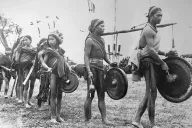
The French résident Léopold Sabatier, who ran Darlac from about 1913 to 1926, had Rhade customary law written down; it was published by the École française d’Extrême-Orient in 1940 as the Recueil des coutumes rhadées du Darlac, in Rhade and French. He also published La Chanson de Damsan (1927), the Rhade epic of Dam San, one of the long chanted epics — klei khan — performed through the night by a singer at the fire. See Sabatier and the Rhade code and Gongs and epics.

Religion
The Rhade pantheon was headed by Aê Diê, the Lord of Heaven, with other spirits below him, among them Dung Dai, who protects the paddy (see Yang). The Christian and Missionary Alliance worked among the Rhade from about 1930, with a mission, school and leprosarium near Ban Me Thuot where six Americans were killed at the mission during Tet in 1968 (see The missions and the doctors). Many Rhade today are Protestant, and many of the churches the state refuses to register are Rhade (see The church they closed).
People
- Y Bham Enuol — leader of BAJARAKA and president of FULRO.
- Y Ngông Niê Kdăm — joined the Viet Minh in 1945 and went north in 1954 (see Highlanders on the other side).
- Y Quynh Bđăp — refugee and co-founder of Montagnards Stand for Justice, extradited from Thailand in 2025.
- Many of the defenders and prisoners in Our defenders and prisoners.
Sources
- Gerald C. Hickey, The Major Ethnic Groups of the South Vietnamese Highlands, RAND RM-4041 (1964) — text copy
- Anne de Hauteclocque-Howe, Les Rhadés: une société de droit maternel (CNRS, 1987)
- L. Sabatier and D. Antomarchi, Recueil des coutumes rhadées du Darlac (EFEO, 1940)
- L. Sabatier, La Chanson de Damsan (1927)
- Glottolog, Rade; Omniglot, Rade
- eHRAF World Cultures, Rhade; Encyclopedia of World Cultures, “Rhade”
- Human Rights Watch, Repression of Montagnards (2002)
Compiled September 2026. We have not been able to verify a list of Rhade clan names and their divisions in a scholarly source; if you can give us your clan’s place in the system as your elders teach it, please do.