


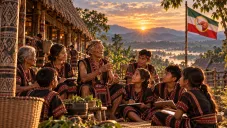
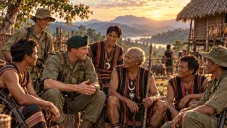
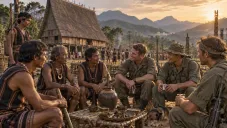
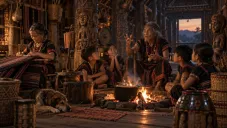
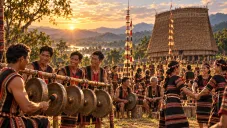
Before the missions, every highland people lived among yang: spirits of the rice, the water, the mountain, the forest, the house, the jar and the gong. Most Dega today are Christian. This page describes the old religion as the ethnographers recorded it, how conversion changed it, and how the state now stages parts of it as heritage while punishing the churches that replaced it.
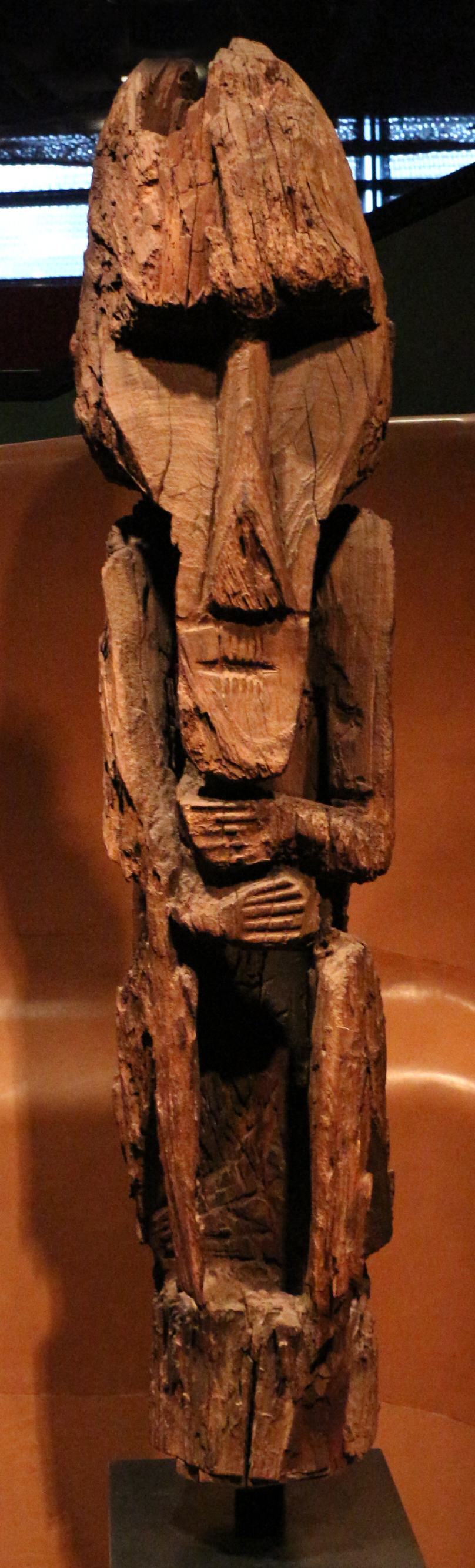

What yang means
“All the highlanders live in the shadow of the spirits,” the anthropologist Gerald Hickey wrote in 1964. The word yang, in its local forms, is shared across the highlands. A Bahnar dictionary defines it as “spirits, nonhuman beings that affect humans”; a recent study of the Bahnar describes yang as persons with a will of their own, who live in the forest and in the places around the village. It names some of them: yang Dak of the water, yang Kong of the mountain, yang Bri of the forest, yang Sri of the rice, the hot-tempered sun and the thunder, Bok Glaih.
The Rhade placed Aê Diê, the Lord of Heaven, at the head of their pantheon. The Mnong had spirits of the paddy, the soil, water, fire and forest, and their elders led the rites for the Spirit of Rice. Jacques Dournes, who lived among the Jarai, wrote that the yang of the village were known and fairly benign, while those of the forest were dangerous: people could do nothing without the forest, but must not let it take them over.
The Mnong Gar counted years by the forest they cleared, so that 1949 was the year they “ate the forest of the Stone-Spirit Gôo” — the phrase Georges Condominas took as the title of his book (see The rice year).
The healers
Between people and yang stood specialists. Among the Bahnar the bơjâu is a healer and ritual master; the recent study distinguishes four kinds by how they diagnose — with a lamp, a hand-span, an arm’s length or an egg — and says the role is given by the spirits rather than chosen. Hickey distinguished these from the feared sorcerers believed to harm by magic. The Mnong called their shamans njau. Among the Jarai the pơjâo is described as a healer and diviner, though we have not been able to check the details against Dournes.
Sacrifice, jar and gong
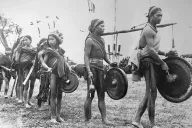
The usual way to satisfy a spirit was sacrifice, in rising order of cost, Hickey recorded: a chicken, then a goat, and for the greatest occasions a buffalo. Condominas wrote that among the Mnong Gar “the two essential elements of sacrifice are the buffalo and rice-beer offered in an earthenware jar.” Alliances and oaths were sealed over jars of rice beer. The gongs were played to call the yang: UNESCO’s listing of the highlands’ gong culture calls them “a privileged language between men, divinities and the supernatural world.” See Gongs and epics.
The Jarai Masters of Fire, Water and Wind were ritual figures of this world, not kings (see The Kings of Fire and Water); and the long cycle of care for the dead ended with the abandonment of the tomb (see The tomb house).
Conversion
- From about 1850 — Catholic missionaries settle among the Bahnar around Kon Tum. Bahnar Catholicism keeps much of the old farming ritual and calls Christ Bă Yang. See The Bahnar.
- About 1930 — The Christian and Missionary Alliance begins work in the highlands, above all among the Rhade.
- 1946–68 — Jacques Dournes, a Catholic missionary, uses the highland supreme being’s name, Ndu, for God, and argues for taking faith “from within rather than sticking it on from outside.” It brings him into conflict with his bishop.
- 1975 — About 70,000 highland Protestants, by one count. Churches are closed and pastors imprisoned. See The church they closed.
- Late 1980s–1990s — As armed resistance ends, conversion accelerates. “In 1988 the ethnic minorities started to become Christians,” a Mnong man told Human Rights Watch. “Jesus changed our idea” — from armed to peaceful struggle.
- 2002 — Human Rights Watch estimates 229,000 to 400,000 evangelical Protestants among highlanders, and about a quarter of highlanders Christian.
Conversion changed the old practices. The anthropologist Oscar Salemink found that many converts refused to play gongs or even to own them, calling them instruments of the devil; some Bahnar Catholic congregations, which brought gongs into church, were the exception.
The state and the old religion
The state treats the old religion in two ways at once. In 2005 UNESCO proclaimed the “Space of Gong Culture” of the Central Highlands a masterpiece of the world’s intangible heritage, and provincial governments now stage gong festivals; Salemink described the 2009 festival in Pleiku as “a mockery of the quiet ritual gong music.” At the same time, officials have used crude imitations of the old rites against Christians. Human Rights Watch documented “goat’s blood oath ceremonies” in 2001, in which Christians in dozens of villages were made to drink rice wine mixed with goat’s blood as a pledge to give up their faith, while other villagers were made to beat the gongs. Jarai villagers told HRW they had never heard of such a ceremony.
See also: Jars, rice wine and the buffalo feast.
Sources
- Gerald C. Hickey, The Major Ethnic Groups of the South Vietnamese Highlands, RAND (1964)
- Trần H., K. D. Harrison et al., “Yang, forest animism, and environmental perception among the Bahnar in the Central Highlands of Vietnam,” PLOS One (2026)
- Georges Condominas, “From the rice-field to the miir,” Social Science Information (1972), and We Have Eaten the Forest
- IRFA, Jacques Dournes, ethnologue en forêt and ethnologue évangélique
- Oscar Salemink, “Described, Inscribed, Written Off: Heritagisation as (Dis)connection,” ANU Press (2016)
- UNESCO, Space of Gong Culture
- Human Rights Watch, Repression of Montagnards (2002), and Montagnard Christians in Vietnam (2011)
- Chung Van Hoang, “The Rise of Protestantism and the State’s Response,” ISEAS Perspective 2017/34 — the source of the 1975 figure, which appears to rest on official counts
Compiled September 2026. This page describes the old religion from outside, through the people who studied it. If you can tell us the names of the yang and the rites as your family kept them, in your own language, we would like to add them.