
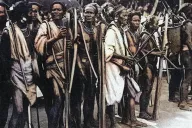


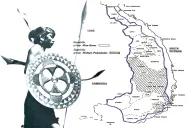
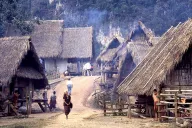

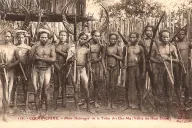
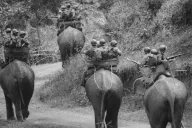





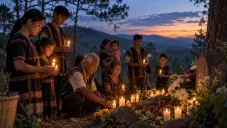
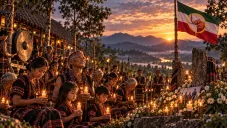
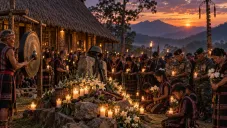


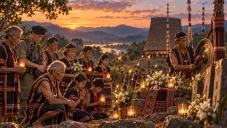


















In the old highland villages wealth was counted in buffaloes, gongs and jars — among the Bahnar, a 1966 handbook says, it was “usually measured” in exactly those three. The jars held the rice wine that every rite was drunk from, through long bamboo straws; the buffaloes were given to the spirits at the great feasts. Both were money, law and religion at once, and both tell us how our peoples lived before the wars.

The jars
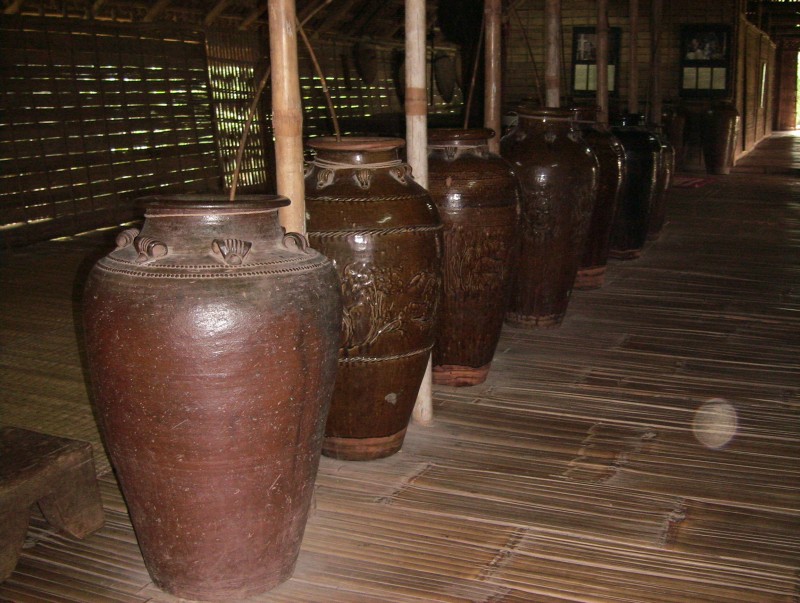
The best jars were old, and most came from far away. A United States Army handbook on the highland peoples, compiled in 1966 from the ethnographies of the time, records that the Hre valued their antique jars at “at least 20 buffaloes,” that few of these old Chinese jars survived, and that the most valuable were buried rather than kept in the house, safe from fire and breakage. The Mnong bought new jars from Vietnamese and Chinese merchants in the towns.
Among the Mnong the handbook describes four classes of jar. The fourth “consists of jars of very exceptional value which are treated almost like people”: their owners recited each jar’s history and heritage, and good spirits were believed to live in them. Owning such jars raised a family’s standing, and in war they were hidden in the forest before the fighting began.
Jars as law and property
- Inheritance. Among the Rhade the house, the harvest, the gongs and the jars belonged to the women of the house and passed down the female line. Gerald Hickey called gongs and jars “great prestige items.”
- Debt. By Rhade law a lender whose loan was not returned could take the borrower’s gongs and jars as well as the thing lent.
- Price and fine. Among the Rengao and the Hroi, prices and legal fines were fixed in buffaloes, jars, gongs, weapons and cloth. See Customary law and the village court.
- Marriage. Among the Bru, Katu and Ma, jars were part of the bride-price paid to the girl’s family. Among the matrilineal Rhade, Hickey wrote, it was the girl who asked for the boy’s hand and paid a dowry.
Drinking from the jar
Rice wine was brewed in the jars and drunk from them. The 1966 handbook describes a Bahnar ceremony: the people gather around a jar of wine, an elder offers a prayer, “and then a long straw for drinking the alcohol is passed from person to person.” At weddings, in one people the handbook describes, the couple drank from the same straw. Hickey described alliances between men being sealed with a jar of rice beer set aside and a chicken and a pig killed.
The buffalo feast
The buffalo was the greatest offering a family could make. Among the Bahnar, the handbook records, “the buffalo is the most important sacrificial animal; goats, pigs, chickens, and eggs follow in order of descending importance.” Healing followed the same ladder: first a chicken, then a goat, and if the sick person did not recover, a buffalo.
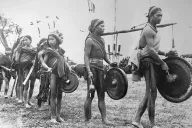
The great sacrifices were held when the Jarai abandoned a tomb, when the heirs killed animals at the grave (see The tomb house); at the Bahnar festivals; and to seal alliances and peace between villages (see Yang). Among the Hre, the handbook records, the buffalo was tied to a post raised with its own ceremony, and the men and women of the village marched around it “to the music of gongs and drums”; the Jeh, Katu, Ma and Bru also tied the buffalo to a pole or stake (see Gongs and epics). At the graves, the Halang went “to sacrifice buffaloes and pigs and to drink many jars of alcohol.”
The feast was also how wealth was spent and shared. Among the Mnong, “the most respected man … is the one who can afford to sacrifice the greatest number of buffaloes,” and a family that could make the sacrifices could rise in rank. Hickey noted the cost: the Stieng rite of sixty buffaloes “can plunge poor villages into debt.”
Missions, the state and the feast
When the missionaries came, the feast was where conversion was hardest. The 1966 handbook records the Jarai belief that a convert who refused to join the ceremonies and sacrifices “incurs the anger of the spirits and will bring disaster for both the convert and his village.” Catholic Bahnar, it said, had “modified, but have not abandoned, their traditional tribal rites.” See The church they closed.
After 1975 the old forms were sometimes turned against us. From May 2001, Human Rights Watch reported, villagers in Ea H’leo who had joined the February protests were made to renounce Christianity by drinking rice wine mixed with goat’s blood, while other villagers were enlisted to beat the ceremonial gongs. The Jarai told HRW they had never heard of such a ceremony before.
What we have not yet found
We have not found an independent source on what became of the old jars after 1975 — how many were sold to collectors or dealers — or on state campaigns against the buffalo sacrifice as a “backward custom.” If your family kept its jars, or remembers when the last feast was held, we would like to record it.
See also: Food and the highland kitchen, The bracelet.
Sources
- Department of the Army, Minority Groups in the Republic of Vietnam, Pamphlet 550-105 (1966) — the Hre, Mnong, Rhade, Bahnar, Jarai, Bru, Katu and Ma chapters
- Gerald C. Hickey, The Major Ethnic Groups of the South Vietnamese Highlands, RAND RM-4041 (1964) — text copy
- Human Rights Watch, Repression of Montagnards (2002), chapter XVI — the Ea H’leo ceremonies
- Further reading (not consulted for this page): Georges Condominas, “Notes sur le Tam Bo Mae Baap Kuong,” International Archives of Ethnology 47 (1955), on the Mnong buffalo rite
Compiled September 2026. The 1966 handbook was compiled for the US Army by American University from the ethnography then available; customs differed from people to people and village to village, and we give each where the source places it.